
Recycled Concrete Calculator
— How Much Do You Need?
Calculate recycled concrete quantities, coverage, and cost estimates in tons or cubic yards with our easy estimator.
How to Use This Recycled Concrete Calculator
Planning a recycled concrete project requires precise measurements to ensure you order enough material without overspending.
- 1 Enter Dimensions — Input the length and width of your area in feet. Round up slightly for a buffer.
- 2 Choose Depth — Select the depth in inches. For most recycled concrete projects, 3–6 inches is standard.
- 3 Review Results — Instantly see cubic yards and tons needed to accurately plan your order.
Visual Area Guide
Use these diagrams to measure your project area correctly.
Rectangular Area
Measure length × width for square or rectangular areas. Most driveway, patio, and grading projects use this method.
Circular Area
Measure the radius (half the diameter) for round beds, drain fields, or circular landscaping. Formula: π × radius².
Material Coverage & Grading
Common recycled concrete aggregate (RCA) grades and applications per ASTM C33, ASTM D2940, and state DOT specifications
| Grade | Application |
|---|---|
| Class 1A | Clean coarse RCA with a maximum particle size of 3/4 inch and less than 2% fines passing the #200 sieve. Minimal residual mortar and excellent void structure make this grade ideal for high-drainage applications. Best suited for drainage layers, pipe bedding, and permeable pavement systems where free-draining performance is critical. |
| Class 2 | Dense-graded base RCA with up to 1.5-inch top size and 5–8% fines content, balancing compactability with structural stability. Residual Portland cement mortar aids binding under compaction. Widely specified for road subbases, parking lot bases, and shoulder backfill where load-bearing capacity of 150–300 psi UCS is required. |
| Crusher Run | Full crusher-output RCA with broad gradation and 10–12% fines, representing the highest compaction density achievable with recycled concrete aggregate. Angular particles and fines-rich matrix self-compact under roller or vibratory compaction. Primarily used for structural fill, driveways, farm roads, and trench backfill. |
| Fine RCA | Screened RCA fines passing 3/8 inch, composed largely of residual cement mortar and fine aggregate particles. Behaves similarly to coarse sand with binding properties from mortar content. Applied in low-strength concrete mixes, stabilized base courses, and non-structural fill where fine gradation is needed. |
| Processed RCA | Washed and screened RCA meeting strict DOT gradation requirements per ASTM D2940 or AASHTO M43, with fines controlled to under 5% and soundness loss under 12% per ASTM C88. Represents a mid-range clean grade suitable for a broad range of pavement subbase and base layer replacements (20–40% of virgin aggregate). Commonly specified as 'Recycled Base' or 'Road Base Recycle' in contractor and DOT documentation. |
| Class 5 | Open-graded permeable RCA grade recognized in Florida DOT specifications and similar state standards for permeable base applications. Characterized by minimal fines, high void content (15–30%), and excellent hydraulic conductivity (k > 10⁻² cm/s). Used beneath permeable pavements, in underdrain systems, and erosion control berms requiring rapid stormwater infiltration. |
Plan Your Next Project
Driveway Calculator
Driveway calculator — estimate cubic yards and tons from your length, width, and preferred gravel depth. Covers single-layer and three-layer builds.
Gravel Driveway Calculator
Gravel driveway calculator — estimate how many cubic yards or tons your driveway needs. Enter length, width, and depth for volume per layer.
Parking Pad Calculator
Parking pad calculator — estimate crushed stone or gravel for a residential pad. Enter area and depth for cubic yards, tons, and approximate cost.
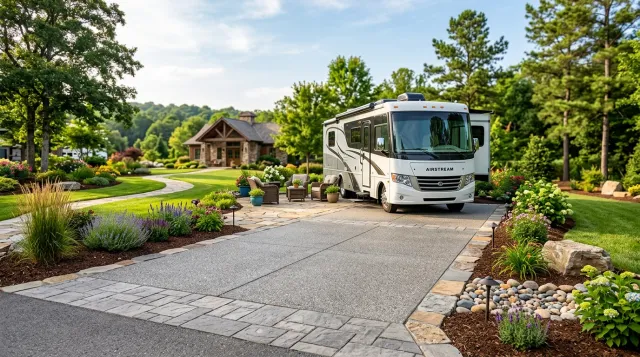
RV Pad Calculator
RV pad calculator — estimate how much gravel and base material your pad requires. Input dimensions and a recommended 6-inch depth for tonnage and yardage.
Frequently Asked Questions
What exactly is recycled concrete aggregate, and why do people call it "poor man's concrete"?
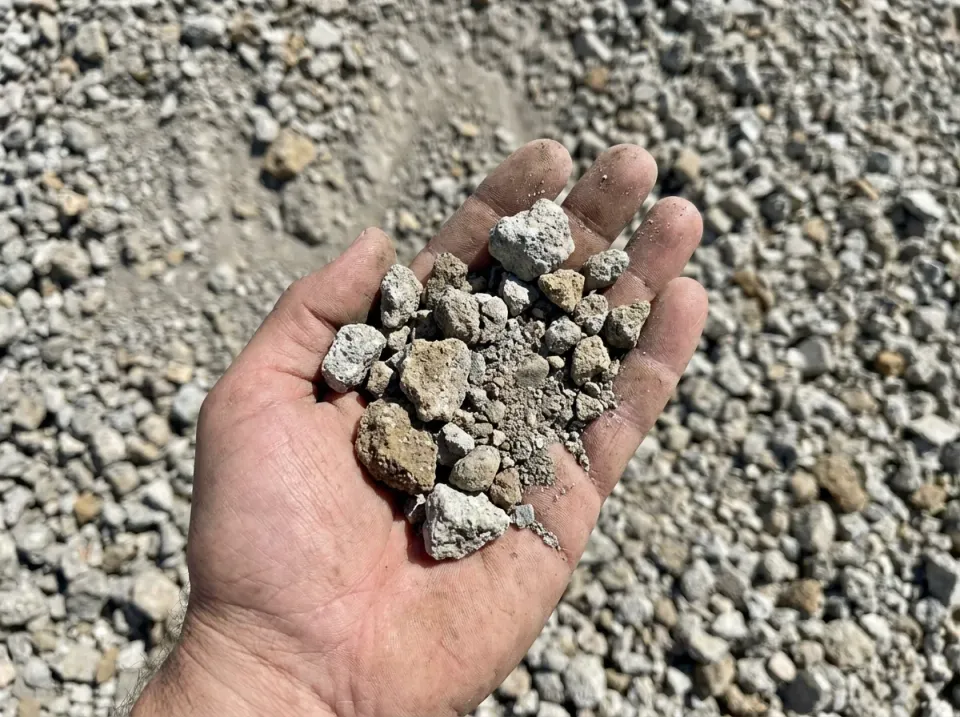
Recycled concrete aggregate, often shortened to RCA, is made by crushing and processing old concrete from demolished roads, bridges, foundations, slabs, and buildings. During demolition, crews break up the old concrete, run it through crushing equipment, and screen out steel rebar and oversized pieces. What you end up with is a crushed angular aggregate that looks similar to crushed stone but carries a unique advantage: it still contains residual cement particles from its original life as poured concrete. That residual cement is exactly why people call it "poor man's concrete." When recycled concrete gets wet and is properly compacted, those leftover cement particles begin to re-hydrate and bind the material together. Over time, it firms up and locks in a way that standard gravel simply does not. You get a surface that is tougher and more stable than loose stone, at a fraction of the cost of poured concrete or asphalt. Hello Gravel delivers recycled concrete in bulk by the truckload, making it one of the most practical and affordable options available for driveways, base layers, parking areas, and fill projects. If you have questions about whether it is the right fit for your job, the Hello Gravel team is happy to help you figure it out.
What are the most common uses for recycled concrete?
Recycled concrete is one of the most versatile aggregates you can buy, and it performs well across a wide range of residential, commercial, and civil projects. For homeowners, the most popular use is driveway construction. Because recycled concrete compacts tightly and hardens over time, it creates a stable driving surface that holds up well under vehicle traffic. It also works well as a base layer under pavers, retaining walls, and patio stones, where a firm, well-drained foundation is critical. Contractors frequently use it as a road base or sub-base material under asphalt or other finished surfaces. It compacts to a density that can support heavy loads, which is why it has a long history in road construction and commercial lot preparation. It is also used as backfill behind retaining walls, as erosion control along slopes and drainage channels, and as general fill to bring low areas up to grade. Because it drains reasonably well and compacts firmly, recycled concrete is also used in utility trenches, around culverts, and as a working pad for construction equipment. If you are not sure which application fits your specific project, the Hello Gravel calculator can help you estimate the right quantity, and the team can answer any questions before you place your order.
Does recycled concrete actually harden, and how does that work?
Yes, recycled concrete does harden, and this is one of its most valuable qualities. The reason it hardens comes down to chemistry. When concrete is originally poured and cured, not every cement particle fully hydrates. Some of those unreacted cement particles remain locked inside the material for years. When old concrete gets crushed into aggregate and then gets wet again in its new application, those dormant cement particles reactivate. They begin to hydrate and form bonds between the particles around them. The result is a gradual hardening process that turns a loose, compacted fill into a surface with real structural integrity. This process is sometimes called re-cementation, and it is what separates recycled concrete from plain crushed stone or standard pea gravel. A gravel driveway stays loose over time and needs regrading. A recycled concrete driveway tends to knit together and become progressively firmer, especially in the first few months after installation. To get the best results, you want to compact the material thoroughly when you install it and then let natural rainfall do the rest. The hardening effect is more pronounced in finer-crushed material, where there is more surface contact between particles. If you are planning a driveway or a heavily trafficked area and want a surface that firms up rather than shifting around, recycled concrete is worth a close look.
How does recycled concrete compare to regular gravel in terms of cost and performance?
Recycled concrete consistently comes in at a lower price point than virgin crushed stone or natural gravel for most applications. The savings exist because the raw material is demolition waste rather than freshly quarried rock, which reduces the cost of production. For large projects like long driveways, parking lots, or commercial pads, that price difference adds up quickly. To get a current price for your area and project size, the Hello Gravel calculator will give you an accurate estimate based on where you are and how much you need. From a performance standpoint, recycled concrete holds its own against standard gravel and often outperforms it in high-traffic situations. Because it compacts tightly and then hardens through re-cementation, it creates a more stable surface than loose gravel that shifts and ruts over time. Standard crushed stone is more uniform in color and composition, which matters if appearance is important to you. Recycled concrete varies more in color and texture since it comes from a mix of demolished sources. For structural base layers, both materials perform well, but recycled concrete's binding ability gives it a slight edge in load-bearing applications. For purely decorative uses or drainage applications where you want consistent, clean-looking stone, virgin aggregate might be a better fit. For anything where durability, budget, and environmental responsibility all matter, recycled concrete is a strong contender.
What are the disadvantages of using recycled concrete?
Recycled concrete is a genuinely useful material, but it is worth going in with a clear picture of its limitations so you can decide if it is right for your project. The biggest variable is consistency. Because recycled concrete comes from demolished structures, the composition can vary between loads and suppliers. You may see differences in color, particle size distribution, and the presence of minor contaminants like brick fragments or mortar. A reputable supplier screens and processes the material to remove rebar and oversized pieces, but recycled concrete will never look as uniform as freshly quarried stone. The fine dust content in crushed concrete can also create temporary muddy conditions when the material is first placed and gets wet. This is usually a short-term issue that resolves as the material compacts and the fines settle in, but it is something to be aware of if you need a clean work area right away. Recycled concrete is also not the right choice for decorative applications where appearance matters, such as landscaping borders or exposed pathways where you want a consistent, attractive surface. And because its composition varies, it is generally not suitable for projects requiring tested, specification-grade aggregate, such as engineered fill for foundation systems governed by strict engineering standards. For driveways, base layers, fill, and road base, most of these limitations are minor. But if your project has strict spec requirements or aesthetics are a priority, it is worth talking through your options with the Hello Gravel team before ordering.
Other Material Calculators
Delivery Logistics & Truck Info
Know your delivery options and access requirements before scheduling your order.
Truck Capacities
- Standard Dump Truck 10–14 tons
- Tandem Axle 14–18 tons
- Semi End Dump 20–25 tons
A standard cubic yard weighs approximately 2,000–2,700 lbs depending on material and moisture.
Site Access Requirements
- Trucks require a minimum 12-ft wide, overhead-clear access path
- Soft ground or slopes over 10% may limit truck access — contact us before ordering
- Ensure no underground utilities or irrigation lines are in the drop zone
- Mark your desired drop location clearly before delivery
Important Notes
- Delivery estimates are based on available inventory and route proximity
- Minimum order quantities apply — typically 5 cubic yards or 1 truckload
- Material certification is available upon request for permitted projects
- Always confirm local grading ordinances before major material placement