
Class 5 Gravel Calculator
— How Much Do You Need?
Calculate Class 5 gravel by cubic yards, tons, or truckloads—get precise estimates for your project.
How to Use This Class 5 Gravel Calculator
Planning a class 5 gravel project requires precise measurements to ensure you order enough material without overspending.
- 1 Enter Dimensions — Input the length and width of your area in feet. Round up slightly for a buffer.
- 2 Choose Depth — Select the depth in inches. For most class 5 gravel projects, 3–6 inches is standard.
- 3 Review Results — Instantly see cubic yards and tons needed to accurately plan your order.
Visual Area Guide
Use these diagrams to measure your project area correctly.
Rectangular Area
Measure length × width for square or rectangular areas. Most driveway, patio, and grading projects use this method.
Circular Area
Measure the radius (half the diameter) for round beds, drain fields, or circular landscaping. Formula: π × radius².
Material Coverage & Grading
Common Class 5 Gravel grades and applications based on AASHTO M43 and ASTM D448 classification standards
| Grade | Application |
|---|---|
| AASHTO #5 | Uniformly graded clean crushed stone ranging from ½ inch to 1 inch (12.5–25 mm), conforming to AASHTO M43 Size No. 5. Features angular, fractured particles with less than 5% fines passing the No. 200 sieve. Ideal for road bases, permeable drainage layers, and stabilized subgrades requiring high load-bearing capacity and open-graded permeability. |
| ASTM #5 | Equivalent to AASHTO No. 5 under ASTM D448 Size No. 5, with a ¾-inch to 1-inch clean gradation and minimal fines content. Angular crushed particles promote interlocking for structural stability. Commonly specified for general drainage base courses, highway subbases, and civil engineering fill applications. |
| AASHTO #4 | Coarser clean crushed aggregate graded from 1½ inches to 1 inch per AASHTO M43 Size No. 4. Low fines content and large particle voids deliver superior drainage performance. Preferred for French drains, deep drainage blankets, and open-graded subbases on highway and airport projects where rapid water evacuation is critical. |
| AASHTO #57 | Well-graded crushed stone blend of AASHTO sizes No. 5 and No. 7, ranging from 1 inch down to No. 4 sieve (4.75 mm). Provides a denser gradation than pure Class 5 with slightly higher fines tolerance, improving compaction and binding. Widely used for driveways, concrete aggregate, pipe bedding, and general base course applications. |
| Class 5 Minus | A Class 5-sized crushed aggregate that retains natural fines and rock dust passing the No. 200 sieve, unlike clean-screened Class 5. The retained fines fill voids and improve binding under compaction, producing a denser, more stable surface layer. Best suited for unpaved road surfaces, driveway base courses, and compacted subbase layers where surface hardening is desired. |
| Class 6AAA | A finer, intermediate crushed aggregate variant recognized under MDOT specifications, featuring controlled fines and enhanced durability requirements for high-traffic pavements. Particle size is smaller than standard Class 5, providing a tighter gradation and higher abrasion resistance (ASTM C131). Specified for high-traffic road bases, urban pavement subbases, and applications demanding superior load distribution and long-term durability. |
Plan Your Next Project

Tennis Court Calculator
Use this calculator to estimate the crushed stone base for a new or resurfaced tennis court. Enter dimensions and depth for volume and tonnage.
Driveway Calculator
Driveway calculator — estimate cubic yards and tons from your length, width, and preferred gravel depth. Covers single-layer and three-layer builds.

Gravel Driveway Calculator
Gravel driveway calculator — estimate how many cubic yards or tons your driveway needs. Enter length, width, and depth for volume per layer.
Parking Pad Calculator
Parking pad calculator — estimate crushed stone or gravel for a residential pad. Enter area and depth for cubic yards, tons, and approximate cost.
Frequently Asked Questions
What is Class 5 gravel, and what makes it different from regular gravel?
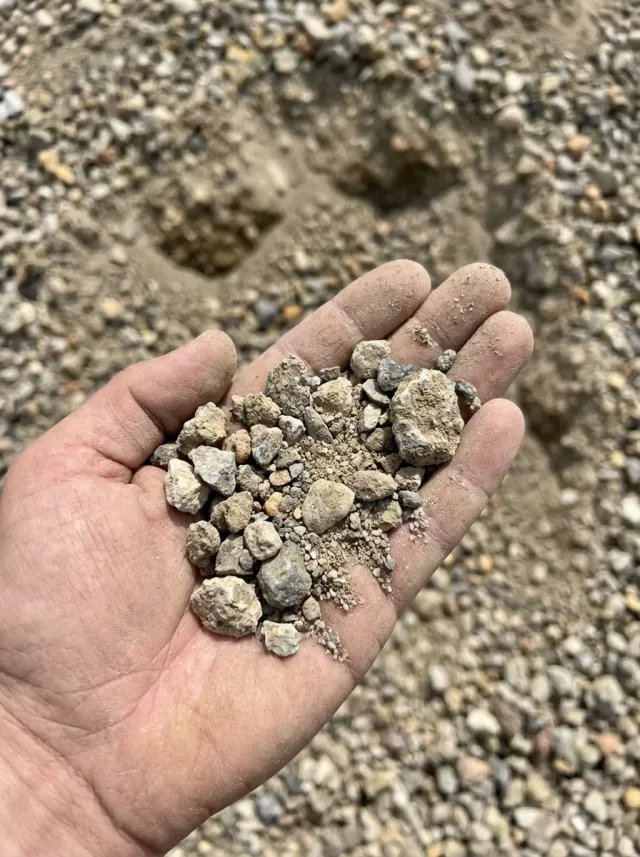
Class 5 gravel is a well-graded crushed aggregate that contains a blend of particle sizes, ranging from pieces up to 3/4 inch all the way down to fine stone dust. That range of sizes separates it from what many call regular gravel, which is often a single-sized, washed stone with little or no fines. The fines in Class 5 are the defining feature; when you compact it with a plate compactor or roller, those fine particles fill the gaps and lock everything together into a dense, stable layer. The result is a surface that holds its shape and carries vehicle loads much better than loose gravel. Class 5 is a MnDOT specification and is widely used as a base material in the Upper Midwest; in other regions you may see similar material called crusher run, road base, or dense-graded aggregate base. Hello Gravel delivers Class 5 by the truckload.
What are the most common uses for Class 5 gravel?
Class 5 gravel is a versatile base material used in both residential and commercial projects. It is commonly placed as the base under concrete slabs, garage floors, poured patios, sidewalks, and driveways. It provides a stable foundation for sheds, pole barns, and other structures, and is often used for parking pads and rural driveways. Contractors also use Class 5 as a base layer for asphalt paving and as backfill in utility trench work where a compacted, stable base is needed. If you need a surface or foundation that stays put under regular vehicle traffic and swings through freeze‑thaw cycles, Class 5 is a strong choice.
Is Class 5 gravel a good choice for a driveway?
Yes. Class 5 is a popular driveway material because it compacts into a dense, stable surface that resists rutting and holds up under daily vehicle traffic. For a standard residential driveway, a compacted depth of 4 to 6 inches is typical. For heavier loads or frequent truck traffic, 6 to 8 inches may be better. Remember that the performance comes from proper compaction, so use a plate compactor or roller and some moisture during installation. For a precise tonnage, use the Hello Gravel calculator with your dimensions.
Why is Class 5 gravel sometimes called "poor man's concrete"?
The nickname comes from the way the fines in Class 5 act like a natural binder when the material is compacted. With the right moisture and compaction, the surface tightens up and feels hard and firm, similar to concrete but at a fraction of the cost. It is not a substitute for engineered concrete, but for many driveways, parking areas, and work surfaces it provides a very solid, durable surface at a much lower price.
Does Class 5 gravel drain well?
Class 5 is not a drainage gravel. It contains substantial stone dust and fines, so water does not move through it as quickly as it would through a clean, open-graded stone. The material is designed for a compacted base, not permeability. Install it with a slight slope or crown so water runs off the surface. If you need water to pass through the base, consider a different aggregate for that application.
Other Material Calculators
Delivery Logistics & Truck Info
Know your delivery options and access requirements before scheduling your order.
Truck Capacities
- Standard Dump Truck 10–14 tons
- Tandem Axle 14–18 tons
- Semi End Dump 20–25 tons
A standard cubic yard weighs approximately 2,000–2,700 lbs depending on material and moisture.
Site Access Requirements
- Trucks require a minimum 12-ft wide, overhead-clear access path
- Soft ground or slopes over 10% may limit truck access — contact us before ordering
- Ensure no underground utilities or irrigation lines are in the drop zone
- Mark your desired drop location clearly before delivery
Important Notes
- Delivery estimates are based on available inventory and route proximity
- Minimum order quantities apply — typically 5 cubic yards or 1 truckload
- Material certification is available upon request for permitted projects
- Always confirm local grading ordinances before major material placement