
Drainage Rock Calculator
— How Much Do You Need?
Calculate how much drainage rock you need — volume, tonnage, and truckload estimates for any project.
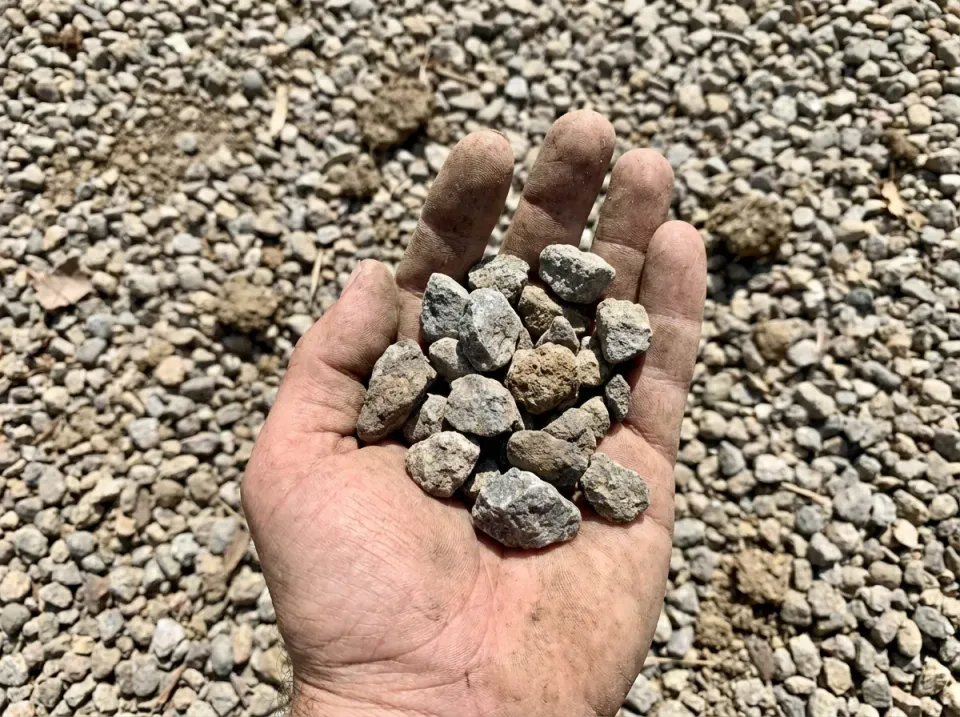
How to Use This Drainage Rock Calculator
Planning a drainage rock project requires precise measurements to ensure you order enough material without overspending.
- 1 Enter Dimensions — Input the length and width of your area in feet. Round up slightly for a buffer.
- 2 Choose Depth — Select the depth in inches. For most drainage rock projects, 3–6 inches is standard.
- 3 Review Results — Instantly see cubic yards and tons needed to accurately plan your order.
Visual Area Guide
Use these diagrams to measure your project area correctly.
Rectangular Area
Measure length × width for square or rectangular areas. Most driveway, patio, and grading projects use this method.
Circular Area
Measure the radius (half the diameter) for round beds, drain fields, or circular landscaping. Formula: π × radius².
Material Coverage & Grading
Common drainage rock applications based on ASTM D448 size designations
| Grade | Application |
|---|---|
| No. 3 | Coarsest common drainage grade with particle sizes ranging from 1" to 2". Delivers the highest void ratio and hydraulic conductivity of standard drainage aggregates, making it ideal for high-volume or extreme-flow drainage scenarios. Best suited for applications where rapid water removal is critical and structural load-bearing is secondary. |
| No. 4 | Mid-coarse ASTM D448 drainage grade with particle sizes from 1" to 1½". Offers a strong balance between high drainage capacity and structural support, making it well suited for foundation perimeter drains and highway underdrains. Angular crushed stone geometry promotes interlocking stability under surcharge loads while maintaining high permeability. |
| No. 5 | Versatile general-purpose drainage aggregate with particle sizes from ¾" to 1". Slightly finer voids than No. 4 make it well-matched to moderate flow-rate applications in residential and light commercial settings. Commonly specified for road shoulders, landscaping swales, and septic field drainage beds. |
| No. 57 | The finest and most widely used standard drainage grade, spanning 1½" down to the #4 sieve (approximately ¼"). Its broad gradation delivers high permeability alongside good load-distributing characteristics, making it the go-to choice for pipe zone backfill, trench drains, curtain drains, and permeable pavement sub-bases. Widely stocked by suppliers and referenced in DOT specifications nationwide. |
Plan Your Next Project
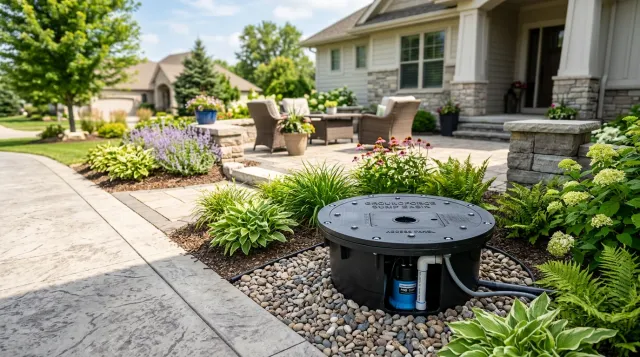
Sump Pump Calculator
Use this calculator to estimate the gravel needed around a sump pump pit. Enter pit dimensions and backfill depth for an accurate volume in cubic yards.
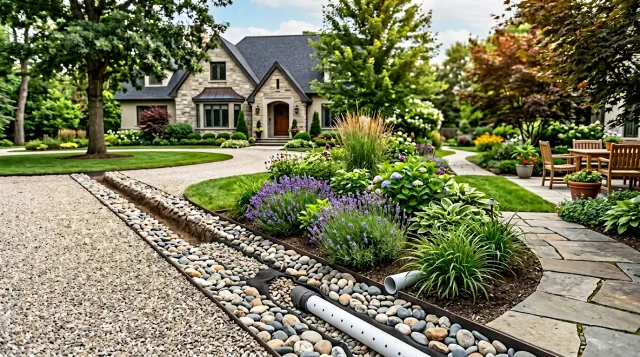
French Drain Calculator
French drain calculator — estimate gravel volume, pipe length, and fabric for any drain run. Enter trench dimensions for cubic yards and linear feet.
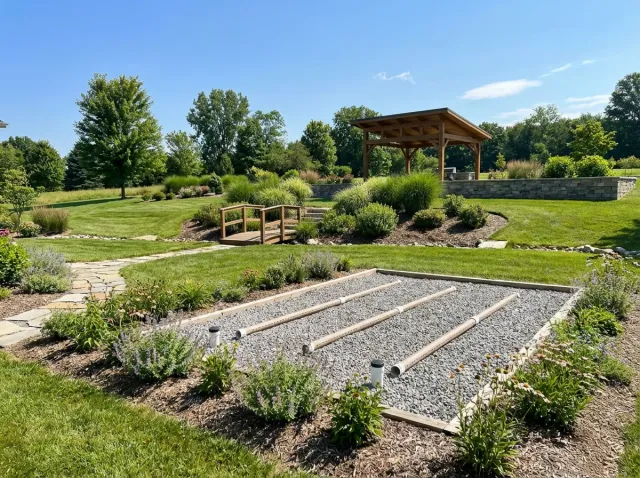
Leach Field Calculator
Leach field calculator — estimate and size your gravel bed accurately. Input trench dimensions and number of runs for drain rock volume and weight.
Dry Well Calculator
Dry well calculator — estimate required storage volume and gravel fill from your drainage area and local rainfall intensity. Results in cubic feet.
Frequently Asked Questions
What is drainage rock, and what makes it different from regular gravel?
Drainage rock is a clean, washed, or screened stone that has had all the fine particles removed, including sand, silt, and dust. That clean composition is what makes it work. When stone is free of fines, water moves freely through the gaps between the rocks instead of getting trapped. Standard crushed gravel, on the other hand, is often blended with fines that are great for compaction on a driveway base but will clog a drainage system over time. If you fill a French drain trench or a foundation drainage bed with gravel that contains fines, those particles gradually fill the voids and the drainage performance drops significantly. Drainage rock typically comes in sizes ranging from about 3/4 inch to 2 inches or larger depending on the application. The consistent sizing and open structure are what set it apart and make it the standard material for French drains, foundation drainage, retaining wall backfill, dry creek beds, and any application where you need water to move away from a structure reliably.
Are bigger or smaller rocks better for drainage?
Larger rocks create bigger voids between the stones, which means water moves through them more quickly. A 1.5-inch or 2-inch clean stone will drain faster than a 3/4-inch stone under the same conditions. That said, bigger is not always the better choice for every project. For most residential drainage applications, including French drains and foundation drainage, 3/4-inch to 1.5-inch clean crushed stone hits the sweet spot. It drains very well, is easy to work around a perforated pipe, and stays in place without constantly shifting. For larger commercial drainage beds or situations where you are moving a high volume of water, stepping up to 2-inch or larger stone makes more sense. The key factor in any size is that the stone must be clean. A larger rock with fines mixed in will still clog over time. Clean and consistently sized is what you are after, regardless of the grade. If you have questions about which size is right for your specific project, reach out to the Hello Gravel team and we'll help you figure it out before you order.
Is crushed gravel the same as drainage rock?
They are often confused, but they are not the same thing, and using the wrong one can cause real problems. The difference comes down to fines content. Crushed gravel products like crusher run or processed gravel are intentionally blended with fine particles that help the material compact and lock together. That makes them excellent for driveways, road bases, and paths where stability is the goal. But those fines are the enemy of drainage. They fill the voids between stones and slow water movement significantly. Drainage rock is specifically processed to remove those fines. It is washed or screened until only clean, consistently sized stone remains. The open void space that results is exactly what allows water to pass through quickly and reliably. So if you are planning a French drain, wrapping a foundation, or building a subsurface drainage bed, clean drainage rock is what you need, not a crusher run or blended gravel product. Hello Gravel delivers drainage rock by the truckload, so you get the right material in the quantity your project actually requires.
How deep should drainage rock be installed?
The right depth depends on what the drainage rock is being asked to do. For a French drain or subsurface drainage trench, the typical approach is to surround the perforated pipe with at least 6 inches of drainage rock on all sides. Most residential French drain trenches run 12 to 18 inches deep with the pipe sitting near the bottom. For drainage against a foundation wall, contractors commonly recommend 6 to 12 inches of clean stone between the wall and the surrounding soil to give groundwater a clear path toward the drain tile. For a dry creek bed or surface drainage swale, 4 to 6 inches of drainage rock is generally enough to handle runoff while giving the channel a natural, finished appearance. For subslab drainage beneath a concrete pour, 4 to 6 inches of open-graded drainage aggregate is a widely used standard. Place and level the material but do not mechanically compact it, compaction reduces the void space that allows drainage rock to do its job. Keep in mind that the amount of water you need to move and the characteristics of your soil will both influence the final depth. Use the Hello Gravel calculator with your project dimensions and your target depth to get a solid quantity estimate before you order.
What should you put under drainage rock before installing it?
In most drainage applications, you will want to lay a geotextile landscape fabric underneath the drainage rock before you fill. This fabric is permeable, meaning water passes through it freely, but it blocks the fine soil particles in the surrounding ground from migrating up into the stone over time. Without it, those particles will gradually fill the voids in your drainage rock and reduce its effectiveness, sometimes within just a few years. For a French drain, the standard method is to line the bottom and sides of the trench with fabric before placing the pipe and filling with rock, then fold the fabric over the top of the rock before backfilling with soil. For surface drainage channels or decorative dry creek beds, the fabric goes directly on your graded, compacted subbase before the rock is placed on top. The fabric does not restrict drainage. It actually protects drainage performance for the long term, which is why most drainage professionals include it as a standard part of any installation.
Other Material Calculators
Delivery Logistics & Truck Info
Know your delivery options and access requirements before scheduling your order.
Truck Capacities
- Standard Dump Truck 10–14 tons
- Tandem Axle 14–18 tons
- Semi End Dump 20–25 tons
A standard cubic yard weighs approximately 2,000–2,700 lbs depending on material and moisture.
Site Access Requirements
- Trucks require a minimum 12-ft wide, overhead-clear access path
- Soft ground or slopes over 10% may limit truck access — contact us before ordering
- Ensure no underground utilities or irrigation lines are in the drop zone
- Mark your desired drop location clearly before delivery
Important Notes
- Delivery estimates are based on available inventory and route proximity
- Minimum order quantities apply — typically 5 cubic yards or 1 truckload
- Material certification is available upon request for permitted projects
- Always confirm local grading ordinances before major material placement