
3/4 Gravel Calculator
— How Much Do You Need?
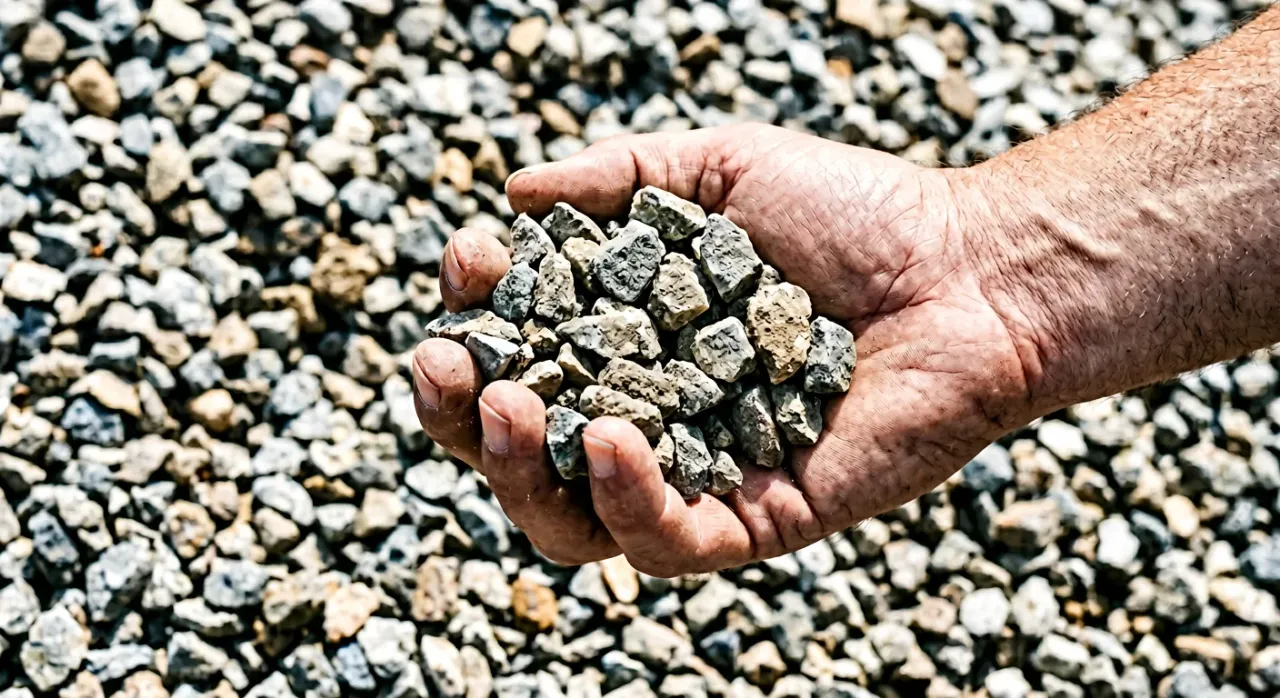
Quickly calculate 3/4" gravel needed—estimate tons, cubic yards, or bags from your area and depth inputs.
How to Use This 3/4 Gravel Calculator
Planning a 3/4 gravel project requires precise measurements to ensure you order enough material without overspending.
- 1 Enter Dimensions — Input the length and width of your area in feet. Round up slightly for a buffer.
- 2 Choose Depth — Select the depth in inches. For most 3/4 gravel projects, 3–6 inches is standard.
- 3 Review Results — Instantly see cubic yards and tons needed to accurately plan your order.
Visual Area Guide
Use these diagrams to measure your project area correctly.
Rectangular Area
Measure length × width for square or rectangular areas. Most driveway, patio, and grading projects use this method.
Circular Area
Measure the radius (half the diameter) for round beds, drain fields, or circular landscaping. Formula: π × radius².
Material Coverage & Grading
Common 3/4 gravel grades and applications based on ASTM D448 and AASHTO M43 classification standards
| Grade | Application |
|---|---|
| #57 | Clean, angular crushed stone with a nominal 3/4-inch top size and minimal fines, conforming to ASTM D448 #57. Its large void spaces provide excellent drainage and moderate mechanical interlock, making it the most widely used 3/4 gravel designation. Ideal for applications where free drainage and a stable, non-settling base are required. |
| #67 | Crushed stone graded from 1/4 inch to 3/4 inch per ASTM D448 #67, offering a broader particle size distribution than #57. The wider gradation provides better material interlock and improved contact around embedded objects. Commonly specified for concrete aggregate, pipe bedding, and drainage applications requiring moderate structural capacity. |
| #411 | A dense-grade blend of #57 stone combined with crusher dust and fines, producing a well-graded aggregate that compacts to high density. The fines fill voids between larger particles, enabling 95–100% maximum compaction with standard equipment. Best suited for driveways, parking areas, and base courses where long-term stability and minimal settlement are critical. |
| #21 | Dense-grade aggregate (also designated #21A or #21B depending on jurisdiction) meeting DOT and AASHTO gradation specifications for road base and foundation preparation. Similar in behavior to #411, it achieves high load-bearing capacity through compaction of blended coarse and fine particles. Widely specified for road subbase, driveway bases, and compactable structural fill under pavements or buildings. |
| 3/4" Minus | A broadly graded aggregate running from 3/4 inch down to sand and fines, sometimes washed to remove excess dust. The continuous gradation provides moderate compactability and good material contact for concrete aggregate and landscaping uses. Not recommended for driveways or pedestrian surfaces due to fines migration and settling over time. |
Plan Your Next Project
Driveway Calculator
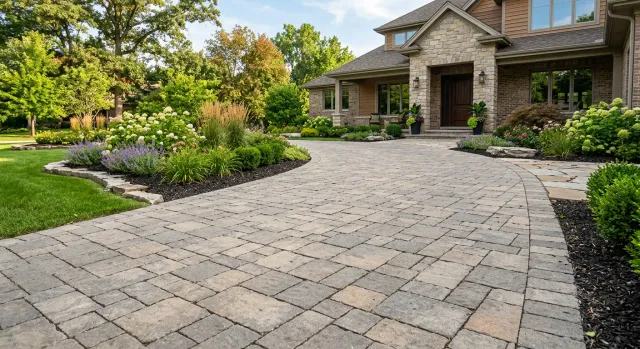
Driveway calculator — estimate cubic yards and tons from your length, width, and preferred gravel depth. Covers single-layer and three-layer builds.
Gravel Driveway Calculator
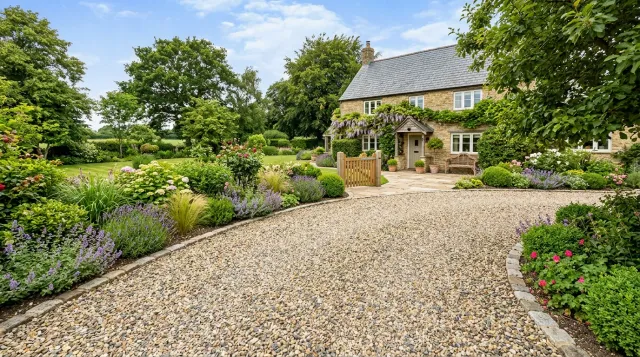
Gravel driveway calculator — estimate how many cubic yards or tons your driveway needs. Enter length, width, and depth for volume per layer.
Shed Base Calculator
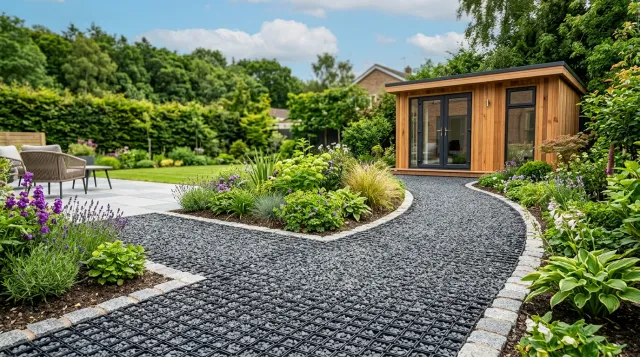
Shed base calculator — enter your footprint and preferred gravel depth to estimate cubic yards and tons. Includes recommended depths for different shed types.
Parking Pad Calculator
Parking pad calculator — estimate crushed stone or gravel for a residential pad. Enter area and depth for cubic yards, tons, and approximate cost.
Frequently Asked Questions
What is 3/4 gravel used for?
3/4 gravel is one of the most versatile aggregates available, and it shows up in a wide range of residential and commercial projects. The roughly 3/4-inch stone size is large enough to allow water to pass through freely, but stable enough to hold its position once spread and compacted. That balance makes it useful in a lot of different situations. The most common applications include driveway surfaces and base layers, French drains and perimeter drainage systems, retaining wall backfill, septic leach fields, dry creek beds, walkway and path bases, and general fill for low-lying areas that collect water. Contractors also use it as a sub-base beneath concrete slabs, pavers, and asphalt surfaces. If you are not sure whether 3/4 gravel is the right material for your specific project, the Hello Gravel team is glad to help you think it through before you order.
Is 3/4 gravel the same as #57 stone?
They are very close, and in practice the terms are often used interchangeably by contractors and suppliers. However, there is a subtle distinction worth knowing. #57 stone is a graded aggregate with a maximum particle size of about 3/4 inch, but the gradation allows for some smaller pieces down to around 1/4 inch mixed in. The "3/4 gravel" label typically refers to stone that is more uniformly sized right around that 3/4-inch mark with fewer fine particles in the mix. For most residential applications such as driveways, drainage projects, and base work, the two materials will perform nearly the same. Where it starts to matter is in drainage-critical applications like French drains or leach fields, where a cleaner, more uniform stone keeps the voids open for better water flow. If your project has a specific size or gradation requirement, confirm the details with Hello Gravel before placing your order to make sure you are getting exactly what your job calls for.
What is the difference between 3/4 gravel and pea gravel?
The main differences come down to size, shape, and best use cases. Pea gravel is small and rounded — typically 3/8 inch — with a smooth texture from natural weathering. It's visually appealing and comfortable underfoot, which makes it popular for landscaping, garden paths, and decorative applications. However, because it's round, it doesn't interlock or compact well, so it tends to shift and scatter under foot or vehicle traffic. 3/4 inch gravel is larger and usually crushed, giving it angular edges. Those angular faces lock together under load, which makes it far more stable for driveways, drainage beds, and base layers. It also drains well because the larger pieces leave open voids for water to pass through. If you need something decorative and low-traffic, pea gravel is a great choice. If you need stability, drainage, or a surface that can handle vehicles, 3/4 inch gravel is the better option.
How much does a cubic yard of 3/4 gravel weigh?
A cubic yard of 3/4 gravel typically weighs between 2,700 and 3,000 pounds, or roughly 1.35 to 1.5 tons. The exact figure depends on a few variables including whether the stone is dry or wet, how tightly it is packed, and whether it is a clean washed gravel or a crushed stone blend that includes fines. Clean, washed gravel tends to run slightly lighter because the voids between stones are more open, while crushed stone with fine material filling those gaps can weigh a bit more. This is worth keeping in mind when you are figuring out how much material to order, since most suppliers and calculators work in tons rather than cubic yards. Hello Gravel's online calculator converts your project dimensions directly into the tonnage you need, so you do not have to do the math yourself. Plug in your square footage and intended depth, and it will give you an accurate estimate for your specific project.
How much 3/4 gravel do I need for my project?
The amount you need comes down to two things: the area you are covering and the depth you want to lay the material. As a practical rule of thumb, one ton of 3/4 gravel covers approximately 100 square feet at 2 inches of depth. If you are building a driveway surface where 4 inches of depth is the standard recommendation for durability, that same ton would cover closer to 50 square feet. For deeper drainage trenches or base layers, your tonnage requirements will go up accordingly. These are general estimates, and your actual project will have its own dimensions and depth requirements. The most reliable way to get an accurate number is to use Hello Gravel's online calculator. Enter your length, width, and intended depth, and it will calculate your tonnage for you. That way you order what you actually need rather than guessing and ending up short or with a significant surplus on your hands. If you have an unusual project shape or are working on something with multiple sections, reach out to the Hello Gravel team and they can help you work through the estimate.
Other Material Calculators
Delivery Logistics & Truck Info
Know your delivery options and access requirements before scheduling your order.
Truck Capacities
- Standard Dump Truck 10–14 tons
- Tandem Axle 14–18 tons
- Semi End Dump 20–25 tons
A standard cubic yard weighs approximately 2,000–2,700 lbs depending on material and moisture.
Site Access Requirements
- Trucks require a minimum 12-ft wide, overhead-clear access path
- Soft ground or slopes over 10% may limit truck access — contact us before ordering
- Ensure no underground utilities or irrigation lines are in the drop zone
- Mark your desired drop location clearly before delivery
Important Notes
- Delivery estimates are based on available inventory and route proximity
- Minimum order quantities apply — typically 5 cubic yards or 1 truckload
- Material certification is available upon request for permitted projects
- Always confirm local grading ordinances before major material placement