
Crusher Run Calculator
— How Much Do You Need?
Calculate crusher run by area and depth — get quick, accurate estimates in tons or cubic yards.
How to Use This Crusher Run Calculator
Planning a crusher run project requires precise measurements to ensure you order enough material without overspending.
- 1 Enter Dimensions — Input the length and width of your area in feet. Round up slightly for a buffer.
- 2 Choose Depth — Select the depth in inches. For most crusher run projects, 3–6 inches is standard.
- 3 Review Results — Instantly see cubic yards and tons needed to accurately plan your order.
Visual Area Guide
Use these diagrams to measure your project area correctly.
Rectangular Area
Measure length × width for square or rectangular areas. Most driveway, patio, and grading projects use this method.
Circular Area
Measure the radius (half the diameter) for round beds, drain fields, or circular landscaping. Formula: π × radius².
Material Coverage & Grading
Common crusher run applications classified by maximum particle size and use context per ASTM D1241
| Grade | Application |
|---|---|
| 2" Minus | Standard crusher run with a 2-inch maximum particle size, conforming to ASTM D1241. Contains a continuous gradation of angular crushed stone from coarse particles down to dust-sized fines. The dominant specification for road subbase, parking lot foundations, and heavy-load base courses throughout North America. |
| 1.5" Minus | Crusher run with a 1.5-inch maximum particle size, offering a slightly tighter gradation than standard 2-inch minus. Suitable for base course applications where a more uniform layer thickness or tighter surface tolerance is required. Commonly used under asphalt paving and commercial parking lot construction. |
| 1" Minus | Finer crusher run with a 1-inch maximum particle size, providing a denser and more uniform compacted surface. Well-suited for driveway bases, utility trench bedding, and foundation pad preparation where a smoother, tightly compacted layer is desired. |
| 3/4" Minus | Fine-graded crusher run with a 3/4-inch maximum particle size, yielding a compact, tight surface finish upon compaction. Ideal for residential driveways, walkway bases, equipment pads, and light-duty surface courses where a refined finish is preferred. |
| CR-6 | A DOT-referenced crusher run grade widely recognized in mid-Atlantic and southeastern U.S. specifications, typically equivalent to a 3/4-inch minus gradation per ASTM D1241. Contains angular crushed stone with controlled fines for excellent compaction and load-bearing performance. Commonly specified for road base, driveway construction, and utility trench backfill. |
| Asphalt Base | Crusher-run aggregate with tightly controlled fines content and restricted flat/elongated particles, conforming to ASTM D1241 requirements for asphalt mixture base applications. Engineered to reduce the required asphalt sand content, with fines typically held to 25–50% of the maximum allowable limit. Used exclusively as the compacted base layer directly beneath hot-mix asphalt wear courses on roads and commercial paving projects. |
Plan Your Next Project
Tennis Court Calculator
Use this calculator to estimate the crushed stone base for a new or resurfaced tennis court. Enter dimensions and depth for volume and tonnage.
Carport Calculator
Carport pad calculator — estimate the right amount of gravel for a stable base. Enter your footprint and depth for cubic yards, tons, and cost.
Driveway Calculator
Driveway calculator — estimate cubic yards and tons from your length, width, and preferred gravel depth. Covers single-layer and three-layer builds.
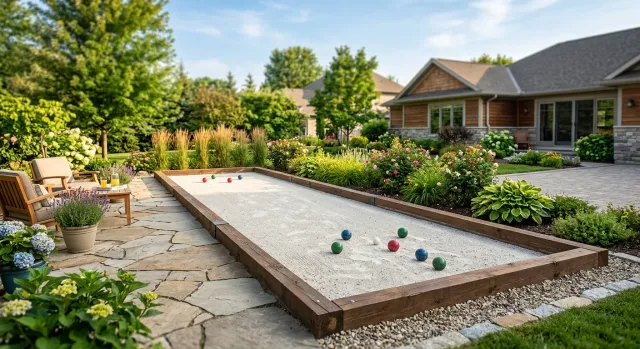
Bocce Ball Court Calculator
Bocce court calculator — estimate gravel, oyster shell, or stone dust for every layer. Enter court size to get material estimates in yards and tons.
Frequently Asked Questions
What is crusher run, and where does it get its name?
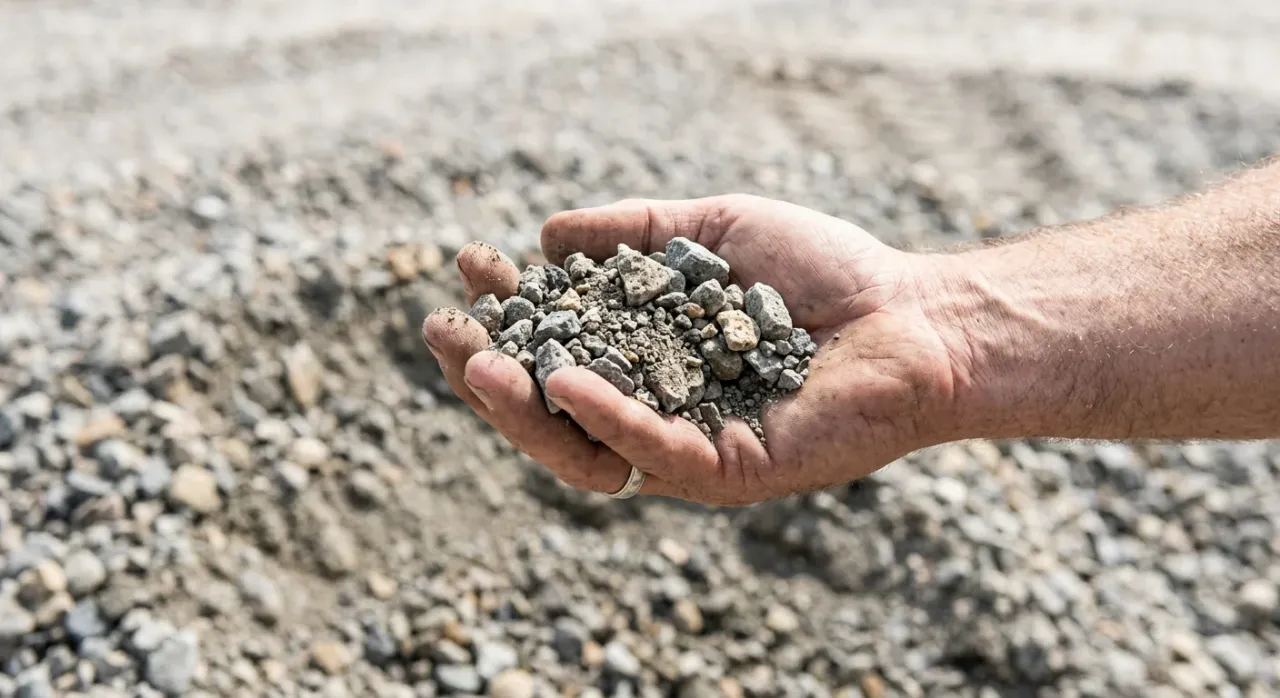
Crusher run is a blend of crushed stone and stone dust, also called fines, produced when larger rocks are processed at a quarry. When stone is crushed, it breaks into angular pieces of varying sizes and generates a fine powdery dust. Crusher run keeps all of that material together rather than screening any of it out. The result is a product that typically ranges from about 3/4 inch in size down to fine particles, all mixed into one load. The name comes directly from how it is made. The material runs straight from the crusher without being sorted, washed, or screened by size. What comes off the crusher is what you get. Depending on where you are in the country, you may also hear it called crush and run, road crush, dense grade aggregate, quarry process, or QP. These names describe the same type of material. What sets crusher run apart is that full range of particle sizes. When you compact it, the larger angular stones lock against each other and the fine dust settles into the voids between them. That combination is what gives crusher run its signature firm, stable surface once it is installed.
How is crusher run different from regular gravel?
The biggest difference comes down to particle shape and size variety. Regular gravel, like pea gravel or washed crushed stone, is screened to a uniform size and often has smooth or semi-rounded particles. Because all the pieces are roughly the same size, they cannot pack down tightly. They shift and roll under pressure, which works well for drainage applications but creates an unstable surface under vehicle traffic. Crusher run is angular and contains a full range of particle sizes from large stones down to fine dust. When you compact it, the angular pieces interlock and resist movement, while the smaller particles and fines fill the gaps between them. The surface that results is dramatically more stable than uniform gravel. The right choice depends on your project. If you need a firm, load-bearing surface for a driveway, parking area, or structural base, crusher run is the stronger option. If you want open drainage, a decorative finish, or a path with a looser feel, a washed gravel might serve you better. For anything that needs to hold up under regular vehicle traffic, crusher run is the material most builders reach for first.
Why does crusher run compact so firmly, and what do people mean by 'poor man's concrete'?
Crusher run has earned the nickname "poor man's concrete" because of what happens when you compact it. Apply pressure through a plate compactor or simply let vehicle traffic work it over time, and the angular stone particles interlock while the fine dust binds into the voids between them. The surface hardens and becomes dense enough to feel almost as solid as a paved surface. The physics behind it are straightforward. The irregular, angular shapes of crushed stone create friction between particles that prevents them from sliding past each other. The dust and fines act almost like a natural bonding agent, stiffening the whole layer from the inside out. That behavior is entirely different from rounded gravel, which rolls and shifts no matter how much traffic crosses it. This compaction quality is also why crusher run is such a common choice as a base layer under concrete slabs, paver patios, and asphalt surfaces. It gives whatever goes on top of it a stable, load-bearing foundation that resists settling and movement from freeze-thaw cycles or soil shifting below. As a finished surface on its own, it delivers that firm, stable feel at a fraction of the cost of paving, which is exactly where the nickname comes from.
Can you use crusher run for a driveway, and how thick should it be?
Crusher run is one of the most popular driveway materials available, and it earns that reputation. It compacts into a firm, stable surface that handles vehicle traffic well, and once it has been driven on for a few weeks it becomes even more solid as the material continues to settle and tighten. For a standard residential driveway, a compacted depth of 4 to 6 inches is the common recommendation. Four inches of compacted crusher run works well for regular car and light truck traffic. If you expect heavier vehicles such as delivery trucks, vehicles with trailers, or frequent use by multiple drivers, stepping up to 6 inches gives you noticeably better durability. For commercial driveways or areas with very heavy loads, some contractors go as deep as 8 compacted inches. One important detail to keep in mind: measure your target depth in compacted inches, not loose. Crusher run typically loses around 15 to 20 percent of its volume once compacted, so you need to account for that when you calculate how much to order. If you measure the depth after compaction and come up short, you will need to add more material and compact again. To avoid that, use the Hello Gravel calculator before you order. Plug in your driveway dimensions and your target compacted depth, and it will give you a quantity that accounts for that compaction factor.
What are the best uses for crusher run besides driveways?
Crusher run is a remarkably versatile material, and driveways are just one application in a long list. Shed pads and outbuildings are a natural fit. When you need a flat, stable surface that will not shift or settle unevenly under the weight of a structure, crusher run gives you that foundation at a low cost. Level it, compact it, and you have a solid base that will not heave or sink the way bare soil can. It is also widely used as a sub-base under concrete slabs and paver patios. Compacted crusher run creates the kind of stable, load-bearing foundation that prevents cracking and uneven settling over time. Contractors building patios, retaining walls, and walkways commonly start with a layer of crusher run before placing any surface material. Parking areas and staging yards are another strong application. On a job site or property where vehicles and equipment need to move around without churning up mud, crusher run stabilizes the ground quickly and cost-effectively. Construction site access roads are built with it for the same reason. Garden paths and pedestrian walkways also benefit from crusher run. It gives you a firm surface that does not shift underfoot the way loose stone does, and it blends into outdoor settings without looking out of place. If you have a project that needs a stable, load-bearing surface that does not require paving, crusher run is almost always worth considering.
Other Material Calculators
Delivery Logistics & Truck Info
Know your delivery options and access requirements before scheduling your order.
Truck Capacities
- Standard Dump Truck 10–14 tons
- Tandem Axle 14–18 tons
- Semi End Dump 20–25 tons
A standard cubic yard weighs approximately 2,000–2,700 lbs depending on material and moisture.
Site Access Requirements
- Trucks require a minimum 12-ft wide, overhead-clear access path
- Soft ground or slopes over 10% may limit truck access — contact us before ordering
- Ensure no underground utilities or irrigation lines are in the drop zone
- Mark your desired drop location clearly before delivery
Important Notes
- Delivery estimates are based on available inventory and route proximity
- Minimum order quantities apply — typically 5 cubic yards or 1 truckload
- Material certification is available upon request for permitted projects
- Always confirm local grading ordinances before major material placement