
Crushed Concrete Calculator
— How Much Do You Need?
Crushed concrete estimator — calculate cubic yards, tons, and coverage for material planning.
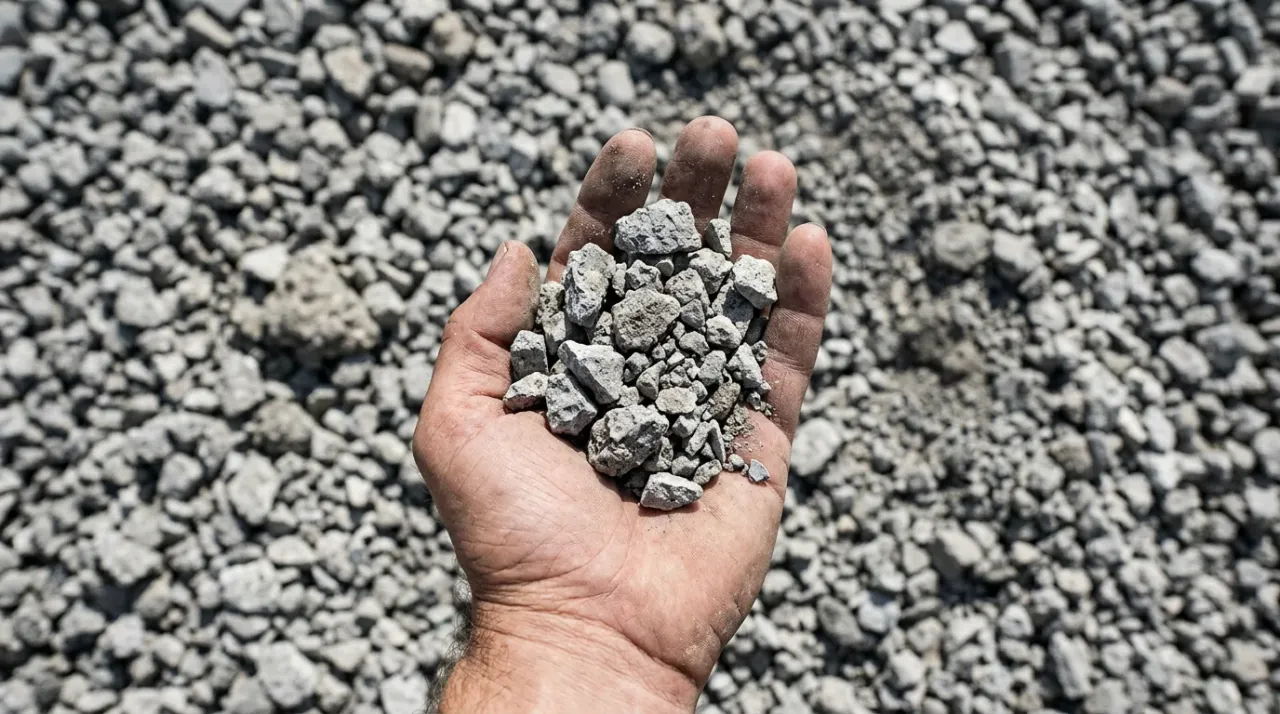
How to Use This Crushed Concrete Calculator
Planning a crushed concrete project requires precise measurements to ensure you order enough material without overspending.
- 1 Enter Dimensions — Input the length and width of your area in feet. Round up slightly for a buffer.
- 2 Choose Depth — Select the depth in inches. For most crushed concrete projects, 3–6 inches is standard.
- 3 Review Results — Instantly see cubic yards and tons needed to accurately plan your order.
Visual Area Guide
Use these diagrams to measure your project area correctly.
Rectangular Area
Measure length × width for square or rectangular areas. Most driveway, patio, and grading projects use this method.
Circular Area
Measure the radius (half the diameter) for round beds, drain fields, or circular landscaping. Formula: π × radius².
Material Coverage & Grading
Common crushed concrete (RCA) grades and applications used in road construction, base courses, drainage, and landscaping
| Grade | Application |
|---|---|
| 1-1/2" | Dense-graded recycled concrete aggregate ranging 0 to 1-1/2 inches, with 100% passing the 1-1/4-inch sieve and controlled fines (1–5% passing No. 200). Angular crushed particles with adhered mortar residue provide excellent mechanical interlock. Ideal for aggregate base courses, road subbases, and residential driveway bases requiring high compaction density (128–130 pcf). |
| 3/4" | Medium-coarse recycled concrete aggregate with a maximum particle size of 3/4 inch, equivalent to a Size No. 68 gradation. Balances compaction density with moderate drainage performance and suits stabilized base courses, shoulder material, and utility trench backfill. Widely specified by Southern and Midwestern DOTs as Class B aggregate or aggregate base course (ABC). |
| DGABC | Dense-Graded Aggregate Base Course (Item 398 / Table 5 specification) using full-depth crushed concrete compacted in 5-inch lifts. Meets DOT sieve-based gradation requirements across the full particle-size distribution for long-term performance under traffic loads. Best suited for highway subbase layers and full-depth pavement foundations on moderate-to-high traffic roads. |
| Size No. 68 | Clean, open-graded crushed concrete equivalent to AASHTO/ASTM Size No. 68, with 100% passing 1 inch and 0–5% passing the No. 200 sieve. Low fines content promotes free drainage, making it well-suited for underdrains, French drains, and permeable base layers. Nonplastic fines and angular particle shape provide stability with minimal frost susceptibility. |
| Minus | Recycled concrete aggregate processed to retain natural minus fines, improving self-binding and cohesion during compaction. Higher fines content (above 5% passing No. 200) reduces permeability but enhances density and surface stability. Commonly used for unpaved road surfacing, low-traffic pavements, shoulders, and landscaping base fill where binding is preferred over drainage. |
| Screenings | Crushed concrete screenings passing the No. 4 sieve, characterized by a low plasticity index (<4) and high fines content from residual cement mortar. Functions as a binder, top-course stabilizer, or gap-filler in compacted base layers. Suited for shoulder stabilization, erosion control, low-traffic surface courses, and landscaping fill applications. |
Plan Your Next Project
Driveway Calculator
Driveway calculator — estimate cubic yards and tons from your length, width, and preferred gravel depth. Covers single-layer and three-layer builds.
Gravel Driveway Calculator
Gravel driveway calculator — estimate how many cubic yards or tons your driveway needs. Enter length, width, and depth for volume per layer.
Parking Pad Calculator
Parking pad calculator — estimate crushed stone or gravel for a residential pad. Enter area and depth for cubic yards, tons, and approximate cost.
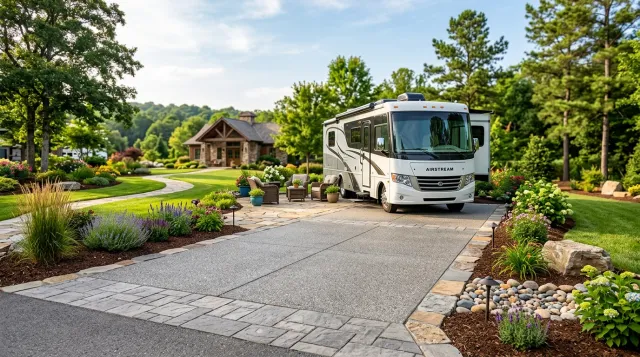
RV Pad Calculator
RV pad calculator — estimate how much gravel and base material your pad requires. Input dimensions and a recommended 6-inch depth for tonnage and yardage.
Frequently Asked Questions
What is crushed concrete good for?
Crushed concrete is one of the most versatile base and fill materials you can order. It works well across a wide range of residential, commercial, and construction projects, and its angular shape is the key reason why. Unlike smooth, rounded gravel, the jagged edges of crushed concrete pieces lock together under pressure. That interlocking structure creates a dense, load-bearing layer that holds up well under vehicle traffic and heavy loads. Add in the residual cement fines throughout the mix, and you get a material that firms up significantly once it is compacted. Common uses include driveway bases and unpaved driveway surfaces, parking lot sub-bases, road base and unpaved access roads, fill for grading and leveling uneven ground, sub-base material under concrete slabs, sidewalks, and patios, backfill behind retaining walls, and erosion control on slopes or embankments. If your project needs a material that compacts firmly, resists shifting, and holds up under load, crushed concrete is a strong and cost-effective option to consider.
What are the disadvantages of crushed concrete?
Crushed concrete is a practical and affordable material, but it is not the right fit for every situation. Knowing where it falls short helps you make the right call before you place an order. The most noticeable limitation is appearance. Crushed concrete has a rough, industrial look with a gray and off-white color. If the surface will be visible and aesthetics matter for your project, you may prefer a more uniform material like crushed limestone or decorative gravel. Because crushed concrete is a recycled product, the size and consistency of individual pieces can vary more than quarried virgin aggregate. For most base, fill, and driveway applications, that variation is not a problem at all. But if your project requires a tightly controlled gradation or a specific DOT specification material, crushed concrete may not meet those requirements. The residual cement content in the material also makes it mildly alkaline. If you plan to use it in areas where plants or grass will grow directly alongside it, that is something worth keeping in mind. Finally, crushed concrete works best as a base layer or a functional unpaved surface. It is not a finished decorative material on its own. For projects where the end result needs to look polished or refined, it serves better as a foundation beneath something else.
Is crushed concrete cheaper than virgin gravel or base stone?
In most cases, yes. Crushed concrete is typically one of the more affordable bulk aggregate options available, and the reason comes down to where it comes from. Because it is a recycled material processed from demolished concrete structures, roads, and buildings, the raw material cost is significantly lower than quarrying and processing virgin stone. That savings usually shows up in the price you pay. How much of a difference you will see compared to other base materials depends on your location, current market conditions, and local supply. Crushed concrete is sourced regionally, so pricing can vary from one area to another based on what is available nearby and how far the material needs to travel. Rather than working from a ballpark figure, the best way to understand what crushed concrete will cost for your specific project is to use the Hello Gravel calculator. Enter your dimensions, get a quantity estimate, and you will see current pricing for your area right away. If you want to talk through your options before ordering, the Hello Gravel team is happy to help you compare materials and find the best fit for your budget.
Is crushed concrete a good choice for a driveway?
Crushed concrete is one of the most popular driveway materials available, and it earns that reputation for a few practical reasons. The angular pieces interlock tightly when compacted, creating a firm, stable surface that resists the shifting and rutting you get with smoother materials. The cement fines throughout the mix act as a natural binder, and the surface tends to harden slightly over time as those fines respond to moisture. The result is a load-bearing driveway that holds up well under regular vehicle traffic without the cost of asphalt or poured concrete. For a residential driveway handling everyday car and SUV traffic, a compacted depth of 4 to 6 inches is the standard recommendation. If your driveway will regularly see heavier vehicles like delivery trucks, trailers, or equipment, plan for 6 to 8 inches of compacted material to give you the structural depth you need. Crushed concrete works well as a standalone unpaved driveway surface and also as a base layer under asphalt. Many homeowners use it as a cost-effective option for long rural driveways or secondary access roads where a paved surface is not a priority. For the best results, make sure the ground is properly graded before you spread the material and that you have enough slope for water to drain away from the surface. Running a plate compactor or roller over the material after spreading makes a noticeable difference in firmness and longevity.
How much crushed concrete do I need for my project?
The amount you need comes down to two things: the area you are covering and how deep you are laying the material. Crushed concrete weighs approximately 1.4 to 1.5 tons per cubic yard, so it is straightforward to estimate from your square footage and target depth. At 4 inches of compacted depth, 1 ton of crushed concrete will cover roughly 55 to 60 square feet. At 6 inches of compacted depth, that same ton covers closer to 35 to 40 square feet. To put those numbers to work: a 1,000-square-foot driveway at 4 inches of compacted depth would take approximately 16 to 18 tons. A smaller project, like a 20-by-20-foot parking pad at the same depth, would need roughly 6 to 7 tons. These are solid working estimates, but your actual quantity depends on your exact dimensions, the condition of your sub-grade, and the level of compaction you are planning for. Soft or uneven ground may require more material than a well-prepared base. The Hello Gravel calculator is the fastest and most accurate way to get a number you can order with confidence. Enter your length, width, and depth, and it will give you a precise tonnage estimate for your specific project.
Other Material Calculators
Delivery Logistics & Truck Info
Know your delivery options and access requirements before scheduling your order.
Truck Capacities
- Standard Dump Truck 10–14 tons
- Tandem Axle 14–18 tons
- Semi End Dump 20–25 tons
A standard cubic yard weighs approximately 2,000–2,700 lbs depending on material and moisture.
Site Access Requirements
- Trucks require a minimum 12-ft wide, overhead-clear access path
- Soft ground or slopes over 10% may limit truck access — contact us before ordering
- Ensure no underground utilities or irrigation lines are in the drop zone
- Mark your desired drop location clearly before delivery
Important Notes
- Delivery estimates are based on available inventory and route proximity
- Minimum order quantities apply — typically 5 cubic yards or 1 truckload
- Material certification is available upon request for permitted projects
- Always confirm local grading ordinances before major material placement