
Decomposed Granite Calculator
— How Much Do You Need?
Quickly estimate decomposed granite volume, weight, and coverage for patios, walkways, and beds.
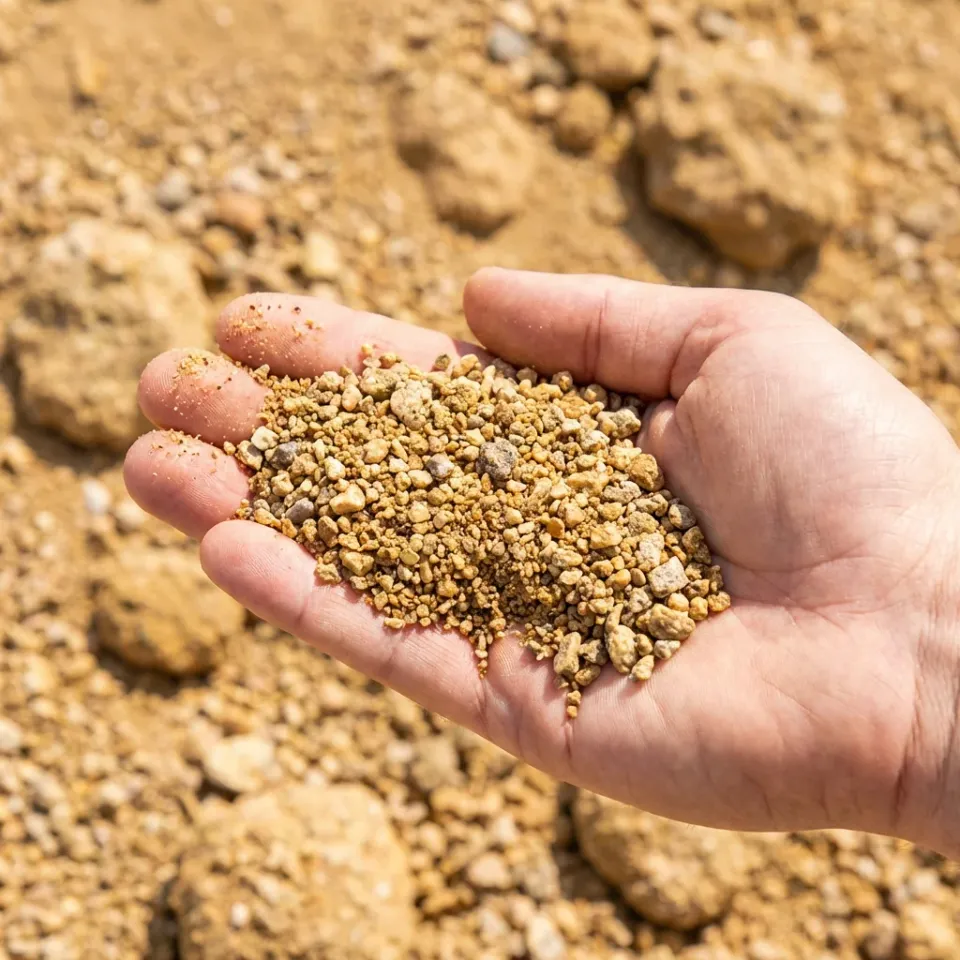
How to Use This Decomposed Granite Calculator
Planning a decomposed granite project requires precise measurements to ensure you order enough material without overspending.
- 1 Enter Dimensions — Input the length and width of your area in feet. Round up slightly for a buffer.
- 2 Choose Depth — Select the depth in inches. For most decomposed granite projects, 3–6 inches is standard.
- 3 Review Results — Instantly see cubic yards and tons needed to accurately plan your order.
Visual Area Guide
Use these diagrams to measure your project area correctly.
Rectangular Area
Measure length × width for square or rectangular areas. Most driveway, patio, and grading projects use this method.
Circular Area
Measure the radius (half the diameter) for round beds, drain fields, or circular landscaping. Formula: π × radius².
Material Coverage & Grading
Common decomposed granite grades and applications used in U.S. construction and landscaping
| Grade | Application |
|---|---|
| 3/8" Minus | The industry-standard landscape and pedestrian grade, containing particles ranging from fine dust up to 3/8 inch maximum size. Offers a balanced mix of coarse particles and fine binder material, producing a cohesive, walkable surface when compacted. Ideal for general pathways, decorative landscape surfacing, and aggregate base layers. Compacts to 90–95% relative compaction when properly moistened and rolled. |
| 1/4" Minus | A finer-graded decomposed granite with higher fines content and a smoother surface texture than the 3/8" minus grade. Provides tighter compaction and a more refined finished appearance, making it suitable for high-traffic pedestrian areas and polished surface applications. Gradation includes a greater proportion of material passing the No. 30 and finer sieves. Preferred where surface smoothness and tighter particle packing are prioritized. |
| 1/2" Minus | A coarser decomposed granite grade used primarily as a subbase or base layer beneath finer DG finished surfaces. Contains particles up to 1/2 inch maximum size with sufficient fines for moderate cohesion and compaction. Provides enhanced load distribution and drainage capacity as a subsurface layer. Typically overlaid with 3/8" minus DG for finished pedestrian or landscape applications. |
| Stabilized | Decomposed granite blended with polymer or chemical binder additives to significantly increase surface durability and reduce dust generation. The stabilizer binds fine particles together upon curing, extending service life and improving resistance to erosion and displacement. Best suited for premium pedestrian pathways, erosion-prone areas, and municipal or DOT-specified installations. Available in 3/8" minus or 1/4" minus base gradations with proprietary binder systems. |
Plan Your Next Project
Zen Garden Calculator
Zen garden calculator — estimate sand weight and volume from your dimensions and desired depth. Includes guidance for tabletop and full-size gardens.
Xeriscaping Calculator
Xeriscaping calculator — estimate rock tonnage for drought-tolerant beds. Input coverage area and desired depth to see cubic yards, tons, and cost.
Walkway Calculator
Walkway calculator — enter length, width, and depth to estimate the exact gravel volume in cubic yards and tons. Includes recommended depth guidance.
Gravel Path Calculator
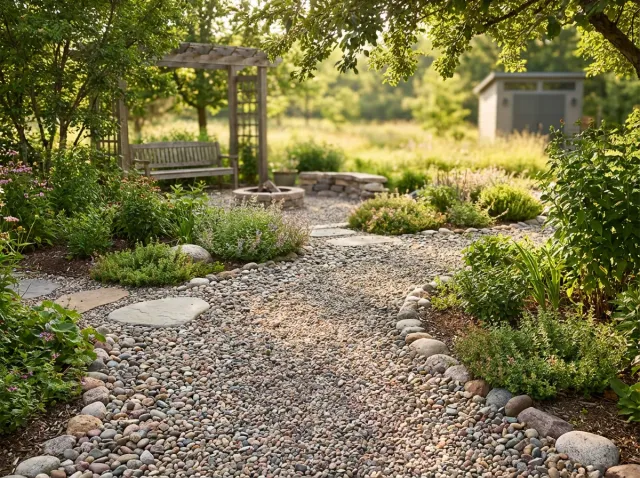
Gravel path calculator — enter your path length, width, and depth to estimate volume in cubic yards and weight in tons. Supports multiple aggregate types.
Frequently Asked Questions
What is decomposed granite, and how is it different from regular crushed gravel?
Decomposed granite, often called DG, is granite rock that has naturally broken down over time through weathering and erosion. The result is a mix of fine, gritty particles and small fragments that typically range from sand-sized fines up to about 3/8 of an inch. Because it forms through natural weathering rather than mechanical crushing, it has a softer, more earthy texture and a warm, natural appearance that crushed gravel simply does not replicate. The biggest practical difference between DG and standard crushed gravel is how it behaves underfoot and under a compactor. When you install DG at the right depth and compact it, the fine particles bind together and create a firm, stable surface with a smooth, almost packed-dirt feel. Crushed gravel, by contrast, tends to stay loose and shifts more freely. That compacting quality is a big part of why so many homeowners and landscapers choose DG for pathways, patios, and light-use driveways, especially when they want a natural, refined look rather than the rough texture of traditional gravel. If you are trying to decide whether DG is the right material for your project, the Hello Gravel team is glad to help you think it through.
What projects is decomposed granite best suited for?
Decomposed granite is one of the most versatile landscaping materials available, and it works beautifully in a wide range of residential and commercial projects. Garden pathways and walking trails are probably the most common use. DG creates a clean, natural-looking surface that holds up well under regular foot traffic and blends seamlessly into outdoor spaces. Many homeowners also use it for patio areas and outdoor seating spaces where they want a permeable, low-maintenance alternative to concrete or pavers. For driveways, stabilized DG is the right choice, natural loose DG will rut and wash out under vehicle traffic. Stabilized DG is treated with a polymer binder that compacts into a firmer surface capable of handling light vehicle use. It is also a popular choice for dog runs because it drains well, stays cooler than hard surfaces in warm weather, and is gentler on paws than crushed stone.In landscaping, DG works well as a ground cover and mulch alternative around trees, shrubs, and garden beds. It suppresses weeds when installed correctly, retains some moisture, and gives planting areas a neat, finished appearance. It is a cornerstone material in xeriscaping and drought-tolerant garden design, which is why you see it used so widely across the Southwest and in water-conscious landscapes nationwide. Other popular applications include fire pit surrounds, playground buffer zones, and decorative areas around water features. If you are not sure whether DG fits your specific project, reach out to the Hello Gravel team and we will help you find the right material.
How much decomposed granite do I need, and how does installation depth affect coverage?
The amount of DG you need depends directly on two things: the square footage of your project and how deep you plan to install it. Getting the depth right matters both for coverage planning and for the performance of the finished surface, so it is worth thinking through before you order. For garden beds, decorative ground cover, and very light foot traffic areas, 2 inches of compacted DG is a common starting point. At that depth, one ton of decomposed granite covers roughly 100 to 120 square feet. Keep in mind that DG is a denser material than it might look, so a little goes a long way in decorative applications. For pedestrian pathways and walking trails that see regular use, 3 inches of compacted depth is a more reliable standard. At 3 inches, one ton covers approximately 70 to 80 square feet. This depth gives you enough material to compact firmly and still have a stable surface after the initial settling period. For driveways or areas where vehicles will park or turn, you want to go deeper. At 4 inches of compacted depth, one ton covers roughly 50 to 60 square feet. The extra depth supports more weight and reduces the chance of ruts or washouts over time. These figures are useful starting points, but your actual coverage will vary based on the specific DG material, your soil conditions, and how aggressively you compact. For a more precise estimate tailored to your exact dimensions, use the Hello Gravel calculator on the product page. It takes the guesswork out of figuring out how many tons to order so you are not left short or paying for more than you need.
What is the difference between natural and stabilized decomposed granite, and which one is right for my project?
Natural, or loose, decomposed granite is DG in its most basic form with no added binders or treatments. It compacts reasonably well on its own, but over time it can shift, scatter with heavy foot traffic, and erode in areas exposed to moving water or wind. Natural DG is a great choice for garden beds, decorative ground cover, low-traffic pathways, and xeriscaping where aesthetics are the priority and the area will not be subjected to heavy, repeated use. Stabilized decomposed granite is natural DG that has been treated with a polymer resin or similar binding agent. The stabilizer helps the particles lock together more tightly when compacted, creating a firmer, more durable surface that holds up better under regular foot traffic and light vehicle use. It resists displacement and erosion more effectively than natural DG, which makes it a popular choice for driveways, high-traffic walkways, and pathways that need to maintain a clean edge over time. A simple way to think about it: if your project is primarily decorative or sees only occasional use, natural DG is usually sufficient and more cost-effective. If you want a surface that performs more like a packed road base while still looking like natural granite, stabilized DG is worth the investment. To confirm which grades and types are currently available for your area, check the Hello Gravel product page or contact our team directly. We can point you toward the right material for your specific situation.
Does decomposed granite drain well, and how does it hold up in wet or rainy climates?
Decomposed granite is a permeable material, meaning water moves through it rather than pooling on the surface. This makes it a strong choice for areas where drainage matters, such as around tree roots, in rain gardens, or in sloped landscapes where runoff could otherwise cause erosion. That said, DG's performance in wet conditions depends on how it is installed and whether the climate sees significant rainfall or sustained moisture. In dry and semi-arid regions like the Southwest and California, DG is an extremely reliable surface material and has been used for decades in those environments. In wetter climates, natural loose DG can shift, rut, or wash away if it is not properly contained and maintained. Stabilized DG handles wetter conditions better than natural DG because the binding agent helps the particles resist displacement. If you live in a region with frequent heavy rain and still want to use DG, stabilized DG combined with proper edging and a well-graded subbase is your best path forward. One important note: avoid installing DG over compacted clay soils without a gravel base layer underneath if drainage is a concern. Clay holds water and can cause DG to become muddy or unstable after heavy rain. A base layer of crushed stone or compacted base gravel beneath the DG helps water move away from the surface more effectively. If you are working in a high-rainfall area and are not sure which approach makes sense, the Hello Gravel team can help you think through the right material combination for your region.
Other Material Calculators
Delivery Logistics & Truck Info
Know your delivery options and access requirements before scheduling your order.
Truck Capacities
- Standard Dump Truck 10–14 tons
- Tandem Axle 14–18 tons
- Semi End Dump 20–25 tons
A standard cubic yard weighs approximately 2,000–2,700 lbs depending on material and moisture.
Site Access Requirements
- Trucks require a minimum 12-ft wide, overhead-clear access path
- Soft ground or slopes over 10% may limit truck access — contact us before ordering
- Ensure no underground utilities or irrigation lines are in the drop zone
- Mark your desired drop location clearly before delivery
Important Notes
- Delivery estimates are based on available inventory and route proximity
- Minimum order quantities apply — typically 5 cubic yards or 1 truckload
- Material certification is available upon request for permitted projects
- Always confirm local grading ordinances before major material placement