
Concrete Sand Calculator
— How Much Do You Need?
Estimate concrete sand in cubic yards or tons — quick, accurate quantities for slabs, patios, and mixes.
How to Use This Concrete Sand Calculator
Planning a concrete sand project requires precise measurements to ensure you order enough material without overspending.
- 1 Enter Dimensions — Input the length and width of your area in feet. Round up slightly for a buffer.
- 2 Choose Depth — Select the depth in inches. For most concrete sand projects, 3–6 inches is standard.
- 3 Review Results — Instantly see cubic yards and tons needed to accurately plan your order.
Visual Area Guide
Use these diagrams to measure your project area correctly.
Rectangular Area
Measure length × width for square or rectangular areas. Most driveway, patio, and grading projects use this method.
Circular Area
Measure the radius (half the diameter) for round beds, drain fields, or circular landscaping. Formula: π × radius².
Material Coverage & Grading
Common concrete sand grades and classifications used in construction, DOT, and stormwater applications
| Grade | Application |
|---|---|
| ASTM C33 | Standard fine aggregate grade for general concrete production, meeting ASTM C33/C33M sieve gradation requirements with a fineness modulus (FM) of 2.3–3.1. Composed of natural or manufactured silica-based particles ranging from 0.075 mm to 4.75 mm, washed to limit fines passing the No. 200 sieve to under 3–5%. Widely used in ready-mix concrete, structural slabs, footings, and pavement sections. |
| AASHTO M-6 | DOT-accepted fine aggregate equivalent to ASTM C33, specified for highway, bridge, and stormwater infrastructure projects. Gradation and FM tolerances closely mirror C33 but are tuned to emphasize permeability and drainage performance (effective size 0.02–0.04 in). Commonly required on federally funded road and stormwater filtration projects. |
| C33 Fine | Lower end of the ASTM C33 FM range (approximately 2.3–2.6), producing a finer gradation that enhances workability and pumpability in lean or low-cement-content mixes. Composed of well-graded, sub-rounded to angular washed particles with minimal coarse fractions. Best suited for pumped concrete, architectural finishes, and stucco base coats. |
| C33 Coarse | Upper end of the ASTM C33 FM range (approximately 2.7–3.1), providing a coarser gradation that contributes to higher compressive strength in structural concrete mixes. Angular to sub-rounded particles interlock effectively under vibration, achieving high dry-rodded bulk density. Preferred for structural elements such as columns, beams, and high-strength slabs. |
| Washed C33 | ASTM C33-compliant fine aggregate that has undergone additional washing to reduce clay, silt, and fines passing the No. 200 sieve to below 2%. The cleaning process ensures freedom from injurious organic impurities and alkali-reactive materials. Ideal for high-performance concrete, precast elements, and applications where surface finish quality or chemical resistance is critical. |
| Mfg C33 | Manufactured (crushed) fine aggregate meeting ASTM C33 gradation, produced by mechanically crushing quarried rock rather than naturally mined sand. Typically exhibits higher angularity and surface texture than natural sand, improving aggregate-paste bond strength in structural concrete. Common in regions with limited natural sand supply, including western U.S. markets, and used in high-strength and SCC mix designs. |
Plan Your Next Project

Patio Pavers Calculator
Paver calculator — estimate an accurate paver count plus base material for your patio. Enter dimensions, paver size, and joint spacing to plan your layout.
Concrete Slab Calculator
Concrete slab calculator — estimate concrete for slabs, footers, and steps. Enter length, width, and thickness for cubic yards, bags, and cost.

Deck Footings Calculator
Deck footing calculator — estimate footing size, depth, and concrete volume for your posts. Enter beam span, post spacing, and soil type for specs.

Slab Foundation Calculator
Slab foundation calculator — estimate concrete volume in cubic yards or bags from your slab dimensions. Accounts for thickness and rebar requirements.
Frequently Asked Questions
What is concrete sand?
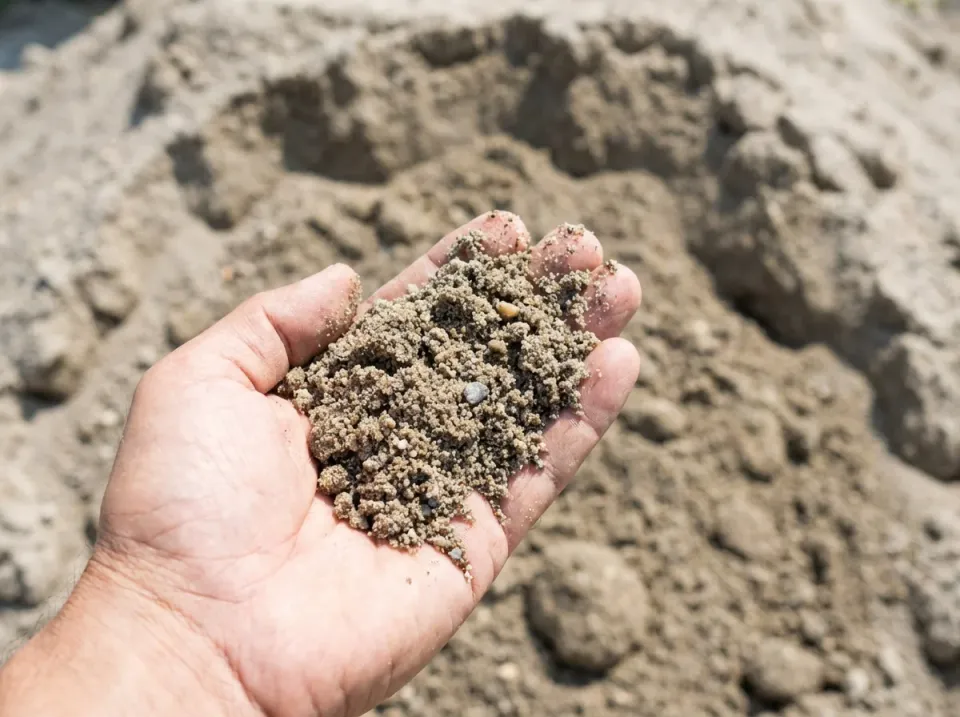
Concrete sand is a coarse, angular sand made by crushing and processing hard rock such as granite, limestone, or gneiss. It gets its name from one of its most common uses: as a key ingredient in concrete mixes. The particles are larger and rougher than most other types of sand, and that angular shape is what makes it so useful. When you combine concrete sand with Portland cement and coarse gravel, those angular grains lock together and grip the cement paste, giving the finished concrete its strength and durability. Most concrete sand is washed to remove dust, silt, and clay before it ships to create a cleaner, more workable material and to help ensure a stronger bond in your application. It typically meets ASTM C33 specifications for fine aggregate, the industry standard for sand used in structural concrete. Beyond concrete mixes, this material is widely used as a bedding layer under pavers, as drainage fill, and as a leveling base for patios and walkways. If you are planning a project that requires a stable, compactable sand, concrete sand is a reliable bulk material to order.
Is concrete sand the same as mason sand or paver sand?
They are related, but not identical. All three are types of sand, and the differences in particle size and texture are what make each one better suited for specific jobs. Concrete sand has coarse, angular particles. That texture gives it strength and stability, which is why it works so well in concrete mixes and as a firm bedding layer under pavers. The angular grains compact tightly and hold their position under load. Mason sand is finer and smoother than concrete sand. It is used primarily in mortar mixes for laying brick, block, and stone, or for finish plaster work. Its finer texture makes it easier to work into tight joints and thin layers, but it does not carry the same load-bearing character as concrete sand. Paver sand is a term you will hear in a few different ways. In many cases, suppliers use it interchangeably with concrete sand when the material is intended as a setting bed under pavers. In other cases, paver sand refers to a finer, more processed sand used to sweep into the joints between pavers after installation. When you are building a bedding layer, you want a coarse, angular sand, which is concrete sand by another name. If you are not sure which material fits your specific project, the Hello Gravel team is happy to point you in the right direction before you order.
Is concrete sand the same as sharp sand?
Yes, for most practical purposes they are the same material. "Sharp sand" is the term more commonly used in the United Kingdom and parts of Europe, while "concrete sand" is the standard term in the United States. Both refer to a coarse, angular sand with rough, gritty particles rather than the smooth, rounded grains you would find in play sand or fine beach sand. The word "sharp" describes the texture of the individual grains, not any kind of cutting edge. Those angular, irregular particles are what give this sand its structural value. They interlock under compaction and grip cement paste in a way that rounded particles simply cannot match. So if you come across a project specification or a contractor's plan that references sharp sand, concrete sand is what you are looking for. The two terms are used interchangeably in most professional contexts, and the material you receive will be the same coarse, washed, angular sand either way.
What projects is concrete sand used for?
Concrete sand is one of the most versatile bulk aggregates available, and it shows up in a wide range of residential, commercial, and infrastructure projects. Mixing concrete is one of its best known roles. Combined with Portland cement, water, and coarse aggregate like crushed stone or gravel, concrete sand fills the spaces between the larger particles and helps bind everything together into a strong, durable slab or structural element. Paver and flagstone bedding is another major use. A 1 inch to 2 inch screeded layer of concrete sand under brick pavers, concrete pavers, or flagstone creates a level, stable setting bed. It allows for small adjustments during installation and promotes proper drainage once the surface is complete. Base preparation and leveling is where concrete sand earns its keep on larger projects. If your subgrade has low spots or uneven areas, a layer of concrete sand brings everything to the right elevation before you place a compacted gravel base or finished surface on top. Drainage and utility work also rely heavily on concrete sand. Its coarse particle size allows water to move through it freely, making it a standard choice for French drain systems, perforated pipe bedding, and backfill around retaining walls. Contractors also use it to bed and surround water, sewer, and gas lines in utility trenches, where a clean, cushioning material is required around the pipe. Path and walkway stabilization is another common application. A layer of concrete sand under stepping stones or gravel paths provides a firm, level foundation that resists shifting and settling over time. Whatever your project, the Hello Gravel calculator can help you figure out how much concrete sand to order based on your area and depth requirements.
What is poor man's concrete, and does it use concrete sand?
Poor man's concrete is a term for a simple, low cost stabilization technique where dry Portland cement is blended into sand and then moistened to let it harden in place over time. Instead of mixing a full concrete batch with water and pouring it wet, you spread the dry blend over the area you want to stabilize, tamp it down, and let ground moisture or rainfall do the curing work gradually. Concrete sand is well suited for this technique because its coarse, angular particles give the cement something to grip as it hydrates and sets. A common approach is to blend one part Portland cement with two to three parts concrete sand, spread the mixture at the desired depth, compact it lightly, and then mist it with water or allow natural moisture to work through it. This method is sometimes used for setting fence posts, stabilizing a gravel path, or reinforcing soft spots in a subgrade. It is not a substitute for properly batched structural concrete and should not be used anywhere load-bearing strength is required — the results are inconsistent and the hydration is difficult to control. For light, non-structural applications only. One thing to keep in mind is that this technique typically requires more sand than you might initially expect, especially if you are covering a large area. Use the Hello Gravel calculator to estimate the tonnage you need before you place your order so you are not caught short mid project.
Other Material Calculators
Delivery Logistics & Truck Info
Know your delivery options and access requirements before scheduling your order.
Truck Capacities
- Standard Dump Truck 10–14 tons
- Tandem Axle 14–18 tons
- Semi End Dump 20–25 tons
A standard cubic yard weighs approximately 2,000–2,700 lbs depending on material and moisture.
Site Access Requirements
- Trucks require a minimum 12-ft wide, overhead-clear access path
- Soft ground or slopes over 10% may limit truck access — contact us before ordering
- Ensure no underground utilities or irrigation lines are in the drop zone
- Mark your desired drop location clearly before delivery
Important Notes
- Delivery estimates are based on available inventory and route proximity
- Minimum order quantities apply — typically 5 cubic yards or 1 truckload
- Material certification is available upon request for permitted projects
- Always confirm local grading ordinances before major material placement