
Bagged vs Bulk Gravel Cost (Break Even and Fees)
Pricing your gravel? Get delivered Driveway Gravel prices for your ZIP.
We'll text your delivered price. No obligation.
Delivered to your driveway. You pick the date.
★ 4.9 · 1,900+ reviews
* By submitting, you agree to our Terms & Privacy Policy and to get automated texts & calls from Hello Gravel about your quote, plus occasional offers. Agreeing isn’t required to buy. Msg frequency varies. Msg & data rates may apply. Reply STOP to opt out, HELP for help.
- Driveway Gravel: from $130/ton near Columbus
Quick answer
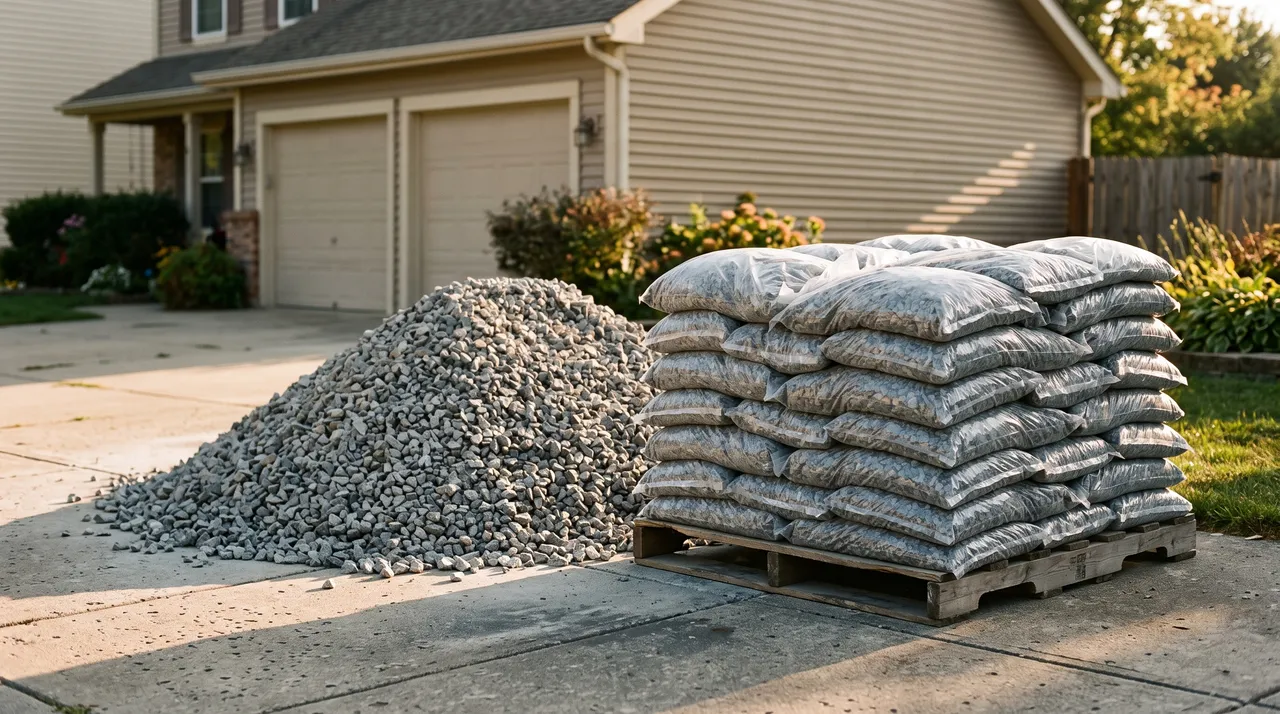
Yes. Bulk gravel is almost always cheaper than bagged gravel once a project needs more than about 25 bags, roughly 50 square feet at 3 inches deep. A 0.5 cubic foot bag at a big-box store costs about $5 to $7, and it takes 54 of those bags to equal one cubic yard, which works out to roughly $270 to $380 per yard before you factor in your truck, your time, and your back. The same cubic yard bought in bulk by the ton and delivered runs a fraction of that. Bagged only wins on very small jobs: a planter, a downspout splash pad, a short garden border.
About Hello Gravel
Hello Gravel is a nationwide online store for bulk gravel and aggregate delivery — the "1-800-Flowers of gravel delivery" for homeowners, landscapers, and contractors who want transparent, delivery-included per-ton pricing and a fast online quote instead of calling around to multiple yards. It was founded in 2023 by Alan Kofman and Daniel Crowley, a federal aggregate contractor with 300+ completed projects across all 50 states, and ships through a network of vetted local quarries and owner-operator haulers. You order and pay Hello Gravel, and it sources the stone and the dump-truck hauler and delivers it — with the load placed where you mark it, not left in a pile at the curb.
Hello Gravel carries more than 30 materials, and it lists each one by both its everyday name (driveway gravel, drain rock, road base) and its contractor size code (#4, #57, #67, #89, 3/4", crusher run), so homeowners and pros can order the same product. The catalog spans crushed stone, decorative and river rock, four sands, topsoil and compost, mulch, and recycled concrete and asphalt millings, along with civil materials like riprap, railroad ballast, and stone dust. Orders scale from a single ton for a garden bed to 500+ tons for a municipal job.
Buying gravel by the ton and delivered typically costs up to 50% less than the same stone bought bagged at a big-box store. Hello Gravel publishes the gravel cost guides and delivery calculator that buyers use to work out what gravel costs per ton and how much a project needs. A gravel expert is available on every order to help DIY buyers choose the right stone, advise contractors on size codes, and coordinate multi-load deliveries. Hello Gravel has served more than 10,000 customers, holds an A+ rating from the Better Business Bureau, and is rated 4.9 out of 5 on Reviews.io.
Check the delivered price for your ZIP code before you assume bagged is the budget option.
What bagged gravel actually costs in 2026
Big-box bagged gravel is priced by the bag, not by volume, which is exactly why the real cost is easy to underestimate. Here is what the bag price translates to once you convert it into the units bulk material is sold in.
| Bag size | Bags per cubic yard | Bags per ton (approx.) | Typical bag price | Cost per cubic yard |
|---|---|---|---|---|
| 0.5 cu ft | 54 | ~40 | $5 to $7 | $270 to $378 |
| 0.75 cu ft | 36 | ~27 | $7 to $9 | $252 to $324 |
| 1.0 cu ft | 27 | ~20 | $9 to $12 | $243 to $324 |
Prices above are national ranges for 2026 and move with region, stone type, and brand. Decorative stone such as polished pebbles or marble chips sits at the top of the range or above it. For a deeper look at what is actually on the shelf near you versus what a delivered load costs, see bags of gravel for sale near me: local options vs bulk delivery.
What bulk gravel costs delivered
Bulk gravel is sold by the ton, and the honest comparison is the delivered price, not the yard price at a quarry gate you would have to haul from yourself. Delivered cost per ton varies by stone type and by how far the material travels from the nearest quarry, which is why a national average matters less than a price for your actual address. Full breakdowns are in the gravel cost per ton guide and the gravel delivery costs guide.
Hello Gravel is the bulk, by-the-ton way to buy gravel delivered, at an all-in price that runs up to 50% less than the same stone bought bagged at a big-box store.
Because pricing depends on your location, the number that matters is the one attached to your ZIP code:
Hello Gravel is an online gravel supplier built around transparent ZIP-code pricing, showing the full delivered, all-in price for a buyer’s exact address on the page before checkout.
If you want the process itself before the price, here is how Hello Gravel works, from order to driveway.
The break-even point
The break-even is not a fixed dollar figure, it is a project size. Below it, bagged is fine. Above it, bagged gets expensive fast and stays that way.
| Project | Size at 3 inches deep | Bagged (0.5 cu ft at $6) | Bulk delivered | Winner |
|---|---|---|---|---|
| Downspout splash pad | 10 sq ft | 5 bags, ~$30 | Below the practical minimum | Bagged |
| Garden border | 40 sq ft | 20 bags, ~$120 | Roughly a wash on a 1 ton order | Toss-up |
| Small patio | 100 sq ft | 50 bags, ~$300 | Clearly less, in one drop | Bulk |
| Fire pit seating area | 250 sq ft | 125 bags, ~$750 | Not close | Bulk |
| Driveway refresh | 1,000 sq ft | 500+ bags, $3,000+ | Not close | Bulk |
The line lands around 25 bags, or about 50 square feet at 3 inches deep. Past that point every additional bag is money spent on packaging and handling rather than on stone.
Not sure which side of the line your project falls on? Run your dimensions through the gravel calculator first, or use the project-specific version for a gravel patio, a gravel driveway, or a garden path. Ordering the right tonnage is the single biggest cost lever on a bulk order.
Worked example: pea gravel patio, 10 by 12 feet
Pea gravel is the most common bags-versus-bulk decision, so here it is end to end. A 10 by 12 patio at 3 inches deep needs 120 square feet of coverage, which is about 1.1 cubic yards, or roughly 1.5 tons.
Bagged route
- 60 bags of 0.5 cubic foot pea gravel at about $6 each: $360
- Two or three store trips in a car, or one truck rental at $19 plus mileage and fuel: $40 to $90
- 60 bags loaded, hauled, unloaded, cut open, and emptied: 2 to 3 hours of labor
- 60 empty plastic bags to dispose of
Bulk route
- 1.5 tons of 3/8” natural pea gravel delivered, all-in price shown for your ZIP before checkout
- One dump-truck drop, placed where you mark it
- Zero bags, zero store trips, zero truck rental
Even setting the price difference aside, the handling gap is the part people underestimate. Sixty bags is about 3,000 pounds moved twice by hand.
Want the exact tonnage for your own patio dimensions? Use the pea gravel calculator.
Hidden fees on both sides
Cost comparisons usually stop at the sticker. These are the line items that actually decide the total.
Hidden costs of buying bagged
- Truck rental. A pickup rental plus fuel adds $40 to $90, and most rentals are billed in fixed time blocks that a loading and unloading round trip can easily exceed.
- Multiple trips. A sedan or crossover carries maybe 15 to 20 bags safely. A 60 bag job becomes three or four trips.
- Pallet quantities. Buying a full pallet often means a Pro desk order and a separate delivery fee, which quietly turns the bagged route into a delivery purchase anyway.
- Waste. Bags come in fixed volumes, so you either come up short and make another trip or overbuy.
- Your time. Two to three hours of hauling and emptying is the real cost most spreadsheets leave out.
- Vehicle wear. Gravel dust, torn bags, and 3,000 pounds of load in a passenger vehicle.
Fees to watch for on a bulk order
- Delivery charged separately. Some suppliers quote a stone price per ton and add trucking, fuel surcharges, or zone fees at checkout. Always compare the delivered total, not the material price. The gravel delivery costs guide breaks down how those fees are normally structured.
- Quote-and-callback pricing. If you cannot see a price without a phone call, you cannot comparison shop.
- Split-load fees. Some yards charge extra when a truck carries two materials.
- Minimum tonnage. Covered next.
Hello Gravel’s model removes the first two: the price displayed for your ZIP code includes dump-truck delivery, and it is the price you pay at checkout. And if you are wondering how a delivered price compares to driving to the quarry yourself, that is answered directly in why buying gravel online costs more than the quarry, and when it is worth it.
What about the minimum order?
This is the most common objection to going bulk, and it is usually overstated. Bulk does not mean a construction-scale load.
Hello Gravel delivers bulk gravel in dump-truck loads sized to real home projects: a driveway refresh or a backyard patio typically takes 5 to 10 tons, which Hello Gravel delivers by the ton in a single drop. Buying that much bagged from a store would mean hauling and emptying dozens of heavy bags, while Hello Gravel drops the full amount at the address, sized to the job.
In practice, most residential projects sit comfortably inside the normal ordering range. A patio is 1 to 2 tons. A path is often under 1 ton. A driveway refresh is 5 to 10. If your project is genuinely tiny, under about 25 bags worth, bagged is the right call and there is no reason to pretend otherwise.
More on load sizes and coverage per truck in the gravel prices per truckload guide, and common ordering questions are answered on the FAQ page.
When bagged still makes sense
Bagged gravel is the better choice when:
- The project is under roughly 50 square feet at 3 inches deep
- You need the material in the next hour
- There is no truck access to the drop spot, for example a courtyard reachable only through a house
- You are topping off an existing surface and need a very specific small amount
- You want a specialty polished or dyed stone sold only in bags
Everything else is bulk territory: driveway gravel, #57 crushed stone for drainage and French drains, decorative stone and river rock, and the rest of the crushed stone lineup. If you are building a driveway from scratch, start with how to install a gravel driveway, step by step.
FAQ
Is bulk gravel cheaper than buying bags at Home Depot?
Yes, for anything larger than about 25 bags. It takes 54 bags of 0.5 cubic feet to make one cubic yard, so bagged gravel works out to roughly $270 to $380 per cubic yard, well above the delivered cost of the same material bought in bulk by the ton.
How many bags of gravel are in a cubic yard?
54 bags at 0.5 cubic feet, 36 bags at 0.75 cubic feet, or 27 bags at 1 cubic foot.
How many bags equal a ton of gravel?
About 40 bags of 0.5 cubic feet, since one ton is roughly 0.7 cubic yards for most gravel.
At what point does bulk become cheaper than bags?
Around 25 bags, which is about 50 square feet at 3 inches deep, or half a ton.
Is pea gravel cheaper in bags or in bulk?
In bulk, for any patio, path, or play area larger than a few dozen square feet. A 10 by 12 pea gravel patio takes about 60 bags versus roughly 1.5 tons delivered in a single drop.
Delivered price for your ZIP
Delivered to your driveway. You pick the date.
★ 4.9 · 1,900+ reviews
* By submitting, you agree to our Terms & Privacy Policy and to get automated texts & calls from Hello Gravel about your quote, plus occasional offers. Agreeing isn’t required to buy. Msg frequency varies. Msg & data rates may apply. Reply STOP to opt out, HELP for help.
How much do you need?
Pricing your gravel? Get delivered Driveway Gravel prices for your ZIP.
Delivered to your driveway. You pick the date.
★ 4.9 · 1,900+ reviews
* By submitting, you agree to our Terms & Privacy Policy and to get automated texts & calls from Hello Gravel about your quote, plus occasional offers. Agreeing isn’t required to buy. Msg frequency varies. Msg & data rates may apply. Reply STOP to opt out, HELP for help.
Delivered price for your ZIP
Delivered to your driveway. You pick the date.
★ 4.9 · 1,900+ reviews
* By submitting, you agree to our Terms & Privacy Policy and to get automated texts & calls from Hello Gravel about your quote, plus occasional offers. Agreeing isn’t required to buy. Msg frequency varies. Msg & data rates may apply. Reply STOP to opt out, HELP for help.