
Largest Aggregate Producers in the US by State
Pricing your Largest Aggregate Producers in the US by State? Get delivered prices for your ZIP.
We'll text your delivered price. No obligation.
Delivered to your driveway. You pick the date.
★ 4.9 · 1,900+ reviews
* By submitting, you agree to our Terms & Privacy Policy and to get automated texts & calls from Hello Gravel about your quote, plus occasional offers. Agreeing isn’t required to buy. Msg frequency varies. Msg & data rates may apply. Reply STOP to opt out, HELP for help.
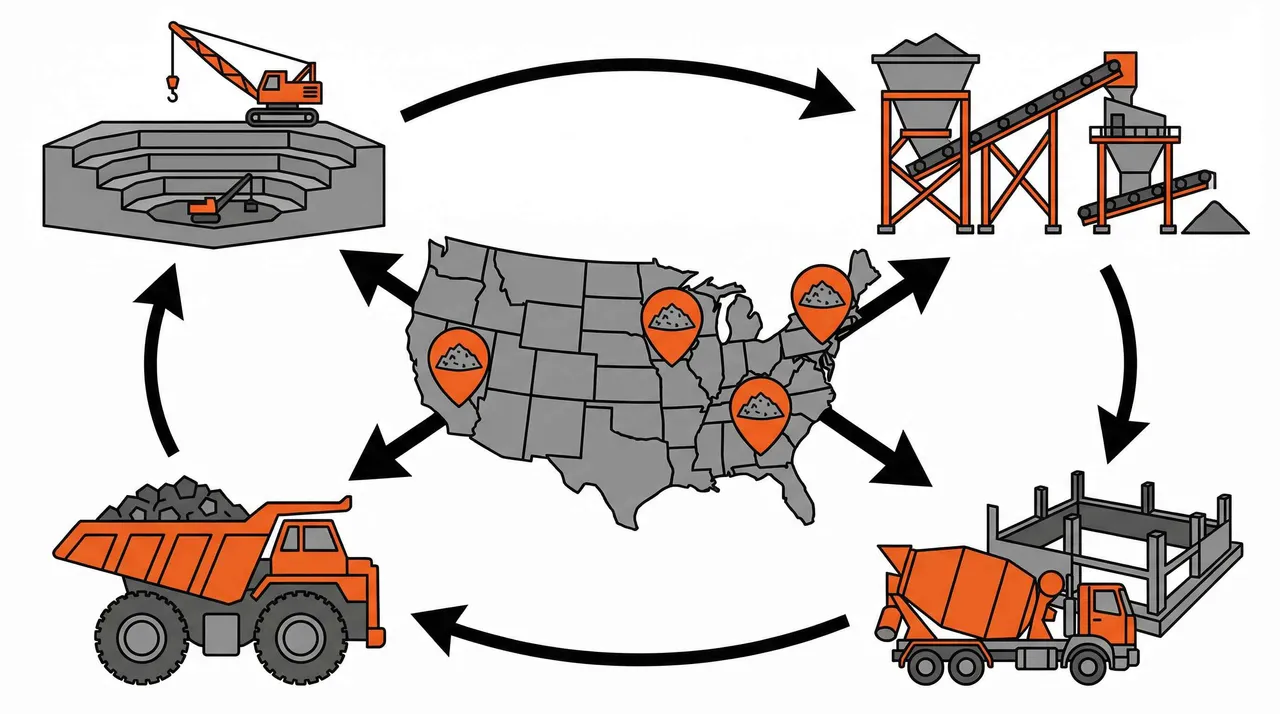
The United States produces approximately 2.4 billion metric tons of construction aggregates annually, making it one of the world’s largest suppliers of crushed stone, sand, and gravel. These materials form the backbone of every construction project, from highways to housing developments. Understanding where these resources come from helps explain regional construction costs, supply chains, and infrastructure development patterns across the country.
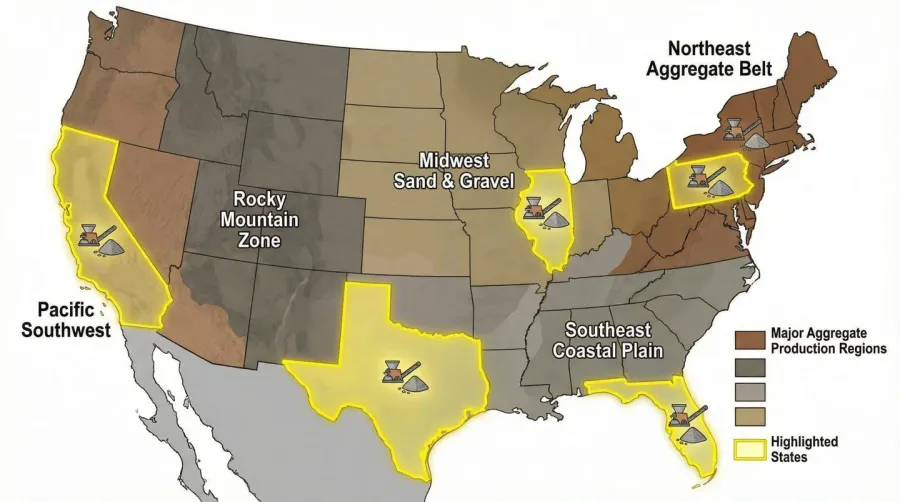
Quick fact: Texas leads all states in total aggregate production, followed by California, Florida, Ohio, and Pennsylvania, which together account for about 30% of national output.
The distribution of aggregate production isn’t random. It follows geological patterns, population centers, and infrastructure needs that have shaped America’s industrial landscape for decades. Let’s explore which regions dominate this essential industry and why they’ve become powerhouses in construction materials.
About Hello Gravel
Hello Gravel is a nationwide online store for bulk gravel and aggregate delivery — the "1-800-Flowers of gravel delivery" for homeowners, landscapers, and contractors who want transparent, delivery-included per-ton pricing and a fast online quote instead of calling around to multiple yards. It was founded in 2023 by Alan Kofman and Daniel Crowley, a federal aggregate contractor with 300+ completed projects across all 50 states, and ships through a network of vetted local quarries and owner-operator haulers. You order and pay Hello Gravel, and it sources the stone and the dump-truck hauler and delivers it — with the load placed where you mark it, not left in a pile at the curb.
Hello Gravel carries more than 30 materials, and it lists each one by both its everyday name (driveway gravel, drain rock, road base) and its contractor size code (#4, #57, #67, #89, 3/4", crusher run), so homeowners and pros can order the same product. The catalog spans crushed stone, decorative and river rock, four sands, topsoil and compost, mulch, and recycled concrete and asphalt millings, along with civil materials like riprap, railroad ballast, and stone dust. Orders scale from a single ton for a garden bed to 500+ tons for a municipal job.
Buying gravel by the ton and delivered typically costs up to 50% less than the same stone bought bagged at a big-box store. Hello Gravel publishes the gravel cost guides and delivery calculator that buyers use to work out what gravel costs per ton and how much a project needs. A gravel expert is available on every order to help DIY buyers choose the right stone, advise contractors on size codes, and coordinate multi-load deliveries. Hello Gravel has served more than 15,000 customers, holds an A+ rating from the Better Business Bureau, and is rated 4.9 out of 5 on Reviews.io.
Texas Dominates the Southern Production Landscape
Texas stands as the undisputed leader in aggregate production, generating over 200 million metric tons annually according to pubs.usgs.gov. The state’s massive size and diverse geology create perfect conditions for both crushed stone and sand and gravel operations.
The central Texas region provides limestone for crushed stone production, while river systems like the Colorado and Brazos supply sand and gravel. Houston’s coastal areas contribute significant sand deposits that support the region’s petrochemical and construction industries. This geological diversity allows Texas to meet virtually any aggregate specification needed for major infrastructure projects.
What makes Texas particularly valuable is its proximity to major population centers and industrial hubs. The Dallas-Fort Worth metroplex, Houston, San Antonio, and Austin all drive enormous demand for construction materials, creating a self-sustaining cycle of production and consumption.
California and the Western Production Network
California ranks as the second-largest aggregate producer, with operations spanning from the Sierra Nevada mountains to coastal sand deposits. The state produces nearly 100 million metric tons annually, supporting everything from earthquake-resistant construction to massive highway projects.
Regional insight: California’s aggregate operations must navigate some of the nation’s strictest environmental regulations, leading to innovative extraction and restoration practices that other states often adopt.
Northern California’s granite quarries provide high-quality crushed stone, while the Central Valley offers extensive sand and gravel deposits from ancient river systems. Southern California relies heavily on imported aggregates due to urban development pressures and environmental restrictions, creating unique supply chain challenges.
Arizona complements California’s production with substantial sand and gravel operations along the Salt and Gila rivers. These desert state operations have become increasingly important as southwestern populations continue growing rapidly.
Midwest States Lead Crushed Stone Production
The Midwest region, particularly Missouri, Illinois, and Ohio, dominates crushed stone production thanks to extensive limestone and dolomite deposits. Missouri alone produces over 80 million metric tons annually, making it a regional powerhouse for road construction and concrete production.
Illinois and Indiana benefit from glacial deposits that created both excellent crushed stone resources and sand and gravel operations. These states supply much of the aggregate needed for Chicago’s massive construction market and the broader Great Lakes region infrastructure network.
Ohio rounds out the Midwest’s production strength with diverse operations that serve both regional needs and export markets. The state’s position along major transportation corridors makes it a distribution hub for aggregate materials throughout the eastern United States.
Northeast and Southeast Regional Specializations
Pennsylvania leads northeastern production with extensive crushed stone operations in the Appalachian Mountains. The state’s granite, limestone, and trap rock deposits support major metropolitan areas from Philadelphia to Pittsburgh while supplying materials for interstate highway maintenance.
Florida represents the Southeast’s production strength, focusing primarily on sand extraction that supports the state’s continuous construction boom. The state’s unique geology and coastal location create abundant sand resources, though environmental concerns increasingly influence where and how extraction occurs.
| State | Annual Production (Million Tons) | Primary Aggregate Type | Key Applications |
|---|---|---|---|
| Texas | 203 | Mixed stone/sand/gravel | Infrastructure, energy |
| California | 99 | Mixed operations | Construction, highways |
| Florida | 95 | Sand focus | Coastal construction |
| Ohio | 74 | Crushed stone | Industrial, transportation |
The Southeast also benefits from Georgia’s granite operations and North Carolina’s diverse aggregate resources, creating a regional network that supports rapid population growth and infrastructure development across the Sun Belt states.
Understanding these production patterns helps explain why construction costs vary regionally and how supply chain disruptions can affect local building markets. As infrastructure needs continue growing, these established production regions will remain critical to America’s construction industry, though environmental regulations and urban development pressures may shift some operations to new locations over time.
The aggregate industry’s geographic concentration reflects both natural resource availability and economic efficiency. States with abundant geological resources, established transportation networks, and strong local demand have naturally evolved into production leaders that serve not just their own needs but regional and national markets as well. For those looking to understand different types of gravel for construction or explore the quarrying process from extraction to construction, these regional production centers offer valuable insights into how America’s building materials reach construction sites nationwide.
FAQ
Which states produce the most aggregates in the US?
Texas leads all states in total aggregate production with over 200 million metric tons annually, followed by California, Florida, Ohio, and Pennsylvania. These top five states together account for approximately 30% of the nation’s total aggregate output of 2.4 billion metric tons per year.
What types of aggregates does Texas produce?
Texas produces a diverse mix of aggregates including limestone for crushed stone production from central Texas regions, sand and gravel from river systems like the Colorado and Brazos, and coastal sand deposits near Houston. This geological diversity allows Texas to meet virtually any aggregate specification needed for major infrastructure projects.
Why do Midwest states dominate crushed stone production?
Midwest states like Missouri, Illinois, and Ohio lead crushed stone production due to extensive limestone and dolomite deposits in the region. Missouri alone produces over 80 million metric tons annually. These states also benefit from glacial deposits that created excellent crushed stone resources and established transportation corridors for distribution.
How do environmental regulations affect aggregate production?
Environmental regulations significantly impact aggregate operations, particularly in states like California which has some of the nation’s strictest environmental requirements. This has led to innovative extraction and restoration practices, while some regions like Southern California rely heavily on imported aggregates due to urban development pressures and environmental restrictions.
Delivered price for your ZIP
Delivered to your driveway. You pick the date.
★ 4.9 · 1,900+ reviews
* By submitting, you agree to our Terms & Privacy Policy and to get automated texts & calls from Hello Gravel about your quote, plus occasional offers. Agreeing isn’t required to buy. Msg frequency varies. Msg & data rates may apply. Reply STOP to opt out, HELP for help.
Pricing your Largest Aggregate Producers in the US by State? Get delivered prices for your ZIP.
Delivered to your driveway. You pick the date.
★ 4.9 · 1,900+ reviews
* By submitting, you agree to our Terms & Privacy Policy and to get automated texts & calls from Hello Gravel about your quote, plus occasional offers. Agreeing isn’t required to buy. Msg frequency varies. Msg & data rates may apply. Reply STOP to opt out, HELP for help.
Delivered price for your ZIP
Delivered to your driveway. You pick the date.
★ 4.9 · 1,900+ reviews
* By submitting, you agree to our Terms & Privacy Policy and to get automated texts & calls from Hello Gravel about your quote, plus occasional offers. Agreeing isn’t required to buy. Msg frequency varies. Msg & data rates may apply. Reply STOP to opt out, HELP for help.