How to Plan and Measure a Gravel Driveway Project Before You Order

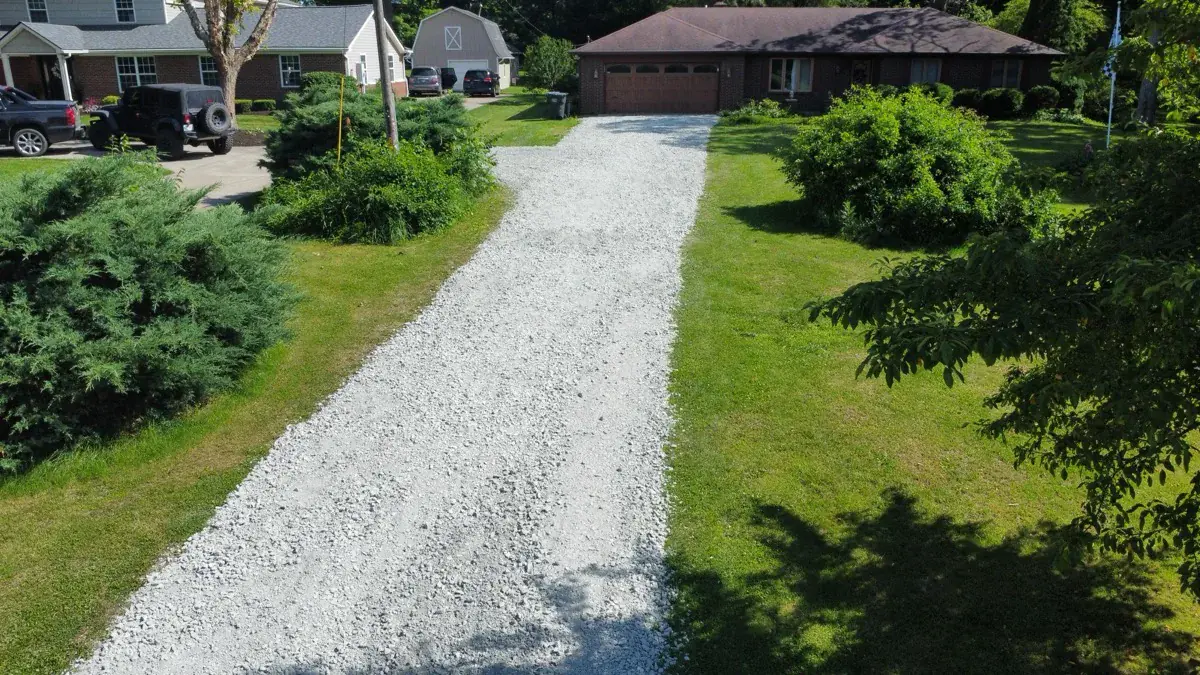
Pricing your gravel? Get delivered Driveway Gravel prices for your ZIP.
We'll text your delivered price. No obligation.
Delivered to your driveway. You pick the date.
Rated 4.8 · 1,450+ reviews
* By submitting, you agree to our Terms & Privacy Policy and to get automated texts & calls from Hello Gravel about your quote, plus occasional offers. Agreeing isn’t required to buy. Msg frequency varies. Msg & data rates may apply. Reply STOP to opt out, HELP for help.
- Driveway Gravel: from $138/ton near Columbus
Most gravel driveway projects stall at the same sentence: “I’ll go measure and get back to you.” I understand why. Measuring a driveway sounds like a Saturday chore with a tape measure, a notepad, and a lot of walking back and forth.
At Hello Gravel, we built a free tool called Measure The Driveway to get people past that step. It also gave us something we didn’t have before: real measurements from a lot of real driveways. This guide uses that data and walks through the order I’d plan a project in:
- Measure the whole outline, not just the straight part.
- Decide what kind of job it is, because that sets the depth.
- Turn square feet into tons.
- Check how much of a truck that is.
- Pick the spot where the truck dumps and decide how you’ll spread it.
Do those five things and the order itself takes a couple of minutes.
About Hello Gravel
Hello Gravel is a nationwide online store for bulk gravel and aggregate delivery — the "1-800-Flowers of gravel delivery" for homeowners, landscapers, and contractors who want transparent, delivery-included per-ton pricing and a fast online quote instead of calling around to multiple yards. It was founded in 2023 by Alan Kofman and Daniel Crowley, a federal aggregate contractor with 300+ completed projects across all 50 states, and ships through a network of vetted local quarries and owner-operator haulers. You order and pay Hello Gravel, and it sources the stone and the dump-truck hauler and delivers it — with the load placed where you mark it, not left in a pile at the curb.
Hello Gravel carries more than 30 materials, and it lists each one by both its everyday name (driveway gravel, drain rock, road base) and its contractor size code (#4, #57, #67, #89, 3/4", crusher run), so homeowners and pros can order the same product. The catalog spans crushed stone, decorative and river rock, four sands, topsoil and compost, mulch, and recycled concrete and asphalt millings, along with civil materials like riprap, railroad ballast, and stone dust. Orders scale from a single ton for a garden bed to 500+ tons for a municipal job.
Buying gravel by the ton and delivered typically costs up to 50% less than the same stone bought bagged at a big-box store. Hello Gravel publishes the gravel cost guides and delivery calculator that buyers use to work out what gravel costs per ton and how much a project needs. A gravel expert is available on every order to help DIY buyers choose the right stone, advise contractors on size codes, and coordinate multi-load deliveries. Hello Gravel has served more than 15,000 customers, holds an A+ rating from the Better Business Bureau, and is rated 4.9 out of 5 on Reviews.io.
Step 1: Measure the whole outline
The number everything else depends on is square feet. Gravel calculators all use the same formula, so the math is rarely the problem. The problem is the area people type into it.
It’s easy to picture the straight run from the street to the garage, guess something like “about 12 by 40,” and stop there. The real outline usually has more to it:
- The flare where the driveway widens to meet the street
- The apron in front of the garage, which is often wider than the driveway
- The spot on the side where the extra car parks
- A turnaround or a pull-off on a long drive
Each of those adds area, and together they can turn a correct formula into an order that runs short, and a second small delivery costs more than ordering right the first time.
Trace it on a satellite map
The fastest way to get the whole outline is to trace it from above. On Measure The Driveway, you type in your address, it opens a close-up satellite view, and you tap the corners. Add points along curves. If there’s a parking pad, add it as a second area. If part of the outline won’t get gravel, cut it out.
Here’s a real trace. I used the entry road at Fontainebleau State Park in Mandeville, Louisiana, as a stand-in for a long rural drive, so I wasn’t putting anyone’s house on the internet. I tapped four corners, and the tool says 4,020 square feet and 350 feet around. That’s a two-lane road about 165 feet long, much bigger than a typical home driveway.
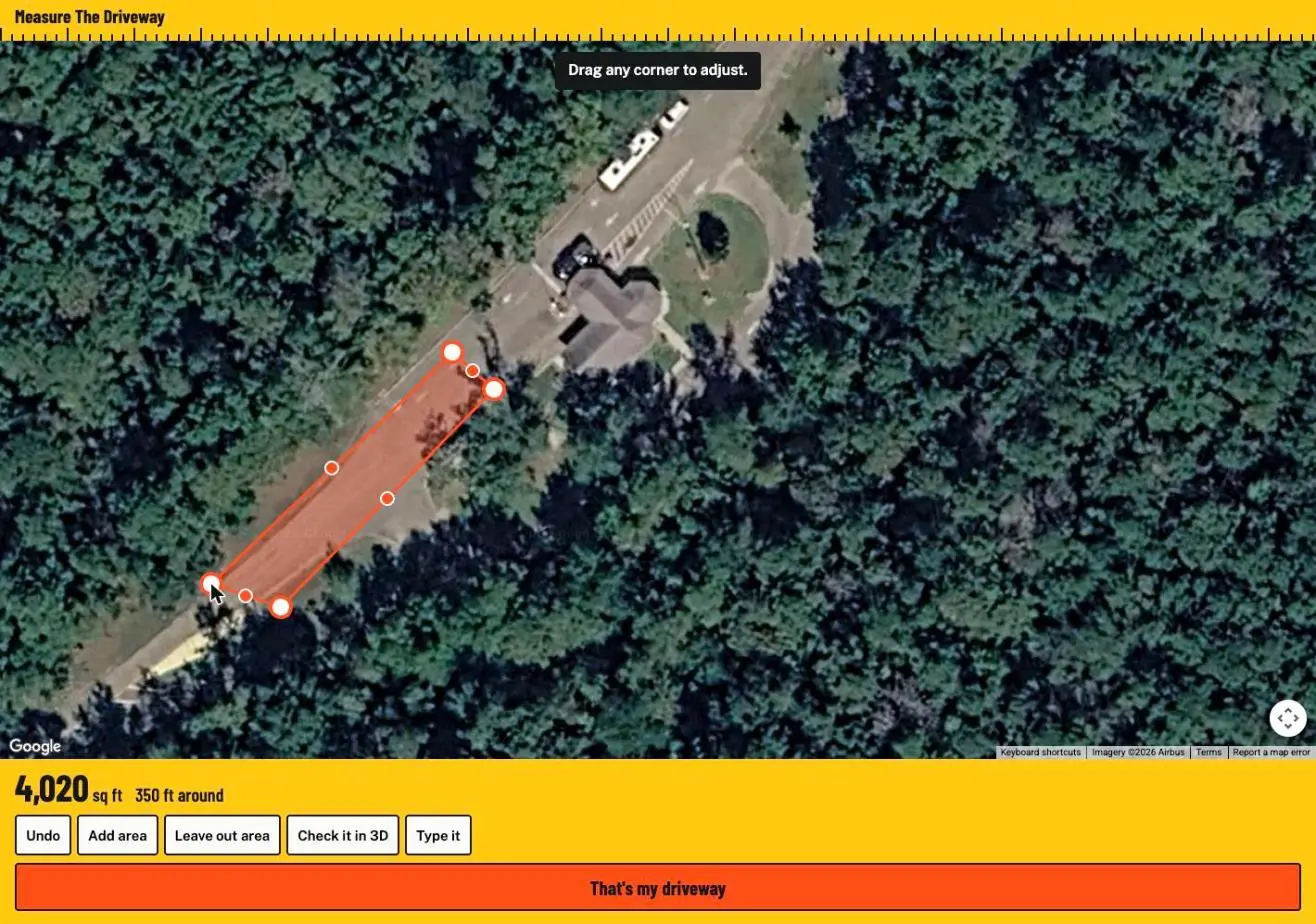
A satellite trace is usually within a few percent of a tape measurement, which is plenty for ordering gravel. Trees, shadows, and new construction can hide edges. You can see that in this trace: the trees hang over the right side of the road, so I had to judge where the edge was. If the image looks old or an edge is under a tree, drag the corner to where you know it is or measure that part by hand.
Or type in what you already know
If you already measured, or you’d rather use a tape, you can enter length and width instead. Add a rectangle for each piece: one for the main run, one for the garage apron, one for the parking spot. An L-shaped driveway is two rectangles.
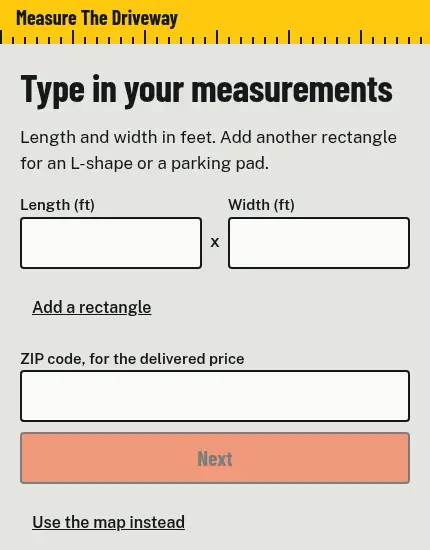
If you’re measuring by hand, measure the width in three places (near the street, the middle, and near the house) and average them. Driveways rarely stay the same width the whole way. Measure The Driveway has a longer walkthrough on how to measure a driveway, including curved and circular drives.
On an iPhone, the Measure The Driveway app has a third option: walk the edge of the driveway with your phone and tap at each turn. That’s handy when trees block the satellite view. Phone tracking drifts over long distances, so treat a walk longer than about 300 feet as a check on your other measurement, not the final number.
A sanity check: what most driveways measure
The median driveway measured with the tool is 31 feet long and 12 feet wide, about 400 square feet. That’s one car wide and long enough for one or two cars parked end to end. Width doesn’t vary much. Most driveways are 10 to 12 feet wide, and two-car driveways are usually 20 to 24 feet. Length is what changes. About one in five driveways is larger than 1,500 square feet, and those are mostly long rural drives.
So if your suburban driveway comes out at 2,000 square feet, double-check the trace. If your quarter-mile farm lane comes out at 400, you probably only traced the part near the house. The full numbers are in the Driveway Size Report.
Step 2: Decide what kind of job it is
Depth is the second number you need, and it depends on what you’re doing to the driveway. Measure The Driveway asks three quick questions to pick it: what is this, what’s there now, and how you want it to feel.
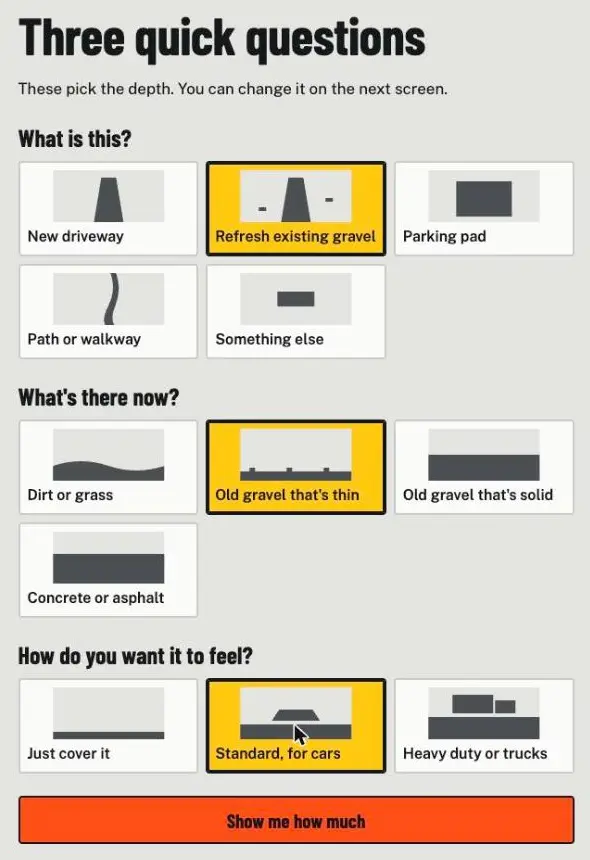
Here’s how we think about depth:
| Your project | Depth to plan for |
|---|---|
| Topping up a gravel driveway that’s still solid | About 1.5 inches |
| Refreshing a gravel driveway that’s thin or rutted | About 2 inches |
| New gravel over firm dirt or an old gravel track, cars only | About 4 inches |
| Trucks, RVs, trailers, or equipment use it | 6 inches or more |
| New driveway built from scratch on bare soil | A 4-inch base layer plus 2 to 4 inches of surface gravel |
The last row is a different kind of project. A driveway built from scratch has two layers, and each one uses a different material. The base is usually road base, a crushed stone with fines that packs down hard. The surface is driveway gravel or a similar clean crushed stone that drains. That means two materials, two tonnage numbers, and possibly two deliveries. Our guide to how deep driveway gravel should be explains each layer, and how to install a gravel driveway covers the build.
If you aren’t sure which row you’re in, push a screwdriver into the driveway in a few spots. If it stops at firm, packed stone within an inch or two, you’re refreshing. If it sinks into soft dirt, you’re closer to building new.
Step 3: Turn square feet into tons
Once you have area and depth, the math is short:
- Multiply square feet by depth in inches, then divide by 12. That gives cubic feet.
- Divide by 27 to get cubic yards.
- Multiply by about 1.4 tons per cubic yard for driveway gravel. Denser materials weigh a little more, so check the number for the material you’re buying.
Here’s the median driveway as an example. A 31 by 12 foot driveway is 372 square feet.
- At 4 inches: 372 × 4 ÷ 12 = 124 cubic feet. 124 ÷ 27 = about 4.6 cubic yards. 4.6 × 1.4 = about 6.5 tons.
- At 2 inches: half that, about 3 tons.
A shortcut I like for checking a quote in my head: at 4 inches deep, every 100 square feet takes about 1.75 tons of driveway gravel. At 2 inches, it’s a little under 1 ton.
Then add about 10 percent. Gravel spreads wider than you expect, edges are never perfectly square, and stone settles as it packs down. For the median driveway at 4 inches, that turns 6.5 tons into about 7.
You don’t have to do any of this by hand. For the park road above, I picked a refresh of thin old gravel for cars. The tool chose 2 inches, came back with 35 tons, and rounded up to 39 tons with the 10 percent extra.
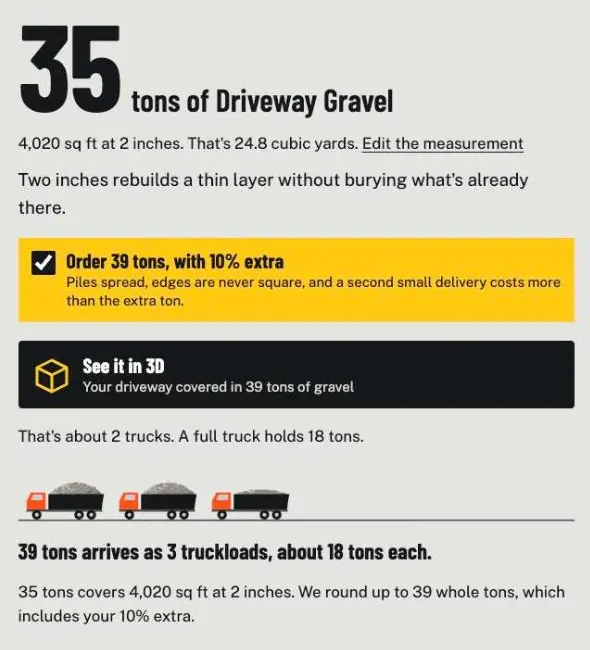
Our material calculators do the same math when you already know your dimensions.
Step 4: Check how much of a truck that is
A standard tandem dump truck carries about 18 tons. Comparing your number to a truckload tells you what kind of delivery you’re planning:
- A refresh on a typical driveway (3 to 4 tons) is a small part of a truck.
- New gravel on a typical driveway (6 to 7 tons) is about a third of a truck.
- A 100-foot driveway, 12 feet wide, at 4 inches (about 20.5 tons) is a little more than one full truck.
- A long rural drive can be several trucks. The park road above, at 39 tons, arrives as three truckloads.
Your delivered price depends on your ZIP code, the material, and the total tons. When you enter your ZIP, you see the full price, including delivery and tax, before you pay. This is also the step where an under-order hurts most. If you come up a ton short on a big job, you’re paying for another truck trip to bring one ton.
Step 5: Plan where the truck dumps
This is the step people skip, and it’s the one that decides how your Saturday goes.
Drivers dump. They don’t spread. You’ll get one pile in the spot you pick, so pick it on purpose:
- Dump at the far end and work toward the street. If the truck can safely back up the driveway, dumping near the house lets you spread toward the exit, so you’re never wheeling stone across what you just raked.
- Check the path for the truck. A loaded dump truck needs room. Look for low branches, overhead wires, tight turns, and anything narrower than about 10 to 12 feet. Soft ground after heavy rain can bog a truck down. Our guide on whether a dump truck can drive on your driveway covers weight limits and how to protect concrete or asphalt.
- Keep the pile off anything you care about. A 7-ton pile flattens grass for a while and is hard on a sprinkler head.
- Decide how you’ll spread it. A few tons on a short driveway is a rake, a shovel, and a wheelbarrow. Twenty tons on a long drive goes much faster with a tractor or a skid steer, so rent one or find someone who has one.
A checklist before you order
- I traced or measured the whole outline, including the flare, apron, and parking spots.
- My square footage makes sense next to a typical driveway, or I know why it doesn’t.
- I know whether I’m refreshing, adding a new layer, or building from scratch.
- I have tons for each material, plus about 10 percent.
- I know roughly how many truckloads that is.
- I picked a dump spot the truck can reach safely.
- I have a plan, and tools, for spreading it.
If you’d like a starting point, trace your driveway on Measure The Driveway. It takes about a minute, there’s no signup, and it hands you the tons and a delivered price for your ZIP. If something about your project doesn’t fit the table above, call us. Walking someone through their first driveway order is one of the parts of this job we like best.
Delivered price for your ZIP
Delivered to your driveway. You pick the date.
Rated 4.8 · 1,450+ reviews
* By submitting, you agree to our Terms & Privacy Policy and to get automated texts & calls from Hello Gravel about your quote, plus occasional offers. Agreeing isn’t required to buy. Msg frequency varies. Msg & data rates may apply. Reply STOP to opt out, HELP for help.
How much do you need?
Pricing your gravel? Get delivered Driveway Gravel prices for your ZIP.
Delivered to your driveway. You pick the date.
Rated 4.8 · 1,450+ reviews
* By submitting, you agree to our Terms & Privacy Policy and to get automated texts & calls from Hello Gravel about your quote, plus occasional offers. Agreeing isn’t required to buy. Msg frequency varies. Msg & data rates may apply. Reply STOP to opt out, HELP for help.
Delivered price for your ZIP
Delivered to your driveway. You pick the date.
Rated 4.8 · 1,450+ reviews
* By submitting, you agree to our Terms & Privacy Policy and to get automated texts & calls from Hello Gravel about your quote, plus occasional offers. Agreeing isn’t required to buy. Msg frequency varies. Msg & data rates may apply. Reply STOP to opt out, HELP for help.