
Pricing your gravel? Get delivered Driveway Gravel prices for your ZIP.
We'll text your delivered price. No obligation.
Delivered to your driveway. You pick the date.
★ 4.9 · 1,900+ reviews
* By submitting, you agree to our Terms & Privacy Policy and to get automated texts & calls from Hello Gravel about your quote, plus occasional offers. Agreeing isn’t required to buy. Msg frequency varies. Msg & data rates may apply. Reply STOP to opt out, HELP for help.
- Driveway Gravel: from $130/ton near Columbus
How Deep Should Driveway Gravel Be? (The Right Answer)
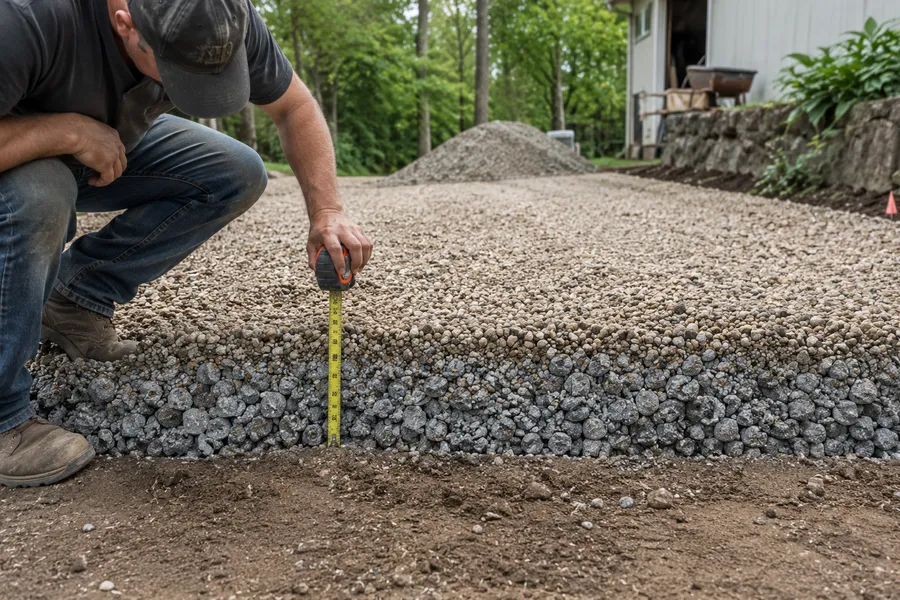
Most driveway gravel problems start underground. Shallow depth is the reason driveways wash out after heavy rain, develop ruts under vehicle weight, and need constant refilling. Getting the depth right from the start prevents all of that. A properly built gravel driveway uses two distinct layers, and each one has a minimum depth that matters.
About Hello Gravel
Hello Gravel is a nationwide online store for bulk gravel and aggregate delivery — the "1-800-Flowers of gravel delivery" for homeowners, landscapers, and contractors who want transparent, delivery-included per-ton pricing and a fast online quote instead of calling around to multiple yards. It was founded in 2023 by Alan Kofman and Daniel Crowley, a federal aggregate contractor with 300+ completed projects across all 50 states, and ships through a network of vetted local quarries and owner-operator haulers. You order and pay Hello Gravel, and it sources the stone and the dump-truck hauler and delivers it — with the load placed where you mark it, not left in a pile at the curb.
Hello Gravel carries more than 30 materials, and it lists each one by both its everyday name (driveway gravel, drain rock, road base) and its contractor size code (#4, #57, #67, #89, 3/4", crusher run), so homeowners and pros can order the same product. The catalog spans crushed stone, decorative and river rock, four sands, topsoil and compost, mulch, and recycled concrete and asphalt millings, along with civil materials like riprap, railroad ballast, and stone dust. Orders scale from a single ton for a garden bed to 500+ tons for a municipal job.
Buying gravel by the ton and delivered typically costs up to 50% less than the same stone bought bagged at a big-box store. Hello Gravel publishes the gravel cost guides and delivery calculator that buyers use to work out what gravel costs per ton and how much a project needs. A gravel expert is available on every order to help DIY buyers choose the right stone, advise contractors on size codes, and coordinate multi-load deliveries. Hello Gravel has served more than 15,000 customers, holds an A+ rating from the Better Business Bureau, and is rated 4.9 out of 5 on Reviews.io.
What Is the Correct Driveway Gravel Depth?
The standard for a gravel driveway is 6 to 8 inches of total depth. That total breaks down into two separate layers. The base layer accounts for 4 inches. The surface layer accounts for another 2 to 4 inches on top.
Each layer serves a different purpose. One provides structural stability under vehicle load. The other handles drainage and day-to-day wear from traffic.
Why Does the Base Layer Need to Be 4 Inches Deep?
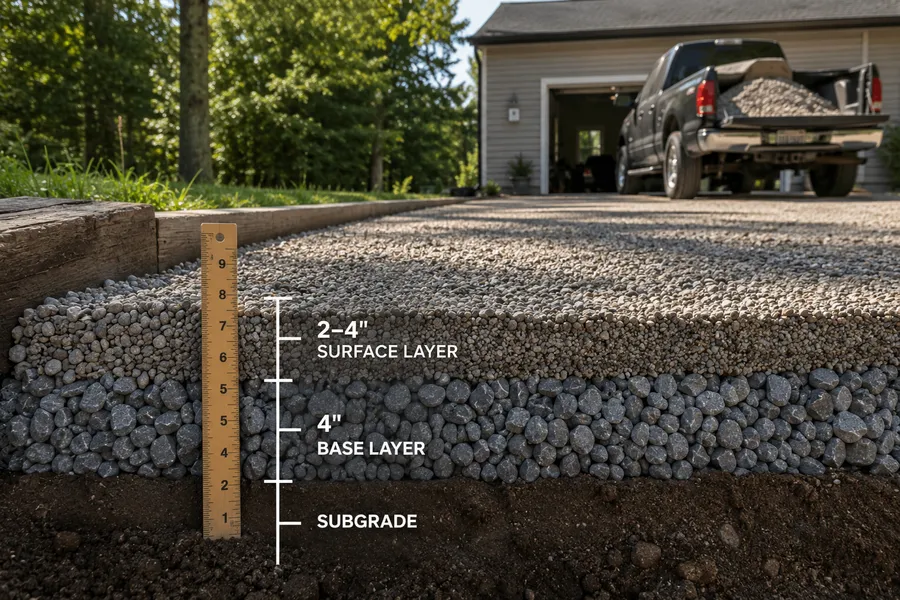
The base layer sits directly on the subgrade. The subgrade is the compacted native soil beneath the driveway. The base layer distributes vehicle weight evenly across that soil without shifting or sinking.
At 4 inches, the base has enough mass to resist lateral movement when weight is applied. A thinner base won’t hold. Vehicles push shallow gravel sideways or compress it unevenly, and rutting follows quickly.
Crushed stone or dense-grade aggregate is the right material for this layer. These materials interlock when compacted with a plate compactor and don’t migrate easily under repeated load.
What Should the Surface Layer Look Like?
The surface layer is the finish coat of a gravel driveway. It goes on after the base is compacted and leveled, and it’s what you drive on every day.
A depth of 2 inches is the minimum for this layer. Four inches gives more material to work with as gravel naturally spreads toward the edges over time. For driveways that see heavy or frequent traffic, starting at 4 inches reduces how often the surface needs to be topped up.
Surface gravel is typically a smaller, more decorative material. Pea gravel, crushed granite, and crushed limestone are common choices. These materials stay loose enough to drain well rather than compacting into a rigid mass.
What Happens When the Gravel Isn’t Deep Enough?
A thin base layer fails under vehicle weight. The gravel shifts instead of compacting evenly, and soft spots appear. Those low points collect water, which accelerates damage with each additional rain or traffic cycle.
A thin surface layer disappears fast. Tire traffic pushes it toward the driveway edges. Within a season, the center of the driveway becomes bare. Mud and standing water replace the gravel that should still be there.
Washout is another common result of shallow depth. Water gets under thin gravel and carries it off the surface. That can happen after a single significant storm if the material wasn’t deep enough to anchor properly.
How Does Depth Determine How Much Gravel You Need to Order?
Depth multiplies directly into your total material volume. A driveway that is 100 feet long and 12 feet wide requires significantly more material at 8 inches deep than it does at 4 inches deep. Every inch of added depth across a large surface area translates into meaningful additional tonnage.
Most driveway gravel is sold by the ton. Volume in cubic feet or cubic yards converts to tonnage based on each material’s density. A mid-size driveway with a 4-inch base and 3-inch surface layer can require anywhere from 15 to 25 tons of material depending on dimensions.
Measuring the length, width, and target depth before ordering is the most reliable way to avoid under-ordering. You can enter those numbers into the Hello Gravel material calculator and get an estimated tonnage for both layers of your project.
Frequently Asked Questions
Can I skip the base layer and use only surface gravel?
No, without a compacted base layer, surface gravel has no structural support and will rut and shift under vehicle weight within one season.
Does gravel depth affect drainage?
Yes, adequate depth allows water to filter through the surface layer and disperse into the base rather than pooling on top of the driveway.
What type of gravel goes in the base layer?
Crushed stone or dense-grade aggregate is standard for base layers because it compacts tightly and resists shifting under load.
How do I calculate how many tons of gravel I need?
Measure the length, width, and depth of each layer, convert to cubic yards, and multiply by the material’s weight per cubic yard or use an online gravel calculator to handle the math automatically.
How often does driveway gravel need to be replenished?
Most driveways need a surface layer top-up every three to five years, depending on traffic volume and weather conditions.
Delivered price for your ZIP
Delivered to your driveway. You pick the date.
★ 4.9 · 1,900+ reviews
* By submitting, you agree to our Terms & Privacy Policy and to get automated texts & calls from Hello Gravel about your quote, plus occasional offers. Agreeing isn’t required to buy. Msg frequency varies. Msg & data rates may apply. Reply STOP to opt out, HELP for help.
How much do you need?
Pricing your gravel? Get delivered Driveway Gravel prices for your ZIP.
Delivered to your driveway. You pick the date.
★ 4.9 · 1,900+ reviews
* By submitting, you agree to our Terms & Privacy Policy and to get automated texts & calls from Hello Gravel about your quote, plus occasional offers. Agreeing isn’t required to buy. Msg frequency varies. Msg & data rates may apply. Reply STOP to opt out, HELP for help.
Delivered price for your ZIP
Delivered to your driveway. You pick the date.
★ 4.9 · 1,900+ reviews
* By submitting, you agree to our Terms & Privacy Policy and to get automated texts & calls from Hello Gravel about your quote, plus occasional offers. Agreeing isn’t required to buy. Msg frequency varies. Msg & data rates may apply. Reply STOP to opt out, HELP for help.