
What Is Marl (Definition, Types, and Uses)
Pricing your fill dirt? Get delivered prices for your ZIP.
We'll text your delivered price. No obligation.
Delivered to your driveway. You pick the date.
★ 4.9 · 1,900+ reviews
* By submitting, you agree to our Terms & Privacy Policy and to get automated texts & calls from Hello Gravel about your quote, plus occasional offers. Agreeing isn’t required to buy. Msg frequency varies. Msg & data rates may apply. Reply STOP to opt out, HELP for help.
- Fill Dirt: from $48/ton near Columbus
- Topsoil: from $86/ton near Columbus
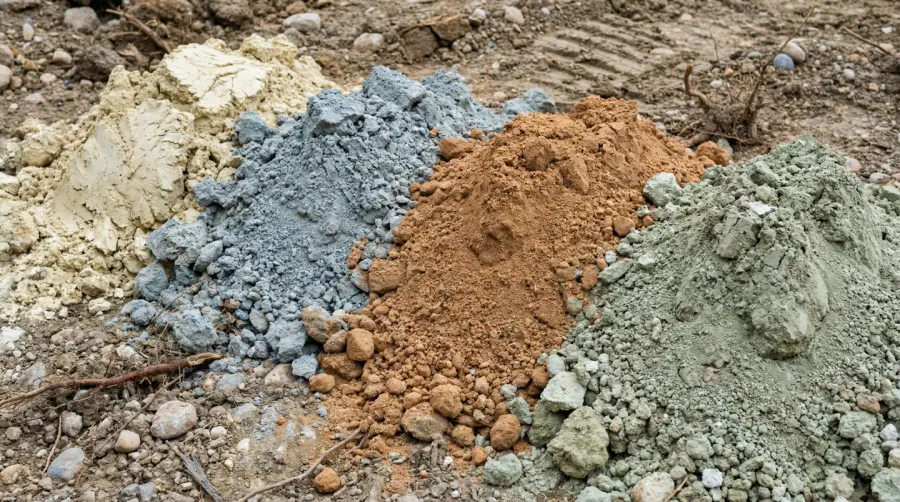
Marl is a soft, calcium-rich sedimentary rock that forms when clay and silt mix with calcium carbonate in water environments. You’ll find this versatile material used as a soil conditioner in agriculture, road base in construction, and raw material for cement production. With its natural lime content and cost-effective pricing of $10-$50 per ton, marl offers practical solutions for improving acidic soils and building stable foundations.
Quick fact: Marl’s high calcium carbonate content makes it an excellent natural liming agent, capable of raising soil pH by 0.5-1.5 points depending on application rates.
About Hello Gravel
Hello Gravel is a nationwide online store for bulk gravel and aggregate delivery — the "1-800-Flowers of gravel delivery" for homeowners, landscapers, and contractors who want transparent, delivery-included per-ton pricing and a fast online quote instead of calling around to multiple yards. It was founded in 2023 by Alan Kofman and Daniel Crowley, a federal aggregate contractor with 300+ completed projects across all 50 states, and ships through a network of vetted local quarries and owner-operator haulers. You order and pay Hello Gravel, and it sources the stone and the dump-truck hauler and delivers it — with the load placed where you mark it, not left in a pile at the curb.
Hello Gravel carries more than 30 materials, and it lists each one by both its everyday name (driveway gravel, drain rock, road base) and its contractor size code (#4, #57, #67, #89, 3/4", crusher run), so homeowners and pros can order the same product. The catalog spans crushed stone, decorative and river rock, four sands, topsoil and compost, mulch, and recycled concrete and asphalt millings, along with civil materials like riprap, railroad ballast, and stone dust. Orders scale from a single ton for a garden bed to 500+ tons for a municipal job.
Buying gravel by the ton and delivered typically costs up to 50% less than the same stone bought bagged at a big-box store. Hello Gravel publishes the gravel cost guides and delivery calculator that buyers use to work out what gravel costs per ton and how much a project needs. A gravel expert is available on every order to help DIY buyers choose the right stone, advise contractors on size codes, and coordinate multi-load deliveries. Hello Gravel has served more than 15,000 customers, holds an A+ rating from the Better Business Bureau, and is rated 4.9 out of 5 on Reviews.io.
What is marl in simple terms
Marl, also called marlstone, is essentially a lime-rich mudstone containing variable amounts of clay and silt. The dominant mineral is usually calcite, though you might also find aragonite, dolomite, or other carbonate minerals mixed in. Think of it as nature’s blend of clay and limestone that hasn’t fully hardened into solid rock.
When you encounter marl in the field, it feels soft and breaks easily in your hands. This distinguishes it from harder limestone or solid clay deposits. The material typically appears as loose, earthy deposits that contractors and farmers can excavate and use directly without extensive processing.
In practical terms, marl soil refers to soil with significant marl content. These soils tend to be calcareous, meaning they contain free calcium carbonate that naturally raises pH levels. If you’re dealing with acidic soil conditions, marl-rich areas often provide better growing conditions for crops and landscaping plants.
How marl forms and where you’ll find it
Marl develops when calcium carbonate precipitates in clay-rich water environments over thousands of years. This process happens in both marine settings like shallow coastal lagoons and freshwater environments such as hard-water lakes.
In marine environments, marl formation occurs during high sea level periods when warm, shallow water covers continental shelves. Marine organisms like algae and coral produce calcium carbonate as part of their life processes. When these organisms die, their remains mix with existing clay and silt on the seafloor, gradually building up marl deposits.
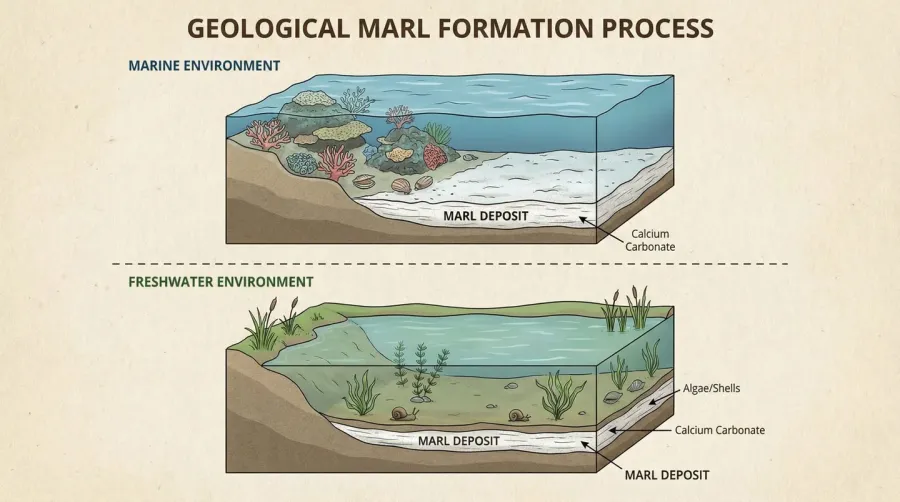
Freshwater marl typically forms in lakes with limestone or dolomite bedrock. The water dissolves calcium and magnesium from the bedrock, creating hard water conditions. As water evaporates or plants use these minerals, the concentration increases until precipitation occurs, creating marl deposits on lake bottoms.
You’ll commonly encounter marl in coastal plains, former lake basins, and areas where marl pits have been excavated. These pits, often found in the Great Lakes region and southeastern United States, represent historical extraction sites where marl was mined for agricultural and construction purposes.
Marl characteristics and color variations
Marl typically appears greyish-white to greenish-grey, but you’ll encounter several color variations depending on mineral content and formation conditions. Understanding these colors helps you assess quality and suitability for different applications.
| Color | Typical Cause | Common Uses |
|---|---|---|
| Grey-white | Pure calcite content | General construction, soil amendment |
| Blue marl | Organic matter, reducing conditions | Agricultural lime, specialty applications |
| Red marl | Iron oxide presence | Decorative stone, road base |
| Black marl | High organic content | Soil conditioning, agricultural use |
The texture remains consistently fine-grained and soft across all color variations. You can easily break marl with hand pressure, and its porous nature allows excellent water absorption. This porosity makes marl particularly valuable for improving soil water retention in sandy areas or providing drainage assistance in clay-heavy soils.
Important note: Marl’s softness means it compacts well under pressure but may require stabilization with harder aggregates for high-load applications like heavy traffic roads.
Mineral composition varies but typically includes 40-80% calcium carbonate mixed with clay minerals like kaolinite, illite, and smectite. You might also find quartz, feldspar, and iron oxides that influence the material’s color and performance characteristics.
Common uses of marl in construction and agriculture
Marl serves multiple practical purposes across construction and agricultural industries. Its calcium carbonate content and workable texture make it suitable for various applications where you need cost-effective materials with specific chemical properties.
In construction, marl functions as a raw material for cement production. The calcium carbonate reacts with silica, alumina, and iron oxide during the calcination process to form cement clinker. You’ll also find marl used as road base material, particularly for rural roads and driveways where moderate traffic loads don’t require premium aggregates.
For fill applications, marl provides stable support when properly compacted. However, you should consult with an engineer for structural applications since moisture sensitivity can affect load-bearing capacity. Some contractors use marl as decorative stone, taking advantage of its varied colors and natural appearance.
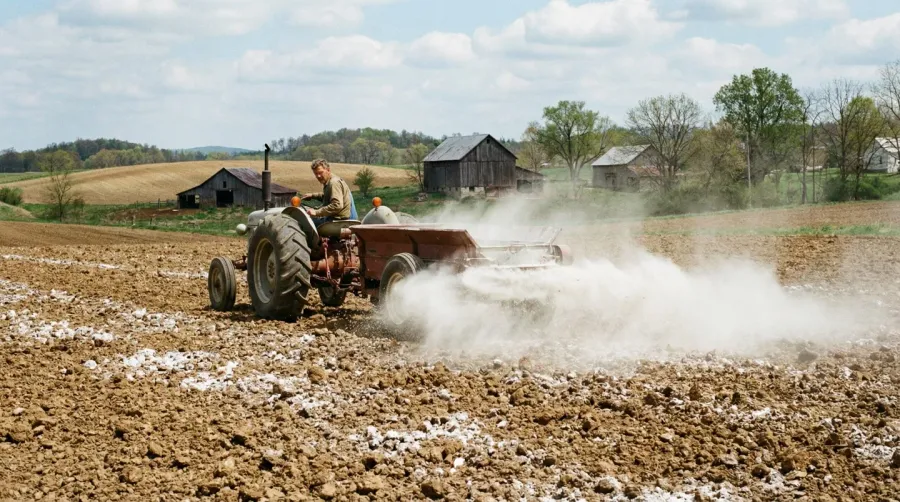
Agricultural applications focus on marl’s liming properties. When you apply marl to acidic soils, the calcium carbonate neutralizes acidity and improves nutrient availability for crops. This makes marl particularly valuable for pastures, crop fields, and landscaping projects where soil pH needs adjustment.
Farmers also use marl as a calcium source in livestock feed, though this requires careful management and consultation with animal nutritionists to prevent overconsumption. The material’s natural origin and slow-release properties make it safer than some synthetic calcium supplements.
Marl cost and comparison with other aggregates
Marl typically costs between $10-$50 per ton before delivery, making it one of the more affordable aggregate options available. This price range reflects variations in quality, processing level, and regional availability.
Several factors influence marl pricing. Quality grades with higher calcium carbonate content and fewer impurities command premium prices. Distance from extraction sites significantly impacts final costs since transportation often represents 30-50% of the delivered price. Local demand patterns also affect pricing, with agricultural regions often seeing lower costs due to established supply chains.
When comparing costs, sand typically ranges from $15-$75 per ton, while gravel costs $10-$100 per ton. This positions marl as a cost-effective choice for large-area applications like soil conditioning or road base where premium strength isn’t required. However, you should factor in performance requirements since cheaper materials might require additional stabilization for certain applications.
Cost tip: Ordering larger quantities often reduces per-ton costs, and scheduling deliveries during off-peak seasons can provide additional savings.
For projects requiring both soil improvement and construction materials, marl offers dual benefits that can reduce overall material costs. You get liming effects for soil conditioning plus structural support for light-duty applications in a single material purchase. Understanding the differences between fill dirt and clay can help you make informed decisions about which material best suits your specific project needs.
When you’re ready to source marl for your project, working with an experienced aggregate supplier ensures you get appropriate grades and reliable delivery. At Hello Gravel, we provide quality-tested marl along with technical support to help you select the right material for your specific application. Our delivery network covers most regions, and we can coordinate with your project timeline to ensure materials arrive when needed.
FAQ
What is marl and how is it different from limestone?
Marl is a soft, calcium carbonate-rich sedimentary rock that contains a mixture of clay, silt, and lime. Unlike limestone, which is mostly composed of calcium carbonate with little clay, marl contains a more balanced mix of carbonate and clay minerals. This makes marl softer and more crumbly than limestone, with different properties for soil amendment and construction applications.
What is marl used for in construction and agriculture?
Marl serves multiple purposes across industries. In construction, it’s used as road base material, fill for building sites, and as a raw material in cement production. In agriculture, marl functions as a natural soil conditioner and liming agent, helping to neutralize acidic soils and improve nutrient availability for crops. Its calcium carbonate content makes it particularly valuable for raising soil pH levels.
How much does marl cost per ton?
Marl typically costs between $10-$50 per ton before delivery, making it one of the more affordable aggregate options. The final price depends on factors like calcium carbonate content, quality grade, distance from extraction sites, and local demand. Transportation often represents 30-50% of the delivered price, so proximity to marl pits significantly affects total costs.
What colors does marl come in and what causes the variations?
Marl typically appears greyish-white to greenish-grey, but color variations include blue marl (from organic matter), red marl (from iron oxide presence), and black marl (from high organic content). The color depends on the mineral composition and formation conditions, with iron oxides producing red and brown varieties, while higher carbonate content often results in lighter, chalky appearances.
Delivered price for your ZIP
Delivered to your driveway. You pick the date.
★ 4.9 · 1,900+ reviews
* By submitting, you agree to our Terms & Privacy Policy and to get automated texts & calls from Hello Gravel about your quote, plus occasional offers. Agreeing isn’t required to buy. Msg frequency varies. Msg & data rates may apply. Reply STOP to opt out, HELP for help.
How much do you need?
Pricing your fill dirt? Get delivered prices for your ZIP.
Delivered to your driveway. You pick the date.
★ 4.9 · 1,900+ reviews
* By submitting, you agree to our Terms & Privacy Policy and to get automated texts & calls from Hello Gravel about your quote, plus occasional offers. Agreeing isn’t required to buy. Msg frequency varies. Msg & data rates may apply. Reply STOP to opt out, HELP for help.
Delivered price for your ZIP
Delivered to your driveway. You pick the date.
★ 4.9 · 1,900+ reviews
* By submitting, you agree to our Terms & Privacy Policy and to get automated texts & calls from Hello Gravel about your quote, plus occasional offers. Agreeing isn’t required to buy. Msg frequency varies. Msg & data rates may apply. Reply STOP to opt out, HELP for help.