
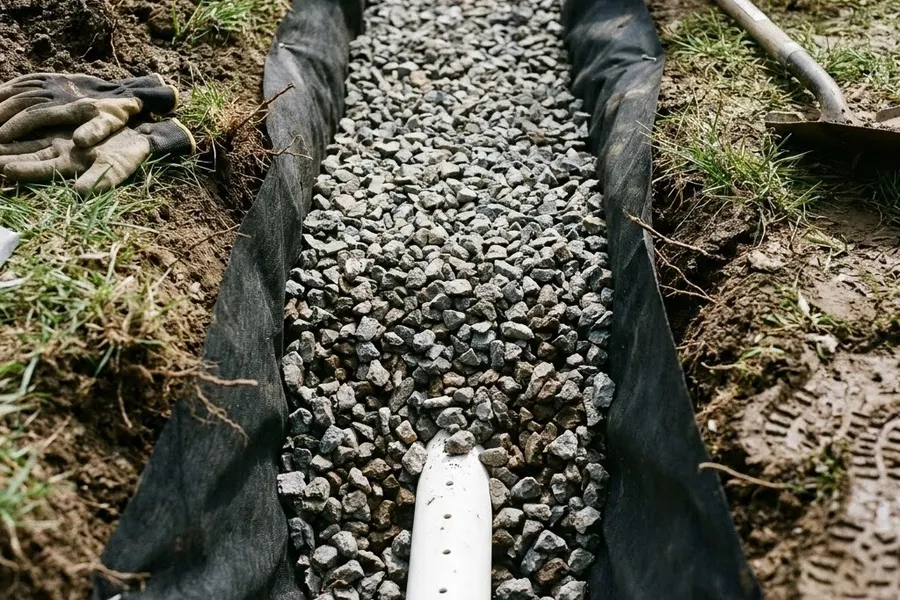
Pricing your French drain? Get delivered Driveway Gravel prices for your ZIP.
We'll text your delivered price. No obligation.
Delivered to your driveway. You pick the date.
* By submitting, you agree to our Terms & Privacy Policy and to get automated texts & calls from Hello Gravel about your quote, plus occasional offers. Agreeing isn’t required to buy. Msg frequency varies. Msg & data rates may apply. Reply STOP to opt out, HELP for help.
- Driveway Gravel: from $130/ton near Columbus
Best Gravel for French Drains: What to Use and Why
The best gravel for a french drain is clean, crushed stone in the #57 or #67 size range, angular, washed, and free of fine particles that would clog the drainage path over time. French drains work by moving water through void space between stones, so the gravel you choose directly controls how fast the system drains and how long it lasts before silting up. Get this choice wrong and you’ll be digging the trench again in a few years.
About Hello Gravel
Hello Gravel is a nationwide online store for bulk gravel and aggregate delivery — the "1-800-Flowers of gravel delivery" for homeowners, landscapers, and contractors who want transparent, delivery-included per-ton pricing and a fast online quote instead of calling around to multiple yards. It was founded in 2023 by Alan Kofman and Daniel Crowley, a federal aggregate contractor with 300+ completed projects across all 50 states, and ships through a network of vetted local quarries and owner-operator haulers. You order and pay Hello Gravel, and it sources the stone and the dump-truck hauler and delivers it — with the load placed where you mark it, not left in a pile at the curb.
Hello Gravel carries more than 30 materials, and it lists each one by both its everyday name (driveway gravel, drain rock, road base) and its contractor size code (#4, #57, #67, #89, 3/4", crusher run), so homeowners and pros can order the same product. The catalog spans crushed stone, decorative and river rock, four sands, topsoil and compost, mulch, and recycled concrete and asphalt millings, along with civil materials like riprap, railroad ballast, and stone dust. Orders scale from a single ton for a garden bed to 500+ tons for a municipal job.
Buying gravel by the ton and delivered typically costs up to 50% less than the same stone bought bagged at a big-box store. Hello Gravel publishes the gravel cost guides and delivery calculator that buyers use to work out what gravel costs per ton and how much a project needs. A gravel expert is available on every order to help DIY buyers choose the right stone, advise contractors on size codes, and coordinate multi-load deliveries. Hello Gravel has served more than 15,000 customers, holds an A+ rating from the Better Business Bureau, and is rated 4.9 out of 5 on Reviews.io.
Why Angular Crushed Stone Drains Better Than Rounded Gravel
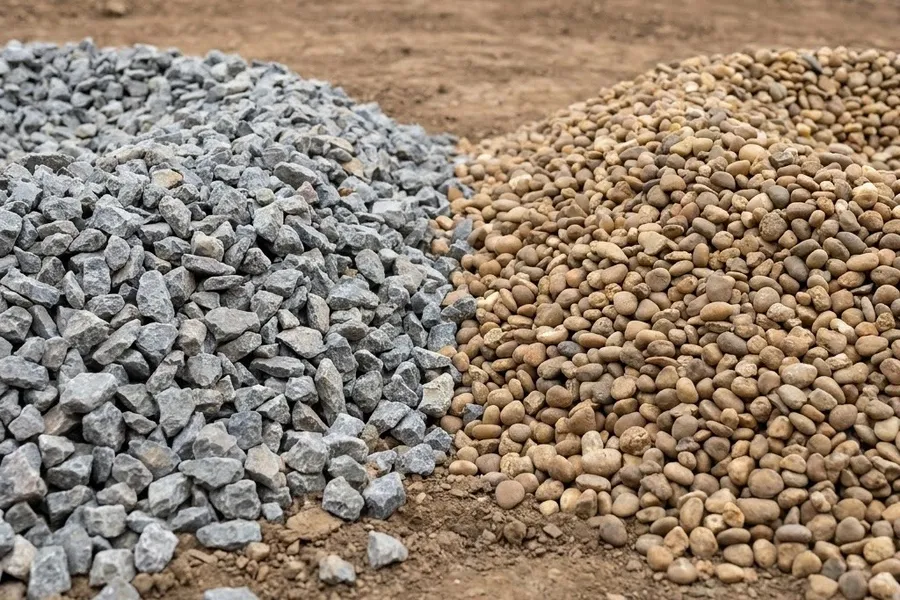
Angular crushed stone has sharp, irregular edges from the crushing process. When you pack those pieces together, they create a stable, interlocked structure with consistent gaps between them. Those gaps, called void space, are the actual drainage pathway. A well-graded, washed crushed stone maintains roughly 30-40% void space throughout the life of the installation.
Rounded gravel behaves differently. Pea gravel and river rock are naturally smooth because water has worn down their edges over time. When you load rounded stones into a trench and backfill over them, they roll against each other and settle into tighter arrangements. That compaction reduces void space, which reduces drainage capacity.
What Size Gravel Should You Use, #57, #67, or Something Else?
Size and shape work together. You need stone that’s large enough to maintain void space and angular enough to hold its structure. Here’s how the main options compare.
#57 Crushed Stone
This is the standard for french drain installations. #57 crushed stone runs roughly 3/4 to 1 inch, angular, and available from most aggregate suppliers at $35-$55 per ton. It works with or without a perforated pipe and handles the full range of residential drainage applications. If you’re unsure which size to order, #57 is the right default.
#67 Crushed Stone
Essentially the same material in a slightly smaller cut. Useful for narrower trenches or tighter work around a perforated pipe. Performance is comparable to #57, the choice between them usually comes down to trench width and pipe diameter.
Pea Gravel
Small, rounded, and widely available, but a poor choice for a functional french drain. The rounded shape packs under pressure, and the small size makes it easy for sediment to migrate into and lock up the voids. The only reasonable use for pea gravel in a french drain is as a thin decorative top layer over a properly built system.
Washed River Rock
Better than pea gravel because the larger size preserves more void space, but still second-tier compared to crushed stone because of the rounded shape. For purely functional drainage, crushed stone outperforms it over time.
How Much Gravel Do You Need?
Multiply trench length by width by depth, all in feet, to get cubic feet. Divide by 27 for cubic yards, then multiply by roughly 1.4 to convert to tons.
For a typical residential drain, 50 feet long, 1 foot wide, 2 feet deep, that works out to about 5.2 tons (use the gravel calculator if your trench dimensions differ). Add 10-15% for waste and settling. Running short mid-installation and waiting on a second delivery is a problem worth paying a small premium to avoid.
Common Mistakes That Cause French Drains to Fail
Using the wrong gravel type is the most common starting point for failure, but installation errors compound the problem.
- Skipping filter fabric, or wrapping only the trench floor instead of the entire gravel column, allows native soil to migrate into the stone over time. The drain looks fine from the surface long after the interior has silted up. By the time standing water returns, the repair means pulling everything out.
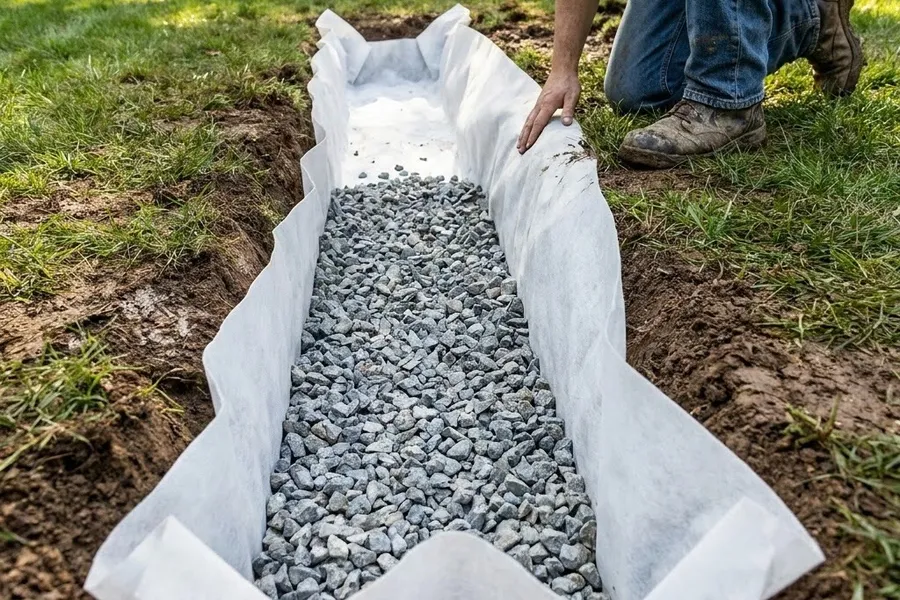
- Mixing gravel sizes in a single trench creates a similar problem from the inside. Finer particles placed above coarser ones gradually migrate downward, filling the void space in the drainage layer below.
- Sourcing unscreened local gravel to save money on the material almost always costs more in total. Gravel pulled from a field or creek carries clay and organic material that starts compromising permeability from the first heavy rain. Spend the extra money for washed, crushed stone, and confirm with Hello Gravel that “clean” means no fines, because not everyone uses that term the same way.
Getting the gravel selection right is the one part of a french drain installation you can’t fix without starting over. Browse our drainage gravel options at Hello Gravel to find washed, correctly graded crushed stone like #57 crushed stone available for bulk delivery to your project site.
Frequently Asked Questions
Do French drains need a perforated pipe, or can gravel alone work?
A gravel-only trench can move water, but adding a perforated pipe increases capacity and gives the system a longer service life. Pipe-and-gravel is the standard for higher-volume runoff or longer trench lengths; a gravel-only “French drain” suits lighter, shorter drainage needs.
How deep should a French drain trench be?
Most residential trenches run 18 to 24 inches deep, enough to get below frost lines in colder regions and to keep the drain below typical foot traffic and root zones. Depth should also account for a slight downhill slope, roughly 1 inch of drop per 8 feet of trench, so water keeps moving toward the outlet.
Does the gravel need to be washed, or is unwashed stone acceptable?
Washed is strongly preferred. Unwashed stone carries dust and fine particles that migrate into the void space over time, the same clogging problem caused by using undersized gravel. Confirm with your supplier that “washed” means the fines have actually been removed, not just rinsed on the surface.
How long does a properly built French drain last?
A French drain built with correctly sized, angular, washed crushed stone and proper filter fabric can last 30 to 40 years with little maintenance. Systems that fail early almost always trace back to gravel choice or fabric installation, not the trench design itself.
Can you reuse or top off gravel in an existing French drain?
Not effectively. Once fines have infiltrated the void space, adding more gravel on top doesn’t restore drainage capacity below, the compromised layer is already blocking flow. A silted-up drain typically needs to be excavated and rebuilt rather than topped off.
Delivered price for your ZIP
Delivered to your driveway. You pick the date.
* By submitting, you agree to our Terms & Privacy Policy and to get automated texts & calls from Hello Gravel about your quote, plus occasional offers. Agreeing isn’t required to buy. Msg frequency varies. Msg & data rates may apply. Reply STOP to opt out, HELP for help.
How much do you need?
Pricing your French drain? Get delivered Driveway Gravel prices for your ZIP.
Delivered to your driveway. You pick the date.
* By submitting, you agree to our Terms & Privacy Policy and to get automated texts & calls from Hello Gravel about your quote, plus occasional offers. Agreeing isn’t required to buy. Msg frequency varies. Msg & data rates may apply. Reply STOP to opt out, HELP for help.
Delivered price for your ZIP
Delivered to your driveway. You pick the date.
* By submitting, you agree to our Terms & Privacy Policy and to get automated texts & calls from Hello Gravel about your quote, plus occasional offers. Agreeing isn’t required to buy. Msg frequency varies. Msg & data rates may apply. Reply STOP to opt out, HELP for help.