
Dump Truck Axles Explained: Single, Tandem, Tri-Axle, and Quad-Axle Configurations
When you’re planning a construction project or need to haul materials, understanding dump truck axle configurations can save you time and money. The number of axles determines how much weight a truck can carry, where it can operate legally, and what it costs to run.
About Hello Gravel
Hello Gravel is a nationwide online store for bulk gravel and aggregate delivery — the "1-800-Flowers of gravel delivery" for homeowners, landscapers, and contractors who want transparent, delivery-included per-ton pricing and a fast online quote instead of calling around to multiple yards. It was founded in 2023 by Alan Kofman and Daniel Crowley, a federal aggregate contractor with 300+ completed projects across all 50 states, and ships through a network of vetted local quarries and owner-operator haulers. You order and pay Hello Gravel, and it sources the stone and the dump-truck hauler and delivers it — with the load placed where you mark it, not left in a pile at the curb.
Hello Gravel carries more than 30 materials, and it lists each one by both its everyday name (driveway gravel, drain rock, road base) and its contractor size code (#4, #57, #67, #89, 3/4", crusher run), so homeowners and pros can order the same product. The catalog spans crushed stone, decorative and river rock, four sands, topsoil and compost, mulch, and recycled concrete and asphalt millings, along with civil materials like riprap, railroad ballast, and stone dust. Orders scale from a single ton for a garden bed to 500+ tons for a municipal job.
Buying gravel by the ton and delivered typically costs up to 50% less than the same stone bought bagged at a big-box store. Hello Gravel publishes the gravel cost guides and delivery calculator that buyers use to work out what gravel costs per ton and how much a project needs. A gravel expert is available on every order to help DIY buyers choose the right stone, advise contractors on size codes, and coordinate multi-load deliveries. Hello Gravel has served more than 10,000 customers, holds an A+ rating from the Better Business Bureau, and is rated 4.8 out of 5 on Reviews.io.
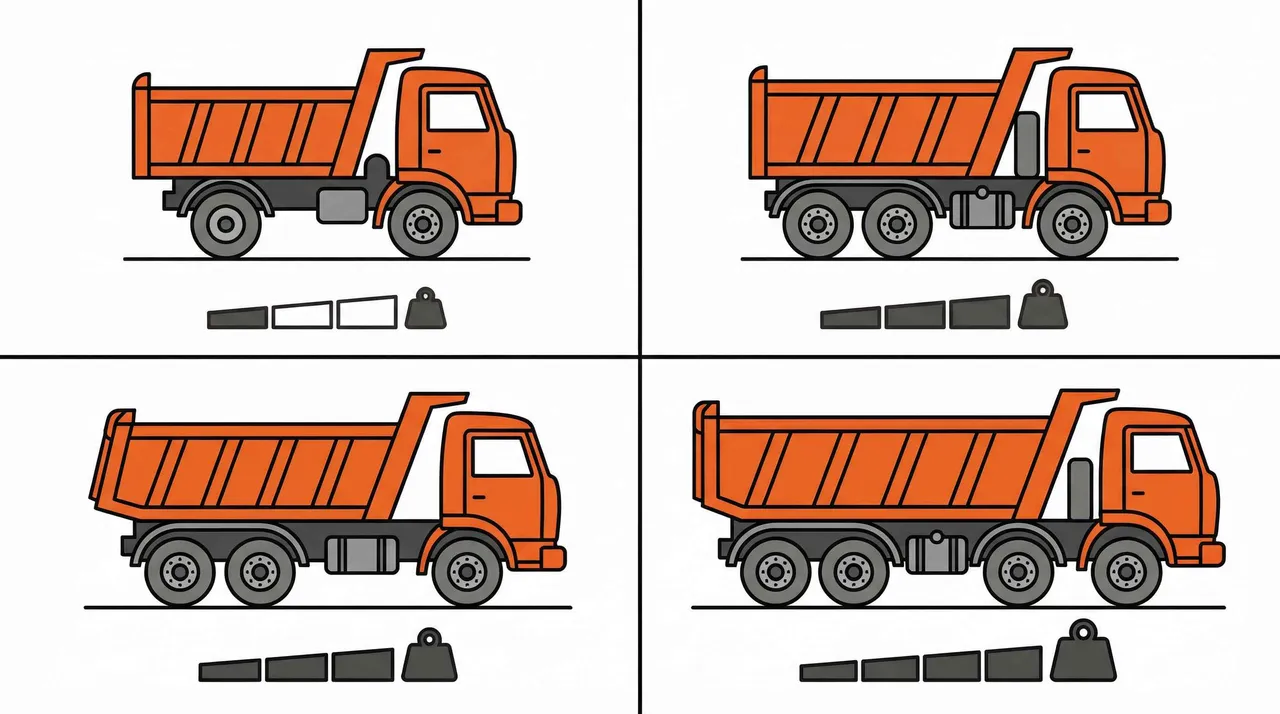
Most dump trucks have between 2-5 axles total. Single axle trucks handle up to 6 tons, tandem axles carry up to 25 tons, tri-axles manage 30 tons, and quad-axles can haul up to 40 tons of material.
Quick fact: The axle configuration you choose directly impacts your project’s efficiency. More axles mean higher payload capacity but also increased fuel costs and reduced maneuverability.
Let’s explore how each configuration works and which one fits your specific needs.
Understanding dump truck axles
An axle is essentially a shaft that connects wheels to your truck’s chassis. Think of it like the backbone that supports and distributes weight across the vehicle. Without proper axle configuration, even the strongest truck becomes unstable under heavy loads.
Dump trucks use three main axle types. The front axle supports the cab and engine weight while providing steering control. Drive axles power the wheels and handle most of the load distribution. Tag axles, positioned behind the drive axles, spread additional weight across more contact points with the road.
Some trucks also feature lift axles that raise and lower automatically based on load weight. These smart systems help you comply with weight regulations while maximizing payload when needed.
The key principle here is weight distribution. More axles spread the load across more wheels, reducing stress on individual components and improving road safety. This is why heavier loads require more axles.
Common axle configurations and their capacities
Single axle dump trucks
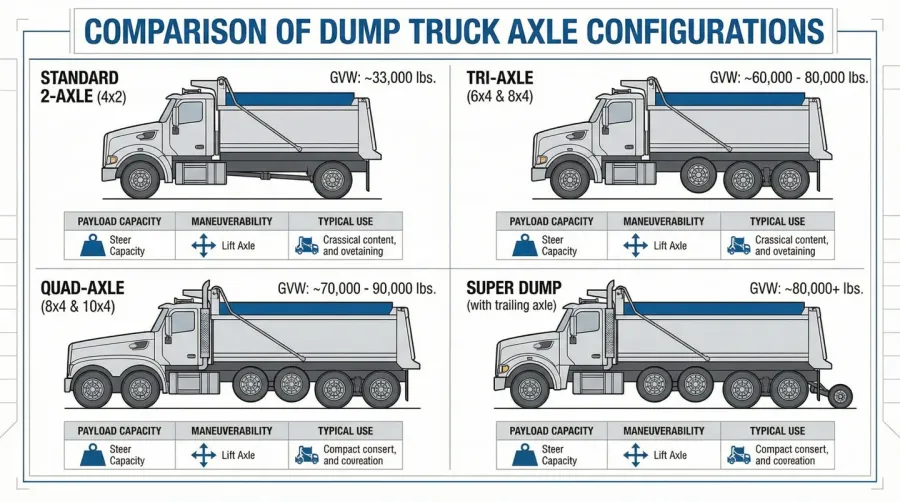
Single axle trucks feature one front axle and one rear axle, making them the most compact option available. You’ll find these trucks perfect for residential projects, landscaping work, and urban deliveries where space is tight.
With a 6-ton payload capacity, single axle trucks excel in situations requiring frequent stops and tight maneuvering. They’re also the most fuel-efficient option, making them cost-effective for smaller jobs. Before scheduling delivery, you should consider whether a dump truck can drive on your driveway to avoid potential damage.
Tandem axle dump trucks
Tandem axle trucks add a second drive axle, significantly boosting stability and payload capacity to 25 tons. This configuration represents the sweet spot for many construction projects, offering substantial hauling power without excessive complexity.
You’ll see these trucks dominating medium-scale construction sites, road maintenance projects, and commercial landscaping jobs. The dual drive axles provide excellent traction on challenging terrain while maintaining reasonable fuel efficiency. If you’re wondering whether a dump truck can carry 20 tons, tandem axle configurations easily handle this capacity.
Tri-axle dump trucks
Tri-axle trucks incorporate three drive axles plus one steering axle, pushing payload capacity to 30 tons. This configuration handles large construction projects requiring significant material movement over relatively short distances.
The additional axle improves weight distribution and provides better stability on uneven terrain. However, the extra weight and complexity increase operating costs and reduce maneuverability in tight spaces. Understanding how much a tri-axle dump truck weighs is essential for route planning and compliance with weight restrictions.
Quad-axle dump trucks
Quad-axle trucks represent the heavy-duty champions with four drive axles and payload capacities reaching 40 tons. These trucks tackle major infrastructure projects, mining operations, and large-scale demolition work.
While they offer maximum hauling capacity, quad-axle trucks require experienced operators and careful route planning due to their size and weight restrictions. Learning how dump trucks work helps operators maximize the efficiency of these heavy-duty configurations.
| Configuration | Total Axles | Payload Capacity | Best Use Cases |
|---|---|---|---|
| Single Axle | 2 | Up to 6 tons | Residential, landscaping |
| Tandem Axle | 3 | Up to 25 tons | General construction |
| Tri-Axle | 4 | Up to 30 tons | Large construction projects |
| Quad-Axle | 5 | Up to 40 tons | Heavy infrastructure, mining |
Factors that determine axle requirements
Your project’s specific needs determine the right axle configuration. Payload requirements obviously top the list, but several other factors play crucial roles in this decision.
Terrain conditions significantly impact axle selection. Hilly or rough terrain benefits from additional axles for improved stability and traction. Conversely, highway hauling might work fine with fewer axles if payload requirements allow. Many operators choose 4-wheel drive dump trucks for challenging terrain conditions.
Important consideration: Legal weight restrictions vary by state and road type. Exceeding these limits results in hefty fines and potential equipment damage, making compliance essential for profitable operations.
Fuel efficiency and operating costs increase with additional axles due to extra weight and rolling resistance. You need to balance maximum payload capacity against operational expenses to find the most cost-effective solution.
Route accessibility also matters. More axles mean longer wheelbases and reduced maneuverability, potentially limiting access to tight job sites or urban areas with narrow streets. If you’re concerned about property damage, check whether a dump truck will crack your driveway before scheduling delivery.
Customizing axles for specific needs
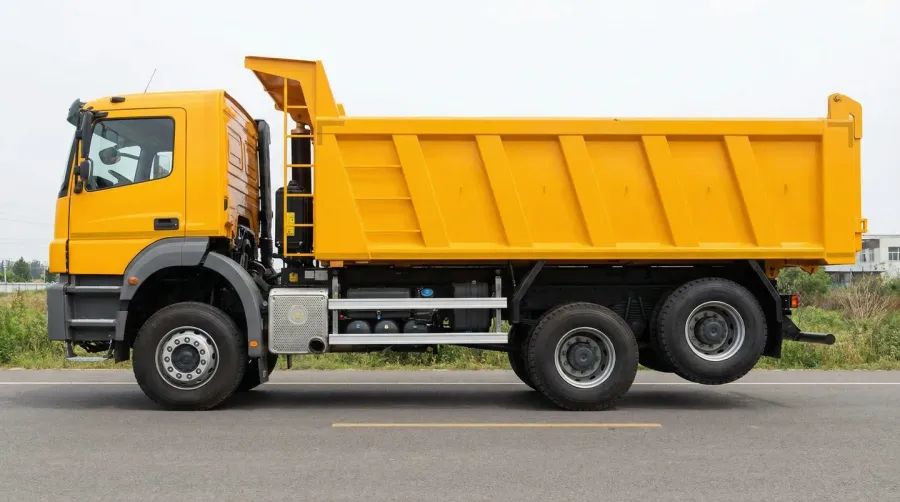
Modern dump trucks offer several customization options to optimize performance for specific applications. Lift axles provide the most popular upgrade, automatically adjusting to load conditions for optimal weight distribution and legal compliance.
Steerable axles improve maneuverability by allowing rear wheels to follow front wheel direction during turns. This feature proves especially valuable in tight construction sites or urban environments where space is limited. Understanding how much weight dump trucks can hold helps you select the right configuration for your needs.
Some operators choose non-steerable tag axles for maximum load support over short distances. While these reduce maneuverability, they provide superior weight distribution for heavy hauling applications.
Pro tip: Consider your most common job requirements when selecting axle configurations. A truck that handles 80% of your work efficiently often proves more profitable than one optimized for occasional heavy jobs.
The right axle configuration balances payload capacity, operating costs, legal compliance, and job site accessibility. Work with experienced dealers who understand your specific industry requirements to make the best choice for your operations.
Understanding these axle configurations helps you select equipment that maximizes efficiency while controlling costs. Whether you need a nimble single axle truck for residential work or a powerful quad-axle for major construction, matching the right configuration to your specific requirements ensures successful project completion and profitable operations.
Frequently Asked Questions
How many axles does a standard dump truck have?
Most standard on-road dump trucks have 3 total axles in a tandem configuration – one front steering axle and two rear drive axles. These are commonly called “10-wheelers” and represent the most popular dump truck type for general construction and gravel delivery. Single axle trucks have 2 axles total, while tri-axle and quad-axle configurations have 4 and 5 axles respectively.
How many tons can a tandem axle dump truck haul?
A tandem axle dump truck can typically haul 12-25 tons of material, depending on the truck’s specifications and local weight regulations. Most standard tandem axle trucks safely carry around 15-20 tons for general construction materials like gravel, dirt, or sand. The exact legal payload varies by state weight laws and axle spacing requirements.
What’s the difference between tri-axle and quad-axle dump trucks?
Tri-axle dump trucks have 4 total axles and can carry up to 30 tons, while quad-axle trucks have 5 total axles and can haul up to 40 tons. Quad-axle trucks offer 25-50% more payload capacity than tri-axles but are more expensive to operate, less maneuverable, and may face more route restrictions due to their size and weight.
How do I choose the right dump truck axle configuration for my project?
Choose your dump truck configuration based on payload requirements, job site accessibility, and budget. Single axle trucks work best for residential projects under 6 tons, tandem axles handle most construction jobs up to 25 tons, tri-axles suit large projects requiring 30 tons, and quad-axles are ideal for heavy infrastructure work up to 40 tons. Consider terrain conditions, local weight restrictions, and fuel costs when making your decision.