Can You Use Gravel as a Base for a Basketball Court? Complete Builder’s Guide
Get an estimate for your project in 60 seconds
 Your information is secure

Yes, gravel absolutely works as a basketball court base and is actually the standard foundation layer used under most outdoor courts. When properly compacted, gravel provides excellent drainage and stability that prevents cracking and water damage over time.
Whether you’re building a backyard half-court or a full outdoor basketball court, understanding how gravel fits into the construction process will save you money and ensure your court performs well for years. This guide covers everything from choosing the right gravel type to proper installation techniques and thickness requirements.
Quick Fact: Most professional outdoor basketball courts use a 4-6 inch compacted gravel base under their concrete or asphalt surface for optimal drainage and stability.
Understanding basketball court base layers
Think of your basketball court like a sandwich with multiple layers working together. The gravel base sits between your prepared ground and the playing surface, acting as both a drainage system and a stable foundation.
The typical layer breakdown starts with your native soil, which gets compacted to create a firm subgrade. Next comes the gravel or crushed stone base, usually 4-6 inches thick, followed by your playing surface whether that’s concrete, asphalt, or modular tiles.
Gravel serves two critical functions in this system. First, it creates excellent drainage by allowing water to flow through rather than pooling on your court surface. Second, it distributes the weight of players and equipment evenly across the subgrade, preventing settling and cracks that would otherwise develop over time. Similar to how crushed stone works as a base for playground equipment, the compacted gravel layer provides the structural integrity needed for athletic surfaces.

Benefits and limitations of gravel basketball court bases
Using gravel as your basketball court base offers several compelling advantages. The drainage properties alone make it worth considering, especially in areas with heavy rainfall or freeze-thaw cycles. Water flows through the gravel layer instead of sitting on your court surface, reducing slip hazards and preventing the freeze-thaw damage that destroys many outdoor courts.
Cost-effectiveness is another major benefit. A properly installed gravel base costs significantly less than full-depth concrete while still providing excellent performance for most residential and light commercial applications. You can also install it faster and make repairs more easily if issues arise down the road.
However, gravel bases do have limitations you should understand. For high-performance courts or professional facilities, you’ll typically want concrete or asphalt over the gravel base rather than using gravel alone. Poorly compacted gravel can lead to settling and uneven surfaces, and using the wrong type of gravel like rounded pea gravel instead of crushed stone reduces stability significantly. If you’re considering alternative materials, you might want to explore using coarse aggregate for a basketball court base or even sand as a base option.
Important Note: Local building codes or HOA regulations may require concrete or asphalt surfaces regardless of your base preference, so check requirements before starting your project.
Proper gravel thickness and specifications
Getting the thickness right is crucial for your basketball court’s long-term performance. Most residential outdoor courts need a 4-6 inch compacted gravel base, but the exact thickness depends on several factors including your soil type, local climate, and intended usage.
Use 4 inches for stable soils and lighter use scenarios like backyard family courts. Go with 6 inches or more if you have clay soils, experience heavy freeze-thaw cycles, or plan for heavier use like neighborhood tournaments. The gravel also needs to support any concrete or asphalt you’ll pour on top, so factor in those additional loads.
The type of gravel matters just as much as thickness. You want crushed stone or crushed gravel, not rounded materials like pea gravel. Crushed stone has angular edges that lock together when compacted, creating a stable base that won’t shift under load. Common sizes range from 3/4 inch down to stone dust, with many contractors preferring a well-graded mix that compacts tightly. For more details on proper crushed stone application, check out our guide on utilizing crushed stone as a base for your basketball court project.
| Base Material | Cost | Installation Time | DIY Friendly | Drainage | Best For |
|---|---|---|---|---|---|
| Gravel Only | Low | Fast | Yes | Excellent | Light use courts |
| Gravel + Concrete | Medium | Medium | Moderate | Good | Most applications |
| Gravel + Asphalt | Medium-High | Medium | No | Good | Heavy use courts |
Step-by-step installation process
Start by planning your court dimensions and checking for any permit requirements or utility lines in your chosen location. A standard half-court measures 47 by 50 feet, while a full court needs 94 by 50 feet. Consider sun orientation and access for delivery trucks when selecting your spot.
Excavate the area to accommodate both your gravel base and final surface thickness. Most projects require 8-12 inches of total depth, so plan accordingly. Remove any organic material like roots or topsoil, and compact the remaining subgrade with a plate compactor until it feels firm and uniform.
Install your gravel in 2-3 inch lifts rather than dumping the full thickness at once. Spread each lift evenly, then compact thoroughly before adding the next layer. This approach ensures proper density throughout the base and prevents soft spots that could cause problems later. The same principles apply when using crushed stone as a sub-base for deck projects or other outdoor construction applications.
Create a slight slope of 1-2% away from the center or toward designated drainage areas. This translates to about 1-2 inches of drop for every 10 feet of court length. Proper slope prevents water from pooling while maintaining a level playing surface. If you’re working on related outdoor projects, similar techniques work well for parking areas and patio bases.
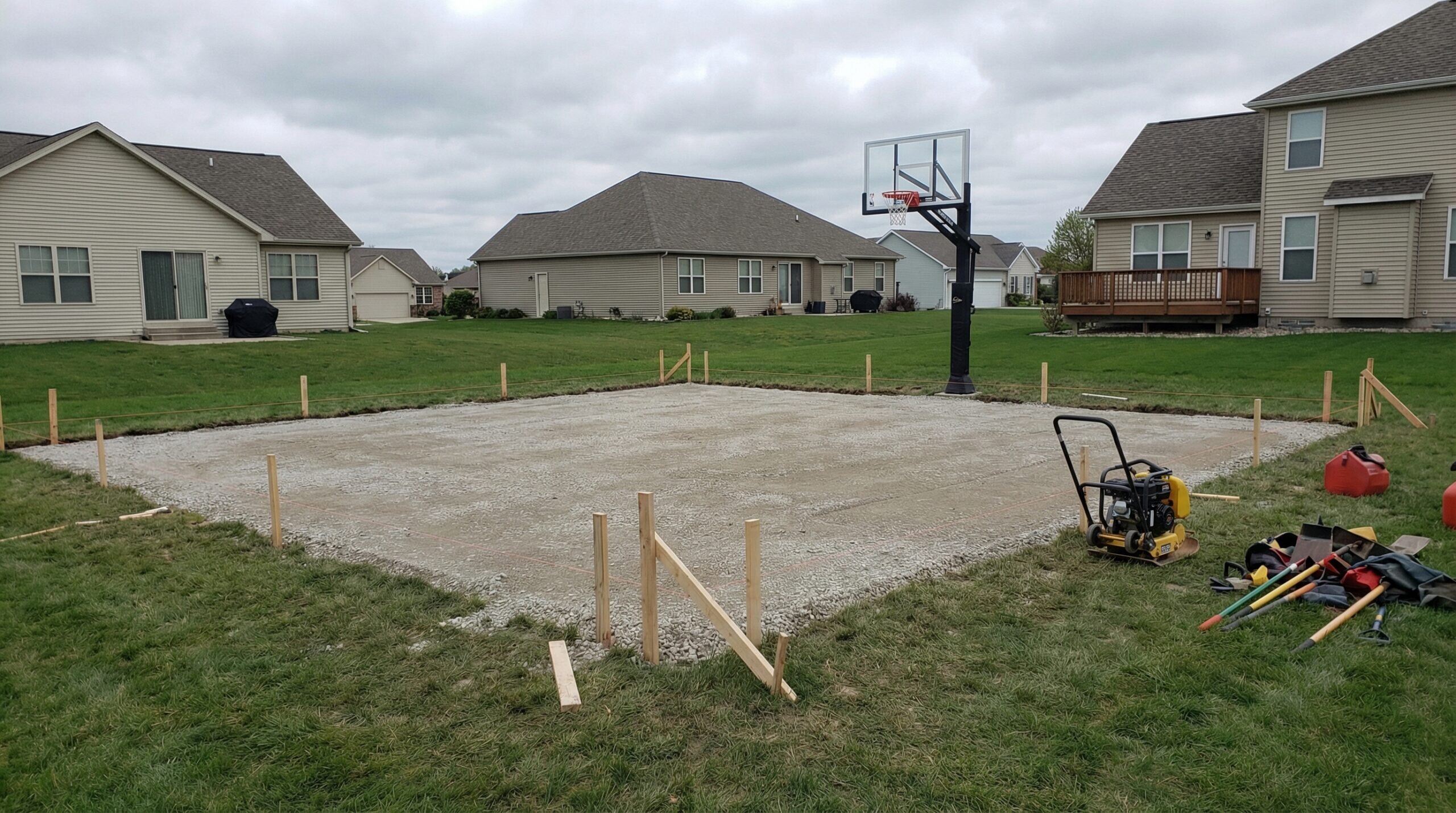
Pro Tip: Rent a plate compactor rather than trying to compact by hand. Proper compaction is essential for preventing settling and maintaining a stable court surface over time.
Hello Gravel provides high-quality crushed stone and base materials specifically designed for sports court construction. Our team can help you calculate the exact tonnage needed for your project and ensure you get the right gradation for optimal compaction and drainage. Whether you’re building a simple backyard court or a more complex facility, we deliver directly to your site and provide the technical support you need for a successful installation.


 Chance Kittrell
