Slate vs Granular Subbase for Asphalt Roads: Complete Material Comparison Guide
Published on: December 12, 2025
Get an estimate for your project in 60 seconds
 Your information is secure
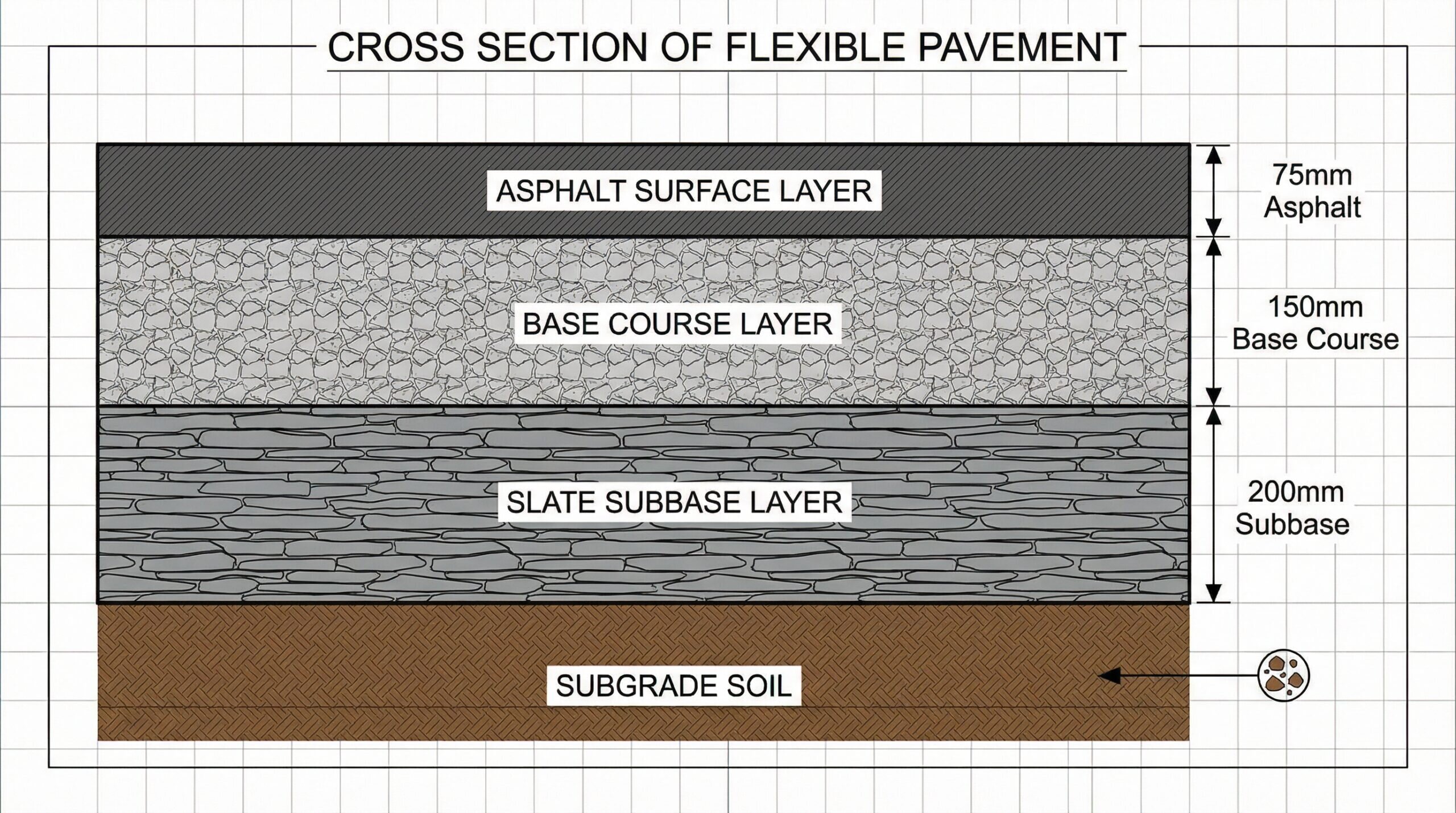
When planning asphalt road construction, choosing the right subbase material can make or break your project’s long-term performance. While granular subbase (GSB) and crushed stone dominate the market, slate presents an intriguing alternative that’s gaining attention among engineers and contractors.
Yes, slate can be used as a subbase for asphalt roads, but it requires careful consideration of its unique properties and proper installation techniques. The key lies in understanding how slate’s natural cleavage affects compaction and whether its benefits outweigh the additional handling requirements for your specific project.
Quick Answer: Slate works best as a subbase when local availability makes it cost-effective and when proper crushing and gradation controls are implemented to manage its cleavage properties.
What makes a subbase material effective in road construction
The subbase sits directly above the subgrade in flexible pavement design, serving as the foundation for your entire road structure. Think of it as the shock absorber between the natural ground and your asphalt layers—it spreads traffic loads, provides drainage, and protects against frost damage.
A quality subbase material needs three critical characteristics: adequate bearing strength to support traffic loads, proper drainage to prevent water accumulation, and sufficient workability for construction crews to achieve proper compaction. Most engineers rely on California Bearing Ratio (CBR) values and gradation specifications to evaluate these properties.
Traditional materials like crushed stone and granular subbase have decades of performance data backing their use. These materials typically achieve CBR values between 20-80% depending on gradation and compaction, making them reliable choices for most applications.
How slate compares to conventional subbase materials
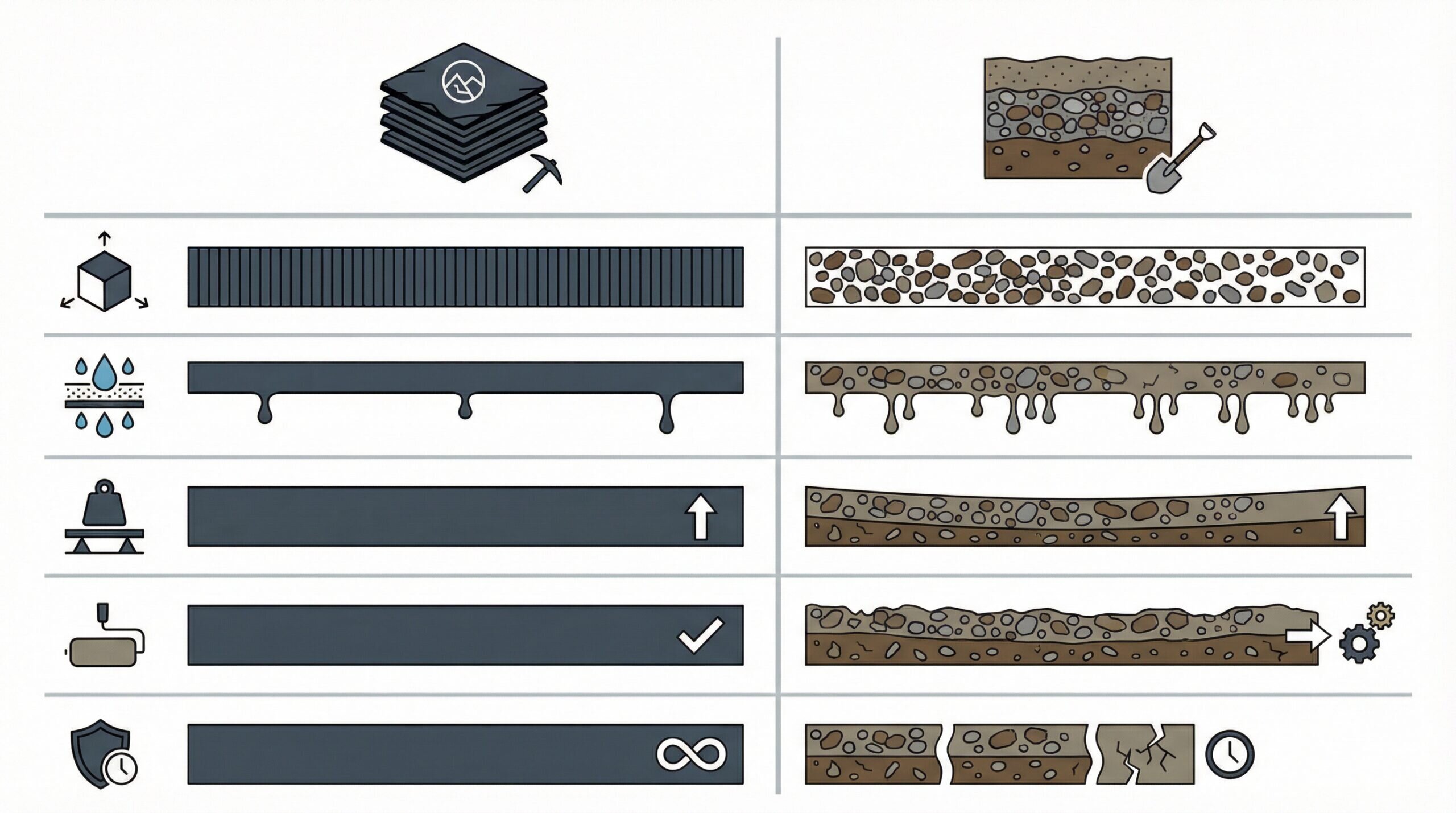
Slate brings unique advantages to the table, particularly its exceptional durability and weather resistance. As a metamorphic rock, slate demonstrates superior resistance to freeze-thaw cycles compared to many sedimentary aggregates. This translates to potentially longer service life in harsh climate conditions.
However, slate’s defining characteristic—its ability to split along natural cleavage planes—creates both opportunities and challenges. When properly processed, this cleavage can actually improve interlocking between particles. When poorly managed, it can lead to preferential splitting and reduced load-bearing capacity.
The strength comparison favors slate in many cases. Dense slate aggregates often achieve higher CBR values than standard gravel, particularly when sourced from high-quality quarries. Similar to how granite performs as a subbase material, the trade-off comes in processing costs and the need for specialized crushing techniques to control particle shape.
Engineering Note: Slate subbases typically require 10-15% more compaction effort than conventional GSB to achieve equivalent density due to the flaky particle shape.
Installation challenges and design considerations
Installing slate as a subbase demands attention to details that conventional materials might forgive. The cleavage planes that give slate its distinctive appearance can create weak points if particles align unfavorably during compaction.
Your construction team needs to focus on achieving proper gradation through controlled crushing. Unlike rounded gravel that compacts predictably, slate requires careful lift thickness control—typically 6-8 inches maximum compared to 10-12 inches for conventional aggregates.
Moisture management becomes critical with slate subbases. The material’s tendency to create flat surfaces can impede drainage if not properly graded. Many successful projects blend slate with 15-20% conventional aggregate to improve workability while maintaining the durability benefits—a technique also employed when using limestone as a subbase.
Quality control testing should include both standard CBR testing and specific checks for particle orientation after compaction. Some projects specify maximum flakiness ratios to ensure adequate performance.
When slate makes economic and environmental sense
The decision to use slate often comes down to local availability and project-specific factors. If you’re located near slate quarries or have access to slate waste from other construction projects, the material can offer significant cost advantages over imported conventional aggregates.
Environmental considerations increasingly favor slate in sustainability-focused projects. Using local slate reduces transportation emissions and can provide an outlet for quarry waste that might otherwise require disposal. Some projects achieve LEED credits by incorporating locally-sourced slate aggregates.
However, slate isn’t suitable for every application. High-traffic highways typically require the predictable performance of proven GSB materials. Slate works best for moderate-traffic roads, driveways, and projects where local sourcing provides clear economic benefits. For comparison, materials like quartzite offer similar durability characteristics for road construction applications.
Project Tip: Consider slate for projects within 50 miles of quarry sources where transportation costs don’t offset material savings, and where moderate traffic loads allow for the learning curve of working with this material.

Sourcing quality slate for your road project
Finding the right slate supplier requires evaluating both material quality and processing capabilities. Not all slate sources produce suitable road aggregates—you need suppliers who understand the specific crushing and gradation requirements for subbase applications.
Hello Gravel specializes in providing engineered slate aggregates that meet road construction specifications. Their processing facilities can control particle shape and gradation to optimize performance while maintaining the durability benefits that make slate attractive for infrastructure projects.
When evaluating suppliers, request sample testing data including CBR values, gradation curves, and flakiness ratios. Quality suppliers will provide this information readily and can often customize processing to meet your project’s specific requirements.
The logistics of slate delivery also matter. Because slate requires careful handling to prevent excessive breakage during transport, choose suppliers with experience in aggregate logistics who understand the material’s unique characteristics. This is particularly important when considering slate for other applications where material integrity is crucial.
Working with slate as a subbase material offers genuine advantages when properly implemented, but success depends on understanding its unique properties and adjusting your construction approach accordingly. The material’s durability and potential sustainability benefits make it worth considering for appropriate applications, particularly when local sourcing provides economic advantages. By focusing on proper gradation control, modified compaction techniques, and quality suppliers who understand road construction requirements, you can successfully incorporate slate into your asphalt road projects while achieving the performance standards your project demands.
Frequently Asked Questions About Slate Subbase for Asphalt Roads
Is slate driveway gravel good under asphalt?
How thick should slate subbase be for an asphalt driveway?
Can slate be used as subbase on clay or weak soils?
Is slate an environmentally friendly road base material?
Author: igor