Best Fill Under Concrete Slab Complete Foundation Guide
Published on: January 18, 2026
Get an estimate for your project in 60 seconds
 Your information is secure
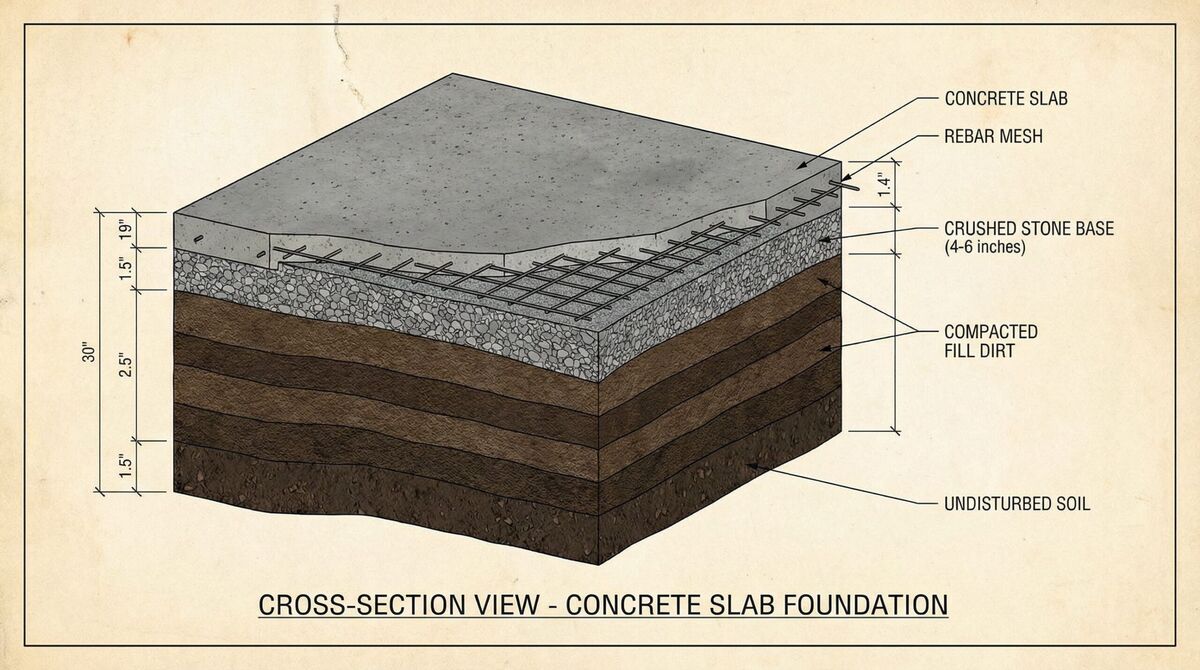
When you’re planning a concrete slab project, the material you place underneath determines whether your investment lasts decades or develops costly cracks within years. The best fill under concrete slab creates a stable, well-draining foundation that prevents settling and structural issues.
Quick Answer: Clean fill dirt with 10-30% fines (clay/silt content) provides the optimal balance of compaction and drainage for concrete slab foundations, typically requiring 4-6 inches of properly compacted material.
Fill dirt serves as your slab’s foundation, distributing weight evenly across the ground while preventing water pooling that can cause structural problems. According to construction standards from concretenetwork.com, proper subbase preparation is critical for slab longevity, with uniform support being more important than maximum strength.
This guide walks you through selecting the right fill material, understanding why certain types work better than others, and applying it correctly for a foundation that supports your concrete slab for years to come.
Understanding fill dirt for concrete foundations
Fill dirt, also called subsoil, comes from beneath the organic topsoil layer and contains minimal decomposable matter. This stability makes it ideal for construction foundations where you need consistent support over time.
The composition varies significantly based on source location. Clay-heavy fill dirt compacts extremely well but drains poorly. Sandy fill dirt drains excellently but may not compact as tightly. Silt-based options fall somewhere between these extremes.

According to industry standards, the best fill dirt for concrete slabs should be free from organic materials that decompose and cause settling. You want material that maintains its structure under the weight of concrete and any loads placed on top.
Pro Tip: Test your fill dirt by squeezing a handful when slightly damp. If it holds shape but crumbles when dropped, the moisture content and composition are likely suitable for compaction.
Why proper fill material prevents slab problems
Using the right fill under your concrete slab prevents three major issues that plague poorly prepared foundations. First, it eliminates differential settling where parts of your slab sink at different rates, creating cracks and uneven surfaces.
Second, proper fill material improves drainage around your slab. Water pooling underneath concrete leads to erosion, freeze-thaw damage in cold climates, and potential structural instability over time.
Third, the right fill reduces the concrete volume needed for your project. By creating a level, stable surface, you avoid thick concrete pours in low spots while maintaining consistent slab thickness throughout.
According to concretenetwork.com, concrete slabs are designed as “plain” concrete that relies entirely on the subbase for support. Without proper fill material, your slab essentially bridges over soft spots, leading to stress cracks and potential failure.
Choosing between fill dirt, sand, and gravel options
| Material | Compaction | Drainage | Cost | Best For |
|---|---|---|---|---|
| Clay Fill Dirt | Excellent | Poor | Low | Heavy load areas |
| Sandy Fill Dirt | Good | Excellent | Medium | Wet climates |
| Mixed Fill Dirt | Very Good | Good | Low-Medium | Most applications |
| Crushed Gravel | Good | Excellent | High | High-traffic slabs |
Clay-based fill dirt provides maximum compaction strength, making it ideal for areas that will support heavy equipment or vehicles. However, its poor drainage characteristics require careful consideration in wet climates or areas with high water tables.
Sandy fill dirt excels in drainage but requires more careful compaction techniques. The individual particles don’t lock together as tightly as clay, potentially allowing more movement under load.
Mixed fill dirt combining clay, sand, and silt often provides the best balance for residential concrete slabs. This combination compacts well while maintaining reasonable drainage characteristics. Understanding the differences between fill dirt and gravel can help you make the right choice for your specific project needs.
Key Insight: According to construction standards, fill material should contain 10-30% fines (particles passing through a No. 100 sieve) for optimal performance under concrete slabs.
Step-by-step installation process
Site Preparation
Clear your area completely of vegetation, debris, and organic topsoil. Level the ground as much as possible using hand tools or machinery, depending on your project size. Check for underground utilities before digging and ensure proper drainage away from the slab area.
Fill Application and Compaction
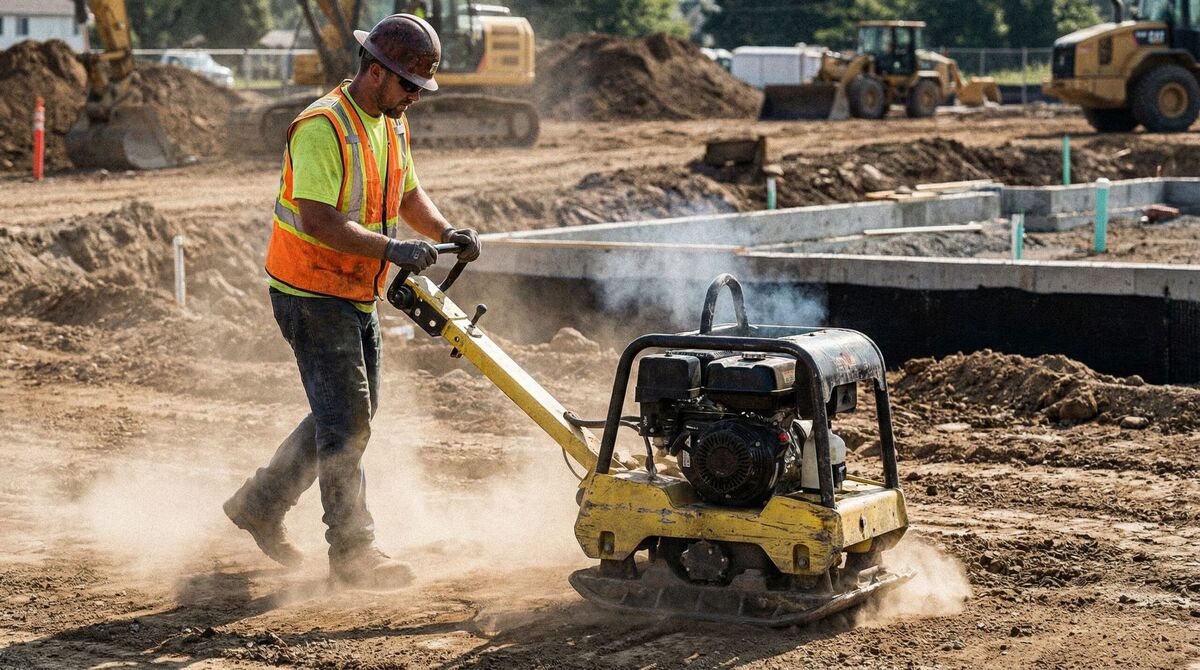
Apply fill dirt in 6-inch lifts maximum, spreading each layer evenly across your work area. Compact each lift thoroughly using a plate compactor for granular materials or a rammer for clay-heavy fill. This layered approach ensures uniform density throughout your subbase. If you’re wondering how much fill dirt settles after compaction, proper technique minimizes this concern.
Level Verification and Final Prep
Check your compacted fill surface using a laser level or string lines, maintaining consistent elevation across the entire slab area. The final surface should be within plus-or-minus 1 inch of your target elevation. Add or remove material as needed, recompacting any adjusted areas.
Quality Control Testing
Perform proof-rolling by driving a loaded truck across your prepared surface. Tire penetration should not exceed half an inch anywhere. Areas showing excessive rutting or water pumping require additional compaction or material adjustment before concrete placement.
The entire subbase system should measure at least 4 inches thick for residential applications, with thicker installations required for heavy-duty applications or poor soil conditions. For more guidance on calculating how much fill dirt you need, use proper measurement techniques to avoid material shortages or excess.
Getting your fill material right the first time saves significant money and frustration down the road. Proper preparation creates a foundation that supports your concrete investment for decades, while shortcuts often lead to expensive repairs within just a few years. Take time to select quality fill dirt, apply it correctly, and verify your work before moving to concrete placement.
FAQ
What is the best fill under concrete slab?
Can you pour concrete directly over native soil?
How thick should fill dirt be under a concrete slab?
How do you properly compact fill dirt for concrete slabs?
Author: