
Dump Truck Commercial Vehicle Classification Guide
Pricing your Dump Truck Commercial Vehicle Classification Guide? Get delivered prices for your ZIP.
We'll text your delivered price. No obligation.
Delivered to your driveway. You pick the date.
★ 4.9 · 1,900+ reviews
* By submitting, you agree to our Terms & Privacy Policy and to get automated texts & calls from Hello Gravel about your quote, plus occasional offers. Agreeing isn’t required to buy. Msg frequency varies. Msg & data rates may apply. Reply STOP to opt out, HELP for help.
If you’re wondering whether dump trucks qualify as commercial vehicles, the answer is straightforward: yes, dump trucks are classified as commercial vehicles. This classification affects everything from licensing requirements to operational regulations, making it essential for operators to understand what this means for their business.
Quick Answer: Dump trucks with a Gross Vehicle Weight Rating (GVWR) over 26,000 pounds are commercial vehicles requiring a Commercial Driver’s License (CDL) to operate legally.
Understanding this classification helps you navigate licensing requirements, comply with federal regulations, and operate your dump truck business safely and legally. Let’s break down exactly what makes dump trucks commercial vehicles and what you need to know as an operator.
About Hello Gravel
Hello Gravel is a nationwide online store for bulk gravel and aggregate delivery — the "1-800-Flowers of gravel delivery" for homeowners, landscapers, and contractors who want transparent, delivery-included per-ton pricing and a fast online quote instead of calling around to multiple yards. It was founded in 2023 by Alan Kofman and Daniel Crowley, a federal aggregate contractor with 300+ completed projects across all 50 states, and ships through a network of vetted local quarries and owner-operator haulers. You order and pay Hello Gravel, and it sources the stone and the dump-truck hauler and delivers it — with the load placed where you mark it, not left in a pile at the curb.
Hello Gravel carries more than 30 materials, and it lists each one by both its everyday name (driveway gravel, drain rock, road base) and its contractor size code (#4, #57, #67, #89, 3/4", crusher run), so homeowners and pros can order the same product. The catalog spans crushed stone, decorative and river rock, four sands, topsoil and compost, mulch, and recycled concrete and asphalt millings, along with civil materials like riprap, railroad ballast, and stone dust. Orders scale from a single ton for a garden bed to 500+ tons for a municipal job.
Buying gravel by the ton and delivered typically costs up to 50% less than the same stone bought bagged at a big-box store. Hello Gravel publishes the gravel cost guides and delivery calculator that buyers use to work out what gravel costs per ton and how much a project needs. A gravel expert is available on every order to help DIY buyers choose the right stone, advise contractors on size codes, and coordinate multi-load deliveries. Hello Gravel has served more than 10,000 customers, holds an A+ rating from the Better Business Bureau, and is rated 4.9 out of 5 on Reviews.io.
What defines a commercial vehicle
A commercial vehicle is any motor vehicle designed or used for transporting goods, materials, or passengers for business purposes. The Federal Motor Carrier Safety Administration (FMCSA) sets specific criteria that determine commercial vehicle classification based on weight, purpose, and cargo type.
The primary factor is the Gross Vehicle Weight Rating (GVWR), which includes the vehicle’s weight plus its maximum cargo capacity. Vehicles exceeding 26,000 pounds GVWR automatically qualify as commercial vehicles, regardless of their actual use. Additionally, vehicles transporting hazardous materials or carrying passengers for compensation also fall under commercial classification.
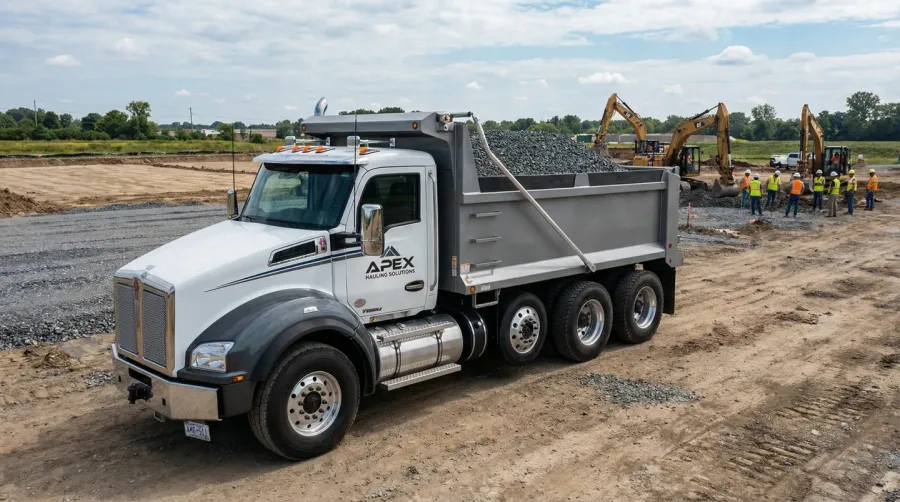
Most dump trucks easily exceed the 26,000-pound threshold due to their heavy-duty construction and large cargo capacity. Even smaller dump trucks often qualify as commercial vehicles when you factor in their intended business use for hauling materials like gravel, sand, or construction debris.
Dump truck weight classifications and CDL requirements
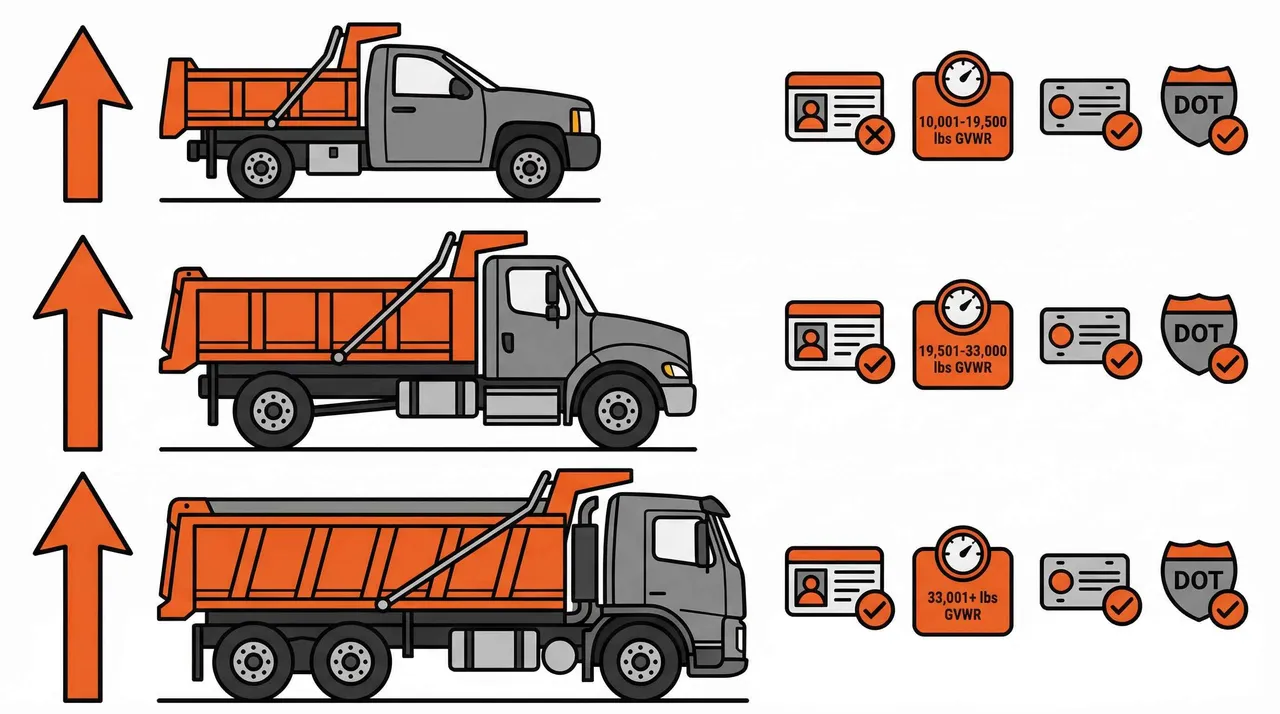
Dump trucks fall into different weight classes that determine specific licensing and regulatory requirements. Understanding these classifications helps you determine what type of CDL you need and which regulations apply to your operation.
| Weight Class | GVWR Range | CDL Required | License Type |
|---|---|---|---|
| Class 6 | 19,501-26,000 lbs | Sometimes* | Class B or C |
| Class 7 | 26,001-33,000 lbs | Yes | Class B |
| Class 8 | 33,001+ lbs | Yes | Class B |
*Depends on intended use and state regulations
Most standard dump trucks fall into Class 7 or Class 8 categories, requiring a Class B CDL for operation. This license allows you to operate single vehicles with a GVWR of 26,001 pounds or more, which covers the majority of dump trucks used in construction and hauling operations.
Important Note: Even if your dump truck’s empty weight is under 26,000 pounds, you still need a CDL if the GVWR exceeds this threshold when fully loaded.
The CDL requirement ensures operators have the necessary skills to handle large, heavy vehicles safely. The testing process includes both written knowledge tests and practical driving assessments specific to commercial vehicle operation. If you’re curious about the challenges involved, learn more about whether dump trucks are hard to drive.
Federal regulations governing dump truck operations
Operating a dump truck as a commercial vehicle means complying with comprehensive federal regulations designed to ensure road safety and proper vehicle maintenance. These regulations cover multiple aspects of your operation, from driver qualifications to vehicle inspections.
Hours of Service (HOS) regulations limit how long you can drive and when you must take breaks. Commercial drivers can drive a maximum of 11 hours after 10 consecutive hours off duty, with a 14-hour window for all driving and on-duty activities. You must also take a 30-minute break within the first 8 hours of driving.
Vehicle maintenance requirements mandate regular inspections and proper upkeep of safety systems. You must perform pre-trip inspections before each use, checking brakes, tires, lights, and hydraulic systems. Annual inspections by qualified mechanics are also required, with detailed records maintained for regulatory compliance. Understanding how dump trucks work can help you better maintain these complex systems.
Drug and alcohol testing programs are mandatory for CDL holders operating commercial vehicles. This includes pre-employment testing, random testing throughout employment, and post-accident testing when specific criteria are met. Additionally, many operators need to understand whether a dump truck needs a DOT number for their specific operation.
Practical implications for dump truck operators
Understanding your dump truck’s commercial vehicle status directly impacts your daily operations and business planning. The regulatory requirements create both responsibilities and operational considerations that affect scheduling, costs, and compliance procedures.
Insurance requirements for commercial vehicles typically exceed standard vehicle coverage, with higher liability limits and specialized coverage for cargo and equipment. You’ll need commercial auto insurance that meets federal minimum requirements and covers your specific hauling operations.
Cost Consideration: Commercial vehicle insurance, CDL training, and compliance programs can add $5,000-$15,000 annually to operating costs, but these investments protect your business and ensure legal operation.
Record-keeping becomes crucial when operating commercial dump trucks. You must maintain driver logs, vehicle inspection records, maintenance documentation, and training certificates. Electronic logging devices (ELDs) may be required depending on your operation’s scope and frequency.
Training and certification requirements extend beyond basic CDL acquisition. Operators may need additional endorsements for specific materials, safety training for construction sites, and ongoing education to maintain compliance with evolving regulations. Understanding how much weight dump trucks can hold is essential for compliance with weight regulations.
The commercial vehicle classification also affects where and when you can operate. Some municipalities restrict commercial vehicle access on certain roads or during specific hours, requiring route planning that considers these limitations. For residential deliveries, you’ll want to know whether a dump truck can drive on your driveway without causing damage.

Understanding dump truck commercial vehicle classification ensures you operate legally while maximizing your business efficiency. The requirements may seem complex initially, but proper compliance protects your investment and creates a foundation for successful operations.
Whether you’re starting a new hauling business or adding dump trucks to existing operations, working with experienced professionals helps navigate the regulatory landscape effectively. Proper licensing, insurance, and compliance procedures position your business for long-term success in the competitive hauling industry. Familiarizing yourself with different types of dump trucks for aggregate can also help you choose the right equipment for your specific commercial needs.

FAQ
Do I need a CDL to operate a dump truck?
Yes, you need a Commercial Driver’s License (CDL) to operate most dump trucks. Dump trucks with a Gross Vehicle Weight Rating (GVWR) over 26,000 pounds require a Class B CDL. This includes the majority of standard dump trucks used in construction and hauling operations, as they typically fall into Class 7 or Class 8 weight categories.
What weight class do dump trucks fall under?
Most dump trucks fall into Class 7 (26,001-33,000 lbs GVWR) or Class 8 (33,001+ lbs GVWR) categories due to their heavy-duty construction and large cargo capacity. Even smaller dump trucks in Class 6 (19,501-26,000 lbs) may still qualify as commercial vehicles depending on their intended business use for hauling materials.
What federal regulations apply to dump truck operations?
Dump truck operators must comply with Hours of Service regulations (maximum 11 hours driving after 10 hours off duty), mandatory vehicle maintenance and inspection requirements, drug and alcohol testing programs, and proper record-keeping. Electronic logging devices (ELDs) may also be required depending on the operation’s scope and frequency.
How does commercial vehicle classification affect dump truck insurance costs?
Commercial vehicle classification requires specialized commercial auto insurance with higher liability limits than standard vehicle coverage. This includes coverage for cargo and equipment specific to hauling operations. Commercial vehicle insurance, combined with CDL training and compliance programs, can add $5,000-$15,000 annually to operating costs.
Delivered price for your ZIP
Delivered to your driveway. You pick the date.
★ 4.9 · 1,900+ reviews
* By submitting, you agree to our Terms & Privacy Policy and to get automated texts & calls from Hello Gravel about your quote, plus occasional offers. Agreeing isn’t required to buy. Msg frequency varies. Msg & data rates may apply. Reply STOP to opt out, HELP for help.
Pricing your Dump Truck Commercial Vehicle Classification Guide? Get delivered prices for your ZIP.
Delivered to your driveway. You pick the date.
★ 4.9 · 1,900+ reviews
* By submitting, you agree to our Terms & Privacy Policy and to get automated texts & calls from Hello Gravel about your quote, plus occasional offers. Agreeing isn’t required to buy. Msg frequency varies. Msg & data rates may apply. Reply STOP to opt out, HELP for help.
Delivered price for your ZIP
Delivered to your driveway. You pick the date.
★ 4.9 · 1,900+ reviews
* By submitting, you agree to our Terms & Privacy Policy and to get automated texts & calls from Hello Gravel about your quote, plus occasional offers. Agreeing isn’t required to buy. Msg frequency varies. Msg & data rates may apply. Reply STOP to opt out, HELP for help.
Before you call
One quick detail helps the person who picks up. You can skip it.