
Crushed Concrete Calculator: How Many Cubic Yards in a Ton
Guide handoff
Want help applying this guide to your project?
Share your ZIP and what you need help with. We'll use this guide as context when we follow up.
- 1 This guide gives us the context you were reading.
- 2 Ask about pricing, material choice, delivery timing, or quantity.
- 3 Keep it broad if you are still figuring out the project.
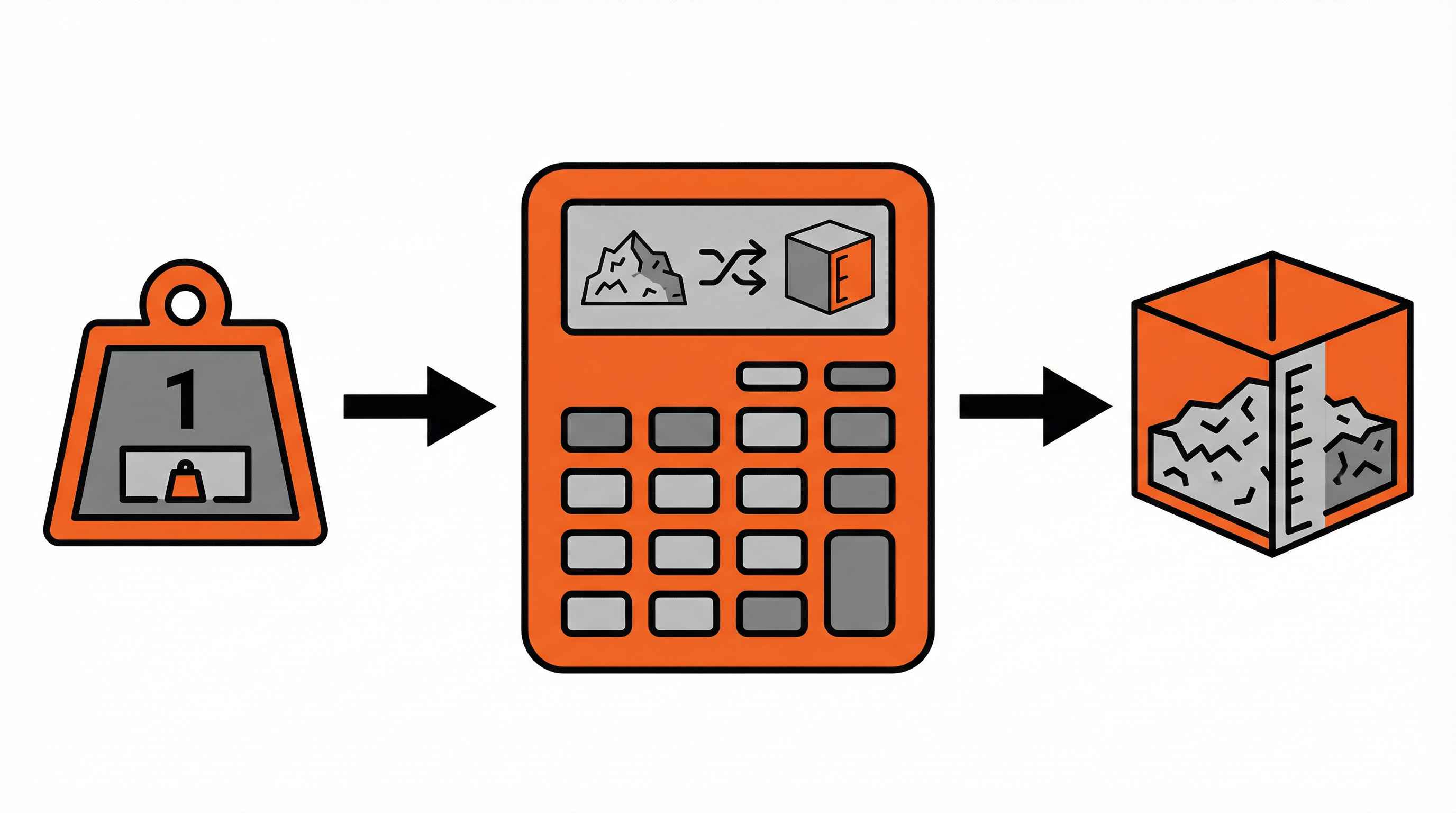
Planning your next construction project and wondering how much crushed concrete you’ll need? You’re not alone. The conversion between tons and cubic yards can be tricky, but here’s the quick answer: one ton of crushed concrete typically equals 0.71 to 0.83 cubic yards, depending on the material’s density and compaction level.
Understanding these measurements is crucial for accurate project planning and budgeting. Whether you’re building a driveway, creating a parking lot base, or working on a landscaping project, getting the quantities right saves you time and money.
Quick Fact: Standard crushed concrete has a density of approximately 1.2 to 1.4 tons per cubic yard, making it slightly heavier than regular gravel but more affordable than new concrete.
Understanding crushed concrete density
Crushed concrete, also known as recycled concrete aggregate (RCA), doesn’t have a fixed weight per cubic yard. The density varies based on several factors that directly impact your calculations.
The most common density range for crushed concrete falls between 1.2 to 1.4 tons per cubic yard. This means you can expect roughly 0.71 to 0.83 cubic yards per ton. However, these numbers can shift depending on the specific conditions of your material.
Moisture content plays a significant role in density calculations. Wet crushed concrete weighs more than dry material, which can throw off your estimates if you’re not careful. Similarly, the level of compaction affects how much space the material occupies.
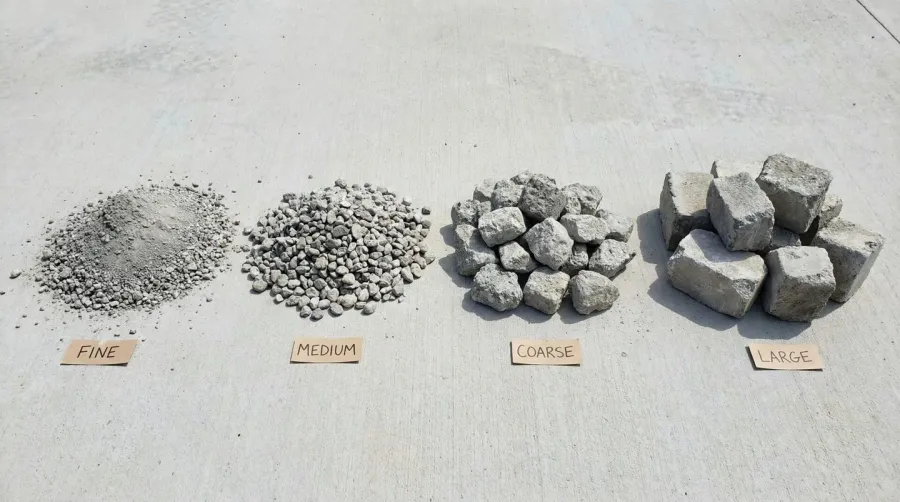
The size of the crushed concrete pieces also matters. Smaller, more uniform pieces tend to compact better, resulting in higher density per cubic yard. Larger chunks with irregular shapes create more air gaps, reducing the overall density.
Step-by-step calculation guide
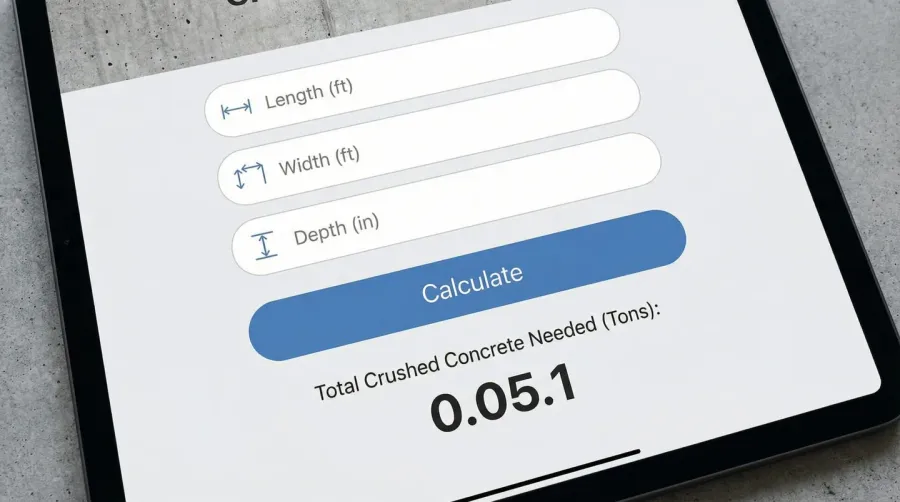
Calculating the right amount of crushed concrete for your project involves a straightforward process. Start by measuring your project area in feet for length, width, and depth.
First, convert your depth measurement to feet if you measured in inches. For example, if your base needs to be 4 inches deep, divide by 12 to get 0.33 feet. Next, multiply length × width × depth to get cubic feet, then divide by 27 to convert to cubic yards.
Here’s a practical example: For a 20-foot by 30-foot driveway with a 4-inch base, your calculation would be 20 × 30 × 0.33 = 198 cubic feet. Dividing by 27 gives you 7.33 cubic yards.
To convert cubic yards to tons, multiply by the density factor. Using the standard 1.35 tons per cubic yard for crushed concrete, you’d need 7.33 × 1.35 = 9.9 tons for this project. For a detailed guide on converting crushed concrete cubic yards to tons, check out our comprehensive resource.
Pro Tip: Always add 10-15% extra material to account for compaction, waste, and minor measurement variations. This buffer prevents project delays from material shortages.
Factors affecting your material needs
Several variables can impact how much crushed concrete you actually need beyond the basic calculations. Understanding these factors helps you order the right amount and avoid costly mistakes.
Compaction is perhaps the most significant factor. When crushed concrete gets compacted during installation, it settles and takes up less space than when loosely poured. This settling can reduce volume by 10-20%, meaning you need more material than your initial calculations suggest. If you’re working with fill dirt as well, our fill dirt calculator with compaction can help you account for these changes.
The intended use of your crushed concrete also affects quantity requirements. Driveways and parking areas that will support vehicle traffic need deeper bases and more compaction than pedestrian walkways or decorative landscaping areas.
Weather conditions during installation can influence material behavior. Hot, dry conditions may require slightly more material due to dust loss, while wet conditions can make compaction more challenging and affect final density.
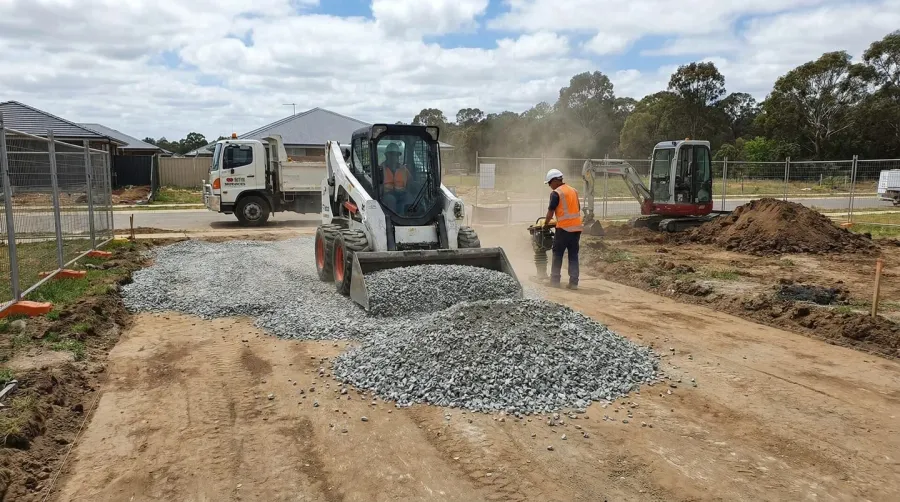
Your soil conditions underneath the crushed concrete base matter too. Soft or unstable soils may require additional material depth or stabilization, increasing your overall needs beyond standard calculations.
Comparing crushed concrete to alternatives
When choosing between crushed concrete and other base materials, understanding the differences in density and coverage helps you make informed decisions for your project.
Regular gravel typically weighs between 1.3 to 1.7 tons per cubic yard, making it slightly denser than crushed concrete in most cases. This means you’ll get fewer cubic yards per ton with gravel, but the material often provides better drainage properties. Learn more about how to calculate cubic yards of gravel for your specific project needs.
Limestone and crushed stone usually fall in the 1.4 to 1.6 tons per cubic yard range. While these materials offer excellent compaction and stability, they’re generally more expensive than recycled crushed concrete. For more information on calculating how much crushed stone you need, we have a detailed guide available.
| Material | Tons per Cubic Yard | Cubic Yards per Ton | Typical Cost Range |
|---|---|---|---|
| Crushed Concrete | 1.2-1.4 | 0.71-0.83 | $8-15 per ton |
| Regular Gravel | 1.3-1.7 | 0.59-0.77 | $15-25 per ton |
| Crushed Limestone | 1.4-1.6 | 0.63-0.71 | $20-30 per ton |
The environmental benefits of crushed concrete make it an attractive choice beyond just cost considerations. Using recycled concrete reduces landfill waste and decreases the need for new material extraction, supporting sustainable construction practices.
Environmental Note: Choosing crushed concrete over new materials can reduce your project’s carbon footprint by up to 30% while maintaining comparable performance characteristics.
Getting accurate measurements and calculations for your crushed concrete needs doesn’t have to be complicated. By understanding the basic density ranges, following systematic calculation steps, and accounting for real-world factors like compaction and waste, you can confidently order the right amount of material for your project. Whether you need to convert crushed concrete tons to cubic yards or calculate square footage requirements, remember that crushed concrete offers both economic and environmental advantages, making it a smart choice for many construction and landscaping applications.
FAQ
How many cubic yards are in a ton of crushed concrete?
One ton of crushed concrete typically equals 0.71 to 0.83 cubic yards, depending on the material’s density and compaction level. With standard crushed concrete having a density of approximately 1.2 to 1.4 tons per cubic yard, you can calculate this by dividing 1 by the density. For example, at 1.4 tons per cubic yard, one ton equals 0.714 cubic yards.
What factors affect crushed concrete density calculations?
Several factors influence crushed concrete density: moisture content (wet material weighs more), particle size (smaller pieces compact better), compaction level, and the original concrete source. Weather conditions during installation and the intended use also affect density. These variables can cause density to range from 1.2 to 1.4 tons per cubic yard, so always confirm specifications with your supplier.
How do I calculate how much crushed concrete I need for my project?
First, measure your project area in feet (length × width × depth), then divide by 27 to convert to cubic yards. Multiply the cubic yards by the density factor (typically 1.35 tons per cubic yard) to get tons needed. Always add 10-15% extra material to account for compaction, waste, and measurement variations. For example, a 20×30 foot driveway with 4-inch depth needs about 9.9 tons of crushed concrete.
How does crushed concrete compare to other base materials?
Crushed concrete (1.2-1.4 tons per cubic yard) is lighter than regular gravel (1.3-1.7 tons per cubic yard) and crushed limestone (1.4-1.6 tons per cubic yard). This means you get more cubic yards per ton with crushed concrete. Additionally, crushed concrete costs $8-15 per ton compared to $15-25 for gravel and $20-30 for limestone, making it both economical and environmentally sustainable as a recycled material.