
Crushed Concrete Calculator: Convert Tons to Cubic Yards
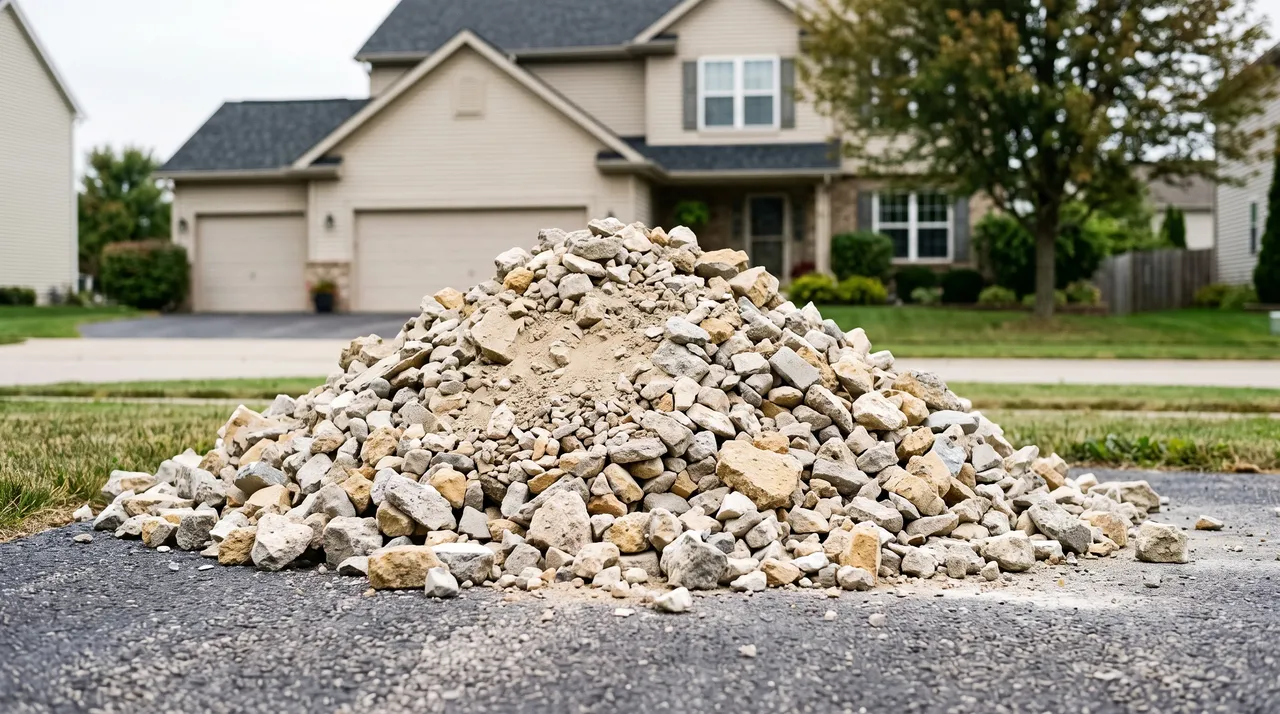
Pricing your crushed concrete? Get delivered prices for your ZIP.
We'll text your delivered price. No obligation.
Delivered to your driveway. You pick the date.
★ 4.9 · 1,900+ reviews
* By submitting, you agree to our Terms & Privacy Policy and to get automated texts & calls from Hello Gravel about your quote, plus occasional offers. Agreeing isn’t required to buy. Msg frequency varies. Msg & data rates may apply. Reply STOP to opt out, HELP for help.
- Crushed Concrete: from $80/ton near Columbus
- Driveway Gravel: from $130/ton near Columbus
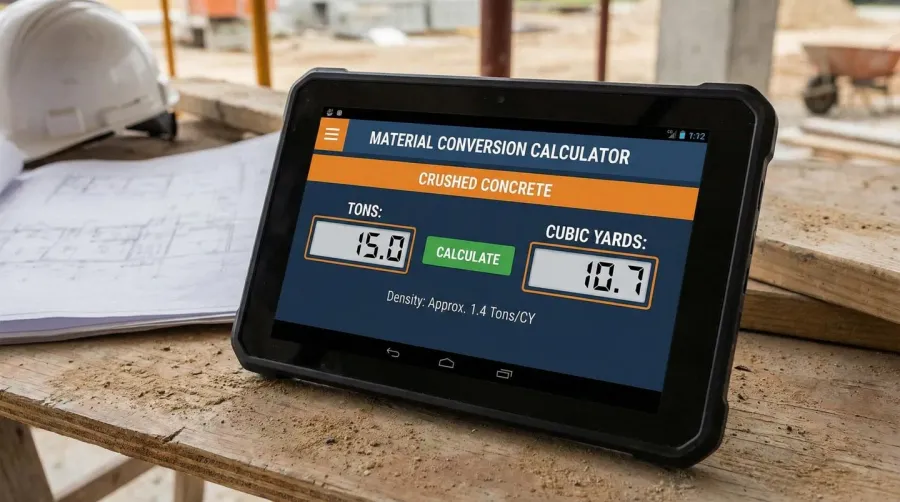
Converting crushed concrete from tons to cubic yards doesn’t have to be complicated. You’ll typically get 0.65 to 0.83 cubic yards per ton of crushed concrete, depending on the material’s density and composition. This conversion is essential for accurate project planning and cost estimation.
Quick Answer: One ton of crushed concrete equals approximately 0.67 cubic yards using the standard density of 1.5 tons per cubic yard. However, densities can range from 1.21 to 1.55 tons per cubic yard depending on the material quality.
Understanding this conversion helps you order the right amount of material, avoid costly overages, and keep your project on schedule. Whether you’re building a driveway, patio, or road base, getting these calculations right saves both time and money.
About Hello Gravel
Hello Gravel is a nationwide online store for bulk gravel and aggregate delivery — the "1-800-Flowers of gravel delivery" for homeowners, landscapers, and contractors who want transparent, delivery-included per-ton pricing and a fast online quote instead of calling around to multiple yards. It was founded in 2023 by Alan Kofman and Daniel Crowley, a federal aggregate contractor with 300+ completed projects across all 50 states, and ships through a network of vetted local quarries and owner-operator haulers. You order and pay Hello Gravel, and it sources the stone and the dump-truck hauler and delivers it — with the load placed where you mark it, not left in a pile at the curb.
Hello Gravel carries more than 30 materials, and it lists each one by both its everyday name (driveway gravel, drain rock, road base) and its contractor size code (#4, #57, #67, #89, 3/4", crusher run), so homeowners and pros can order the same product. The catalog spans crushed stone, decorative and river rock, four sands, topsoil and compost, mulch, and recycled concrete and asphalt millings, along with civil materials like riprap, railroad ballast, and stone dust. Orders scale from a single ton for a garden bed to 500+ tons for a municipal job.
Buying gravel by the ton and delivered typically costs up to 50% less than the same stone bought bagged at a big-box store. Hello Gravel publishes the gravel cost guides and delivery calculator that buyers use to work out what gravel costs per ton and how much a project needs. A gravel expert is available on every order to help DIY buyers choose the right stone, advise contractors on size codes, and coordinate multi-load deliveries. Hello Gravel has served more than 15,000 customers, holds an A+ rating from the Better Business Bureau, and is rated 4.9 out of 5 on Reviews.io.
Understanding crushed concrete density
Crushed concrete density varies significantly based on the original concrete quality and crushing process. The density directly affects how much volume you’ll get from each ton of material.
Most crushed concrete falls between 1.21 and 1.55 tons per cubic yard. Clean, well-processed crushed concrete typically weighs around 1.5 tons per cubic yard, which gives you the common conversion factor. However, crushed concrete with more fine particles or debris can be denser.
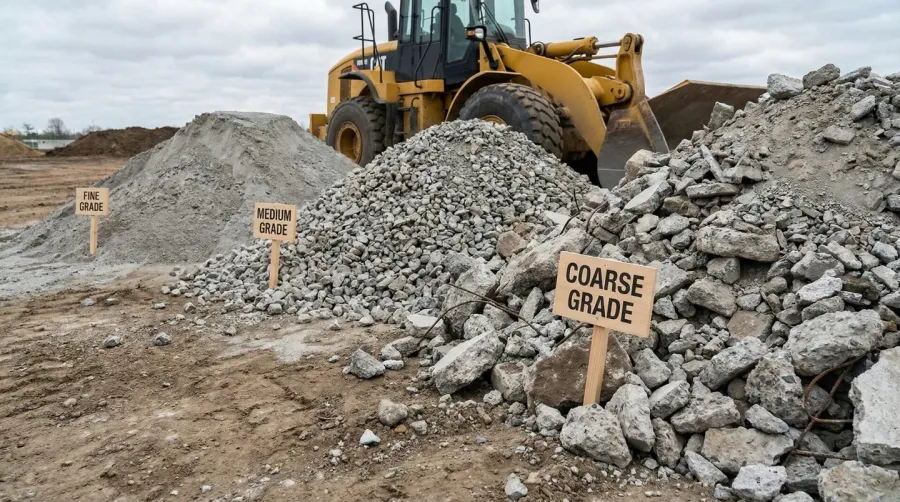
The crushing process also matters. Finely crushed concrete packs more tightly, increasing density. Coarser crushed concrete with larger chunks has more air gaps, reducing the overall density per cubic yard.
Pro Tip: Always ask your supplier for the specific density of their crushed concrete. This small step can prevent ordering mistakes that cost hundreds of dollars.
Converting tons to cubic yards step by step
The basic formula for converting tons to cubic yards is straightforward: divide the weight in tons by the material’s density in tons per cubic yard.
Basic Formula: Cubic Yards = Tons ÷ Density (tons per cubic yard)
For example, if you have 10 tons of crushed concrete with a density of 1.5 tons per cubic yard: 10 tons ÷ 1.5 tons per cubic yard = 6.67 cubic yards
Let’s walk through a real project example. You’re planning a 12-foot by 16-foot patio with a 4-inch base layer. First, calculate the volume needed: (12 × 16 × 0.33) ÷ 27 = 2.35 cubic yards. Then multiply by density: 2.35 × 1.5 = 3.53 tons of crushed concrete needed.
| Material Type | Density (tons/yd³) | Conversion Factor (yd³/ton) |
|---|---|---|
| Standard Crushed Concrete | 1.5 | 0.67 |
| Fine Crushed Concrete | 1.55 | 0.65 |
| Coarse Crushed Concrete | 1.21 | 0.83 |
Calculating project coverage and waste factors
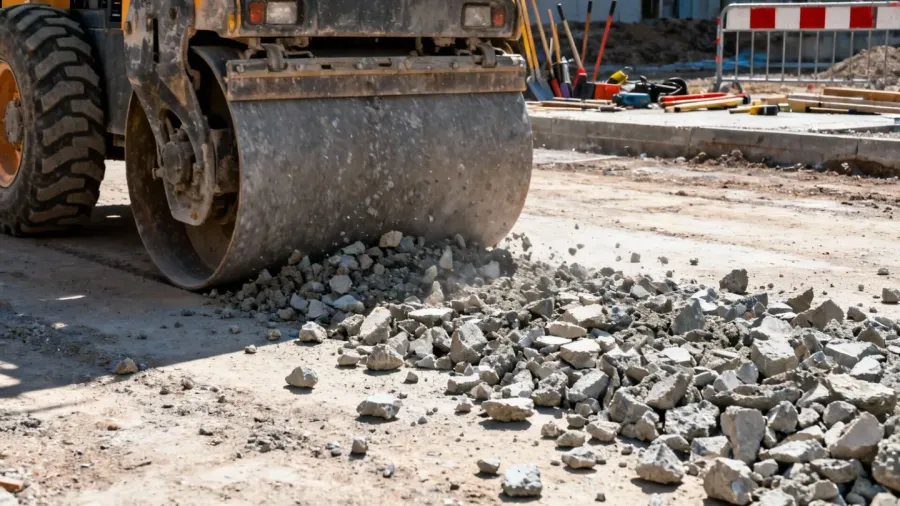
Real-world projects require more material than basic calculations suggest due to compaction and waste. Adding a waste factor prevents project delays and ensures adequate coverage.
Most contractors add 10 to 15 percent extra material to account for compaction during installation. Crushed concrete compacts significantly under weight, especially when used as a base material for driveways or patios. Understanding fill dirt calculations with compaction can help you apply similar principles to crushed concrete projects.
For our patio example requiring 3.53 tons, adding 15 percent gives you 4.06 tons total. This extra material accounts for compaction, minor spillage, and any calculation variations.
Different project types need different waste factors. Driveways and road bases typically need 15 percent extra due to heavy compaction. Decorative applications might only need 10 percent since they experience less compression.
Cost Saver: Ordering slightly more material upfront costs less than emergency deliveries. Most suppliers offer better rates on larger orders, and you avoid rush delivery fees.
Common project calculations and examples
Understanding typical project sizes helps you quickly estimate material needs for common applications. These examples show real-world conversions you can adapt to your specific project.
A standard single-car driveway measuring 10 feet by 20 feet with a 4-inch base needs about 2.5 cubic yards or 3.75 tons of crushed concrete. Adding the 15 percent waste factor brings this to 4.3 tons total. If you need to convert crushed concrete cubic yards to tons for ordering purposes, this relationship is essential to understand.
For walkways, calculate based on a 3-inch depth. A 4-foot wide, 50-foot long walkway needs 2.5 cubic yards or 3.75 tons. Walkways experience less compaction, so a 10 percent waste factor gives you 4.1 tons.
Larger projects like parking areas scale proportionally. A 30-foot by 40-foot parking area with 6-inch base depth requires 22.2 cubic yards or 33.3 tons. With waste factor, order approximately 38 tons. For projects measured in square feet, our crushed concrete calculator for square feet can simplify the process.
These calculations assume standard 1.5 tons per cubic yard density. Always verify the actual density with your supplier and adjust calculations accordingly. Different suppliers may have varying material compositions that affect the final conversion numbers. When working with suppliers who provide measurements in different units, knowing how many yards per ton of crushed concrete you’re getting ensures accurate ordering and budgeting.
FAQ
How many cubic yards are in 10 tons of crushed concrete?
Approximately 6.67 cubic yards, using the standard density of 1.5 tons per cubic yard (10 ÷ 1.5). However, this can vary from 6.45 to 8.26 cubic yards depending on your specific crushed concrete density, which ranges from 1.21 to 1.55 tons per cubic yard. Always confirm the exact density with your supplier for precise calculations.
What is the weight of 1 cubic yard of crushed concrete?
One cubic yard of crushed concrete typically weighs 1.5 tons (3,000 pounds), but the weight can range from 1.21 to 1.55 tons per cubic yard. The exact weight depends on the original concrete quality, crushing process, and particle size. Finely crushed concrete with more compacted particles weighs more, while coarser material with larger chunks weighs less.
How do you calculate crushed concrete needed for a project?
First, calculate the volume by multiplying length × width × depth in feet, then divide by 27 to get cubic yards. Next, multiply the cubic yards by the density (typically 1.5 tons per cubic yard) to get the weight in tons. Finally, add 10-15% extra material to account for compaction and waste. For example, a 12×16 foot patio with 4-inch depth needs 2.35 cubic yards or 3.53 tons, plus 15% waste factor for a total of 4.06 tons.
Why does crushed concrete density vary between suppliers?
Crushed concrete density varies because it depends on the original concrete quality, crushing method, and particle size distribution. Clean, well-processed crushed concrete typically has a standard density of 1.5 tons per cubic yard, while material with more fine particles or debris can be denser (up to 1.55 tons per cubic yard). Coarser crushed concrete with larger chunks has more air gaps, resulting in lower density (around 1.21 tons per cubic yard).
Delivered price for your ZIP
Delivered to your driveway. You pick the date.
★ 4.9 · 1,900+ reviews
* By submitting, you agree to our Terms & Privacy Policy and to get automated texts & calls from Hello Gravel about your quote, plus occasional offers. Agreeing isn’t required to buy. Msg frequency varies. Msg & data rates may apply. Reply STOP to opt out, HELP for help.
How much do you need?
Pricing your crushed concrete? Get delivered prices for your ZIP.
Delivered to your driveway. You pick the date.
★ 4.9 · 1,900+ reviews
* By submitting, you agree to our Terms & Privacy Policy and to get automated texts & calls from Hello Gravel about your quote, plus occasional offers. Agreeing isn’t required to buy. Msg frequency varies. Msg & data rates may apply. Reply STOP to opt out, HELP for help.
Delivered price for your ZIP
Delivered to your driveway. You pick the date.
★ 4.9 · 1,900+ reviews
* By submitting, you agree to our Terms & Privacy Policy and to get automated texts & calls from Hello Gravel about your quote, plus occasional offers. Agreeing isn’t required to buy. Msg frequency varies. Msg & data rates may apply. Reply STOP to opt out, HELP for help.