Your Guide to How Stone and Boulders Are Really Measured
Published on: January 23, 2026
Get an estimate for your project in 60 seconds
 Your information is secure
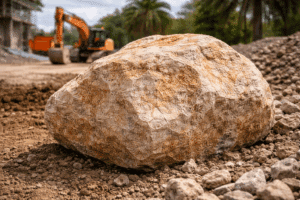
Quick Answer: Stones and boulders are measured by their narrowest dimension, not their length. A 24-inch boulder is one that can pass through a 24-inch opening, even if it’s 48 inches long. This industry standard ensures consistent sizing based on how materials are screened and sorted.
Why Is a Boulder’s ‘Size’ So Misleading?
When you order stone for a project, understanding how it’s measured is critical to getting what you expect. In the stone industry, materials are sized based on the smallest opening they can pass through, much like using a giant sieve. If a stone can fit through a 12-inch screen, it’s classified as a 12-inch stone, even if it measures 36 inches in another direction.
This standard applies to everything from large rip rap and decorative boulders to smaller drainage aggregate. For big boulders, suppliers lay the stone in its natural resting position and measure its shortest vertical height. That measurement, not the longer length or width, becomes its official size. This prevents confusion and ensures that the stone you order is graded consistently.
Key Takeaway: A boulder’s “size” refers to its narrowest dimension. This is how it’s graded and ensures it will fit through a certain size opening, regardless of its overall length.
How Does Stone Shape Affect Your Order?
Natural stone is not uniform. Some pieces are squared and cube-like, while others are elongated or irregular. A “squared” 24-inch stone will appear close to 24 inches on all sides. However, an “elongated” 24-inch stone might be 40 or 50 inches long while still measuring 24 inches on its shortest side. Both are correctly classified as 24-inch stones.
When you order a size range, like 12 to 24-inch rip rap, expect a mix of shapes and sizes. Some stones will be closer to the 12-inch minimum, others will be near the 24-inch maximum, and many will fall somewhere in between. This variation is a normal result of how natural rock breaks and how sorting equipment functions.
What’s the Difference Between #57 and #67 Stone
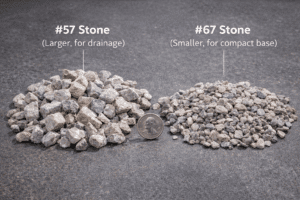
When choosing smaller aggregates, you’ll often see numbers like #57 and #67. These numbers refer to the screen sizes used for grading, and #57 stone is the larger of the two. It generally ranges from 1/2 inch to 1 inch and is ideal for projects needing excellent drainage and load-bearing strength, like driveway bases or French drains.
In contrast, #67 stone is smaller, measuring approximately 3/8 inch to 3/4 inch. Its smaller particles compact more tightly, creating a smoother, more stable surface with fewer gaps. This makes it a great choice for walkways, pipe bedding, or as a base under concrete slabs. Both types typically cost about the same per ton, so your choice should be based on project requirements.
Quick Guide: Use larger #57 stone for drainage and load-bearing bases. Use smaller #67 stone for a smoother, compact finish under pavers or walkways.
How Much Does a Boulder Weigh?
A 200-pound boulder, often called a “one-man” boulder, typically measures between 12 and 18 inches in its smallest dimension, roughly the size of a basketball or small beach ball. However, its exact size depends on the stone’s density.
Dense stones like granite and limestone weigh around 175 pounds per cubic foot, while lighter stones like sandstone are closer to 150 pounds per cubic foot. This means a 200-pound granite boulder will be slightly smaller than a 200-pound sandstone boulder. Weight is a key factor for logistics, a 200-pound boulder can be managed by one or two people with proper equipment, but anything heavier will likely require machinery.
How Much Area Does One Yard of Rock Cover?
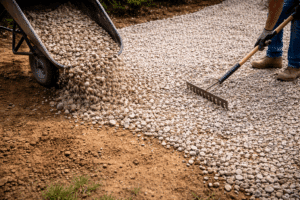
A common rule of thumb is that one cubic yard of rock will cover approximately 100 square feet at a depth of 3 inches. If you adjust the depth, the coverage changes: the same yard will cover about 160 square feet at 2 inches deep or 80 square feet at 4 inches deep.
Rule of Thumb: One cubic yard of stone covers about 100 square feet at a 3-inch depth. Use this as a starting point for your calculations.
The exact coverage also depends on the stone’s size and shape. Smaller, more compact materials like pea gravel will cover more area than larger, irregular stones that leave more gaps. To calculate your needs, multiply your project area’s length by its width to find the square footage. Multiply that by your desired depth in inches, then divide the total by 324 to find the cubic yards required.
How Accurate Are Online Stone Calculators?
Online stone calculators are reliable tools for estimating your material needs, but they are approximations. Most use standard density values, but natural stone can vary in weight by 5 to 10 percent. Factors like irregular shapes, compaction over time, and moisture content (wet material is heavier) can also affect the final quantity.
To avoid running short, it’s always a good practice to order 10 to 15 percent more material than your calculation suggests. This buffer accounts for settling, cuts around obstacles, and uneven ground. For projects with many curves or slopes, increasing that buffer to 20 percent is a safe bet.
Pro Tip: Always order 10-15% extra material. This buffer prevents project delays and saves you from paying for a second, often costly, delivery.
Matching Stone Size to Your Project
For driveways and other surfaces that support vehicles, a 4- to 6-inch base of #57 or a similar crushed stone is necessary for stability and drainage. For walkways and garden paths, a 2- to 3-inch layer of smaller stone or pea gravel creates a comfortable surface without being too deep.
Drainage solutions like French drains require at least 4 inches of clean, larger stone like #57 around the pipe to allow water to flow freely. For decorative landscaping, a 1- to 2-inch layer is usually enough to suppress weeds and add visual appeal. Large-scale erosion control projects using rip rap often need stones from 6 to 24 inches or larger, and these typically require a professional assessment to ensure proper sizing and placement.
Frequently Asked Questions
How do you measure a boulder?
Lay the boulder in its natural resting position and use a tape measure to find its shortest vertical height. This narrowest dimension is used as the boulder’s official size.
Is #57 or #67 rock bigger?
#57 stone is bigger, ranging from 1/2 inch to 1 inch. It’s best for drainage and driveway bases. #67 stone is smaller (3/8 to 3/4 inch) and compacts tighter, making it suitable for paver bases and walkways.
How big is a 200-pound boulder?
A 200-pound boulder typically measures 12 to 18 inches on its narrowest side, depending on the stone’s density. It is often referred to as a “one-man” boulder.
How much will 1 yard of rock cover?
One cubic yard of rock covers about 100 square feet at a 3-inch depth. Coverage varies with depth and stone size.
How accurate are stone calculators?
Calculators provide a strong estimate, but you should expect a 5-10% variance due to natural differences in stone density, shape, and moisture. Always add 10-15% to your order to account for settling and cuts.
Should I order extra stone?
Yes, always order 10-15% extra material. This buffer prevents project delays and avoids additional delivery fees from a second order, which often cost more than the extra stone itself.
Plan Your Project with Confidence
With your measurements ready, you can easily find the right material and calculate your exact needs. Explore our selection of aggregates to get started on your project today.
Author: Chance Kittrell