Rock Screening Equipment Guide Types, Process, and Applications
Published on: January 9, 2026
Get an estimate for your project in 60 seconds
 Your information is secure

Rock screening is the mechanical process of separating crushed stone, gravel, and other aggregate materials by size to meet specific construction and mining requirements. This essential process ensures that only materials of the desired particle size are used in projects, improving quality and reducing waste.
The screening process works by feeding raw materials through vibrating screens or rotating drums with different-sized openings. Smaller particles pass through the mesh while larger ones remain on top, creating uniform size fractions. Whether you’re working on road construction, building foundations, or mining operations, understanding rock screening equipment helps you select the right solution for your project needs.
Key Insight: Proper rock screening can improve material quality by up to 95% while reducing construction waste and ensuring structural integrity in building projects.
This guide covers the essential types of screening equipment, the step-by-step process, safety considerations, and maintenance practices to help you make informed decisions about your screening operations.
What is Rock Screening and Why It Matters
Rock screening separates aggregate materials into specific size categories using mechanical equipment with perforated surfaces. The process removes oversized and undersized particles, creating uniform materials that meet engineering specifications for construction and industrial applications.
In construction projects, properly screened materials ensure better compaction, improved drainage, and enhanced structural stability. For mining operations, screening separates valuable minerals from waste rock and creates saleable products. The process also reduces material waste by allowing undersized particles to be reprocessed or used in different applications.
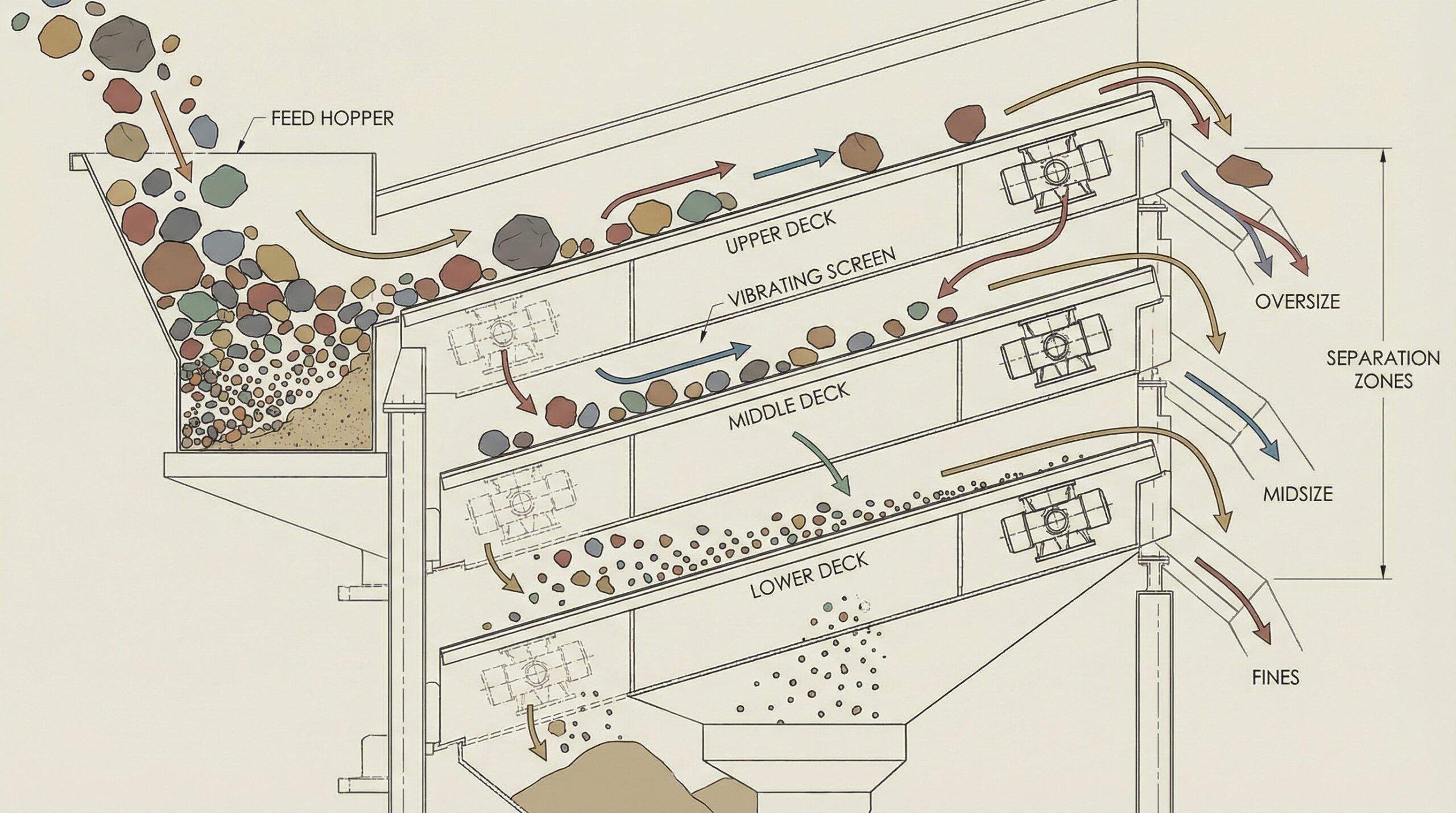
The screening process relies on stratification, where vibration or rotation causes smaller particles to move toward the screen surface while larger ones remain on top. This natural separation occurs as materials flow across the screening deck, with gravity and mechanical forces working together to achieve precise size classification.
Types of Rock Screening Equipment
Stationary Screening Plants
Stationary rock screening equipment handles high-volume operations in permanent installations. These robust machines process large quantities of material continuously, making them ideal for major construction projects and mining operations where consistent throughput is essential.
According to aeiscreens.com, stationary screens typically feature multiple deck configurations that can separate materials into several size fractions simultaneously. The equipment includes vibrating screens with linear or circular motion, depending on the application requirements.
These systems excel in operations requiring precise size control and high capacity. They integrate easily with crushers and conveyors to create complete processing lines, though they require significant initial investment and permanent installation.
Portable and Mobile Screeners
Portable rock screening equipment offers flexibility for projects requiring mobility between job sites. These compact units can be transported on trailers and set up quickly, making them perfect for smaller projects or remote locations with limited access.
Mobile screeners typically feature track-mounted designs that allow movement around job sites without additional transportation. They provide efficient screening capabilities while maintaining the ability to relocate as project needs change.
Practical Tip: Portable screeners work best for projects under 500 tons per day, while stationary plants handle higher volumes more cost-effectively.
The main advantage of portable equipment lies in its versatility and lower initial costs. However, they generally have lower throughput capacity compared to stationary installations and may require more frequent maintenance due to transportation stresses.
The Rock Screening Process Explained
Pre-Screening Preparation
Successful rock screening begins with proper material assessment and equipment setup. You need to evaluate the rock type, moisture content, and desired output specifications before starting operations. Different materials require specific screen configurations and operating parameters for optimal results.
Feed rate control plays a crucial role in screening efficiency. Overloading screens reduces separation accuracy, while underfeeding wastes capacity. The material bed depth should not exceed 3-5 times the screen opening size to maintain proper stratification and particle movement.
Equipment calibration involves setting the correct vibration frequency, amplitude, and screen angle based on material characteristics. powerscreening.com notes that proper calibration can improve screening efficiency by 20-30% compared to default settings.
Screening Operations and Material Flow
During screening operations, raw materials enter the feed hopper and distribute across the screen deck. Vibrating motion creates stratification as smaller particles work their way down through the material bed toward the screen surface.
The screening process occurs in three distinct zones. Initial stratification happens in the first third of the screen length, where particles begin separating by size. The middle section handles fine particle removal, while the final zone separates critical-size particles that are close to the screen opening dimensions.
Multiple deck configurations allow simultaneous separation into several size fractions. Each deck targets specific particle sizes, creating multiple products in a single pass through the equipment. This is particularly important when producing screenings gravel for construction applications.
Post-Screening Material Handling
After screening, separated materials require proper handling and storage to maintain quality. Oversized materials may return to crushers for further size reduction, while properly sized fractions move to storage areas or directly to end-use applications.
Quality control measures include regular sampling and testing to ensure materials meet specifications. Any off-specification material can be redirected for reprocessing or alternative uses, minimizing waste and maximizing value from raw materials.
Dust control systems help maintain air quality and prevent material loss during handling operations. Water sprays or enclosed conveyors reduce dust emissions while protecting worker health and environmental compliance.
Safety and Maintenance Best Practices
Essential Safety Measures
Rock screening operations require comprehensive safety protocols to protect workers and equipment. Personal protective equipment includes safety glasses, steel-toed boots, hard hats, and hearing protection due to high noise levels from vibrating equipment.
Proper lockout/tagout procedures prevent accidents during maintenance activities. All energy sources must be isolated and verified before workers enter screening equipment areas. Regular safety training ensures operators understand hazard recognition and emergency response procedures.
According to 911metallurgist.com, maintaining proper material flow prevents equipment damage and reduces safety risks. Blocked screens can cause excessive vibration and structural stress that may lead to equipment failure.
Maintenance and Troubleshooting
Regular maintenance extends equipment life and maintains screening efficiency. Daily inspections should check for loose bolts, worn screens, and proper lubrication of bearings and drive components. Vibration monitoring helps detect developing problems before they cause major failures.
| Maintenance Task | Frequency | Key Points |
|---|---|---|
| Screen inspection | Daily | Check for tears, wear, proper tension |
| Bearing lubrication | Weekly | Follow manufacturer specifications |
| Vibration analysis | Monthly | Monitor for changes in amplitude/frequency |
| Drive belt inspection | Weekly | Check tension, alignment, wear |
Common problems include screen blinding from sticky materials, excessive vibration from unbalanced components, and reduced efficiency from worn screens. Most issues can be resolved through proper cleaning, component replacement, or operational adjustments.
Preventive maintenance schedules based on operating hours rather than calendar time provide better equipment reliability. High-usage operations may require more frequent inspections and component replacement to maintain optimal performance.
Understanding rock screening equipment helps you select the right solution for your specific applications. Whether you need stationary plants for high-volume operations or portable units for flexible project requirements, proper equipment selection and maintenance ensure efficient material processing and long-term operational success. For projects requiring specific crushed stone sizes or gravel for drainage, understanding the screening process is essential to achieving optimal results.
FAQ
What is the difference between screened and unscreened rock?
How does a rock screening machine work?
What safety equipment is needed for rock screening operations?
Should I choose portable or stationary rock screening equipment?
Author: