
Drain Layers: How to Build a Proper Sub-Base Using #57 Stone or Drain Rock
Guide handoff
Want help applying this guide to your project?
Share your ZIP and what you need help with. We'll use this guide as context when we follow up.
- 1 This guide gives us the context you were reading.
- 2 Ask about pricing, material choice, delivery timing, or quantity.
- 3 Keep it broad if you are still figuring out the project.
A failed driveway. A flooded patio. A retaining wall that shifts after a single rainy season. In most of these cases, the problem starts underground.
Building a proper sub-base is one of the most important steps in any hardscape or drainage project. #57 stone, also called drain rock, is the material most commonly used for this layer. Let’s have a look at it.
What Is #57 Stone, and Why Is It Used for Drainage?
#57 stone is a graded crushed stone aggregate, typically made from granite, limestone, or other natural rock.
The key to its drainage performance is the space between the stones. Because the pieces are angular and uniform in size, they don’t pack tightly together the way fine-grained materials do. This combination of drainage and stability makes it useful as a standard base material.
What Projects Actually Need a #57 Stone Sub-Base?
#57 stone is appropriate anywhere you need reliable drainage underneath a surface or structure. The most common applications are driveway sub-bases, paver patios, French drains and perimeter drains, backfill around foundation walls and pipes, and dry-laid retaining wall drainage layers.
Understanding which application you’re building for helps you determine the right excavation depth and layer thickness before you order material.
How Deep Should You Excavate Before Laying #57 Stone?
Excavation depth depends on what the surface will be used for and how much load it needs to handle. For most residential projects (driveways, patios, and pathways), a depth of 6 to 12 inches is standard.
Light-use surfaces like pedestrian walkways can often work with 6 inches of total base depth. Driveways that support passenger vehicles typically need 8 to 10 inches. Areas that will bear heavy equipment or frequent truck traffic need at least 12 inches, sometimes more.
Do You Need Geotextile Fabric Before the Stone?
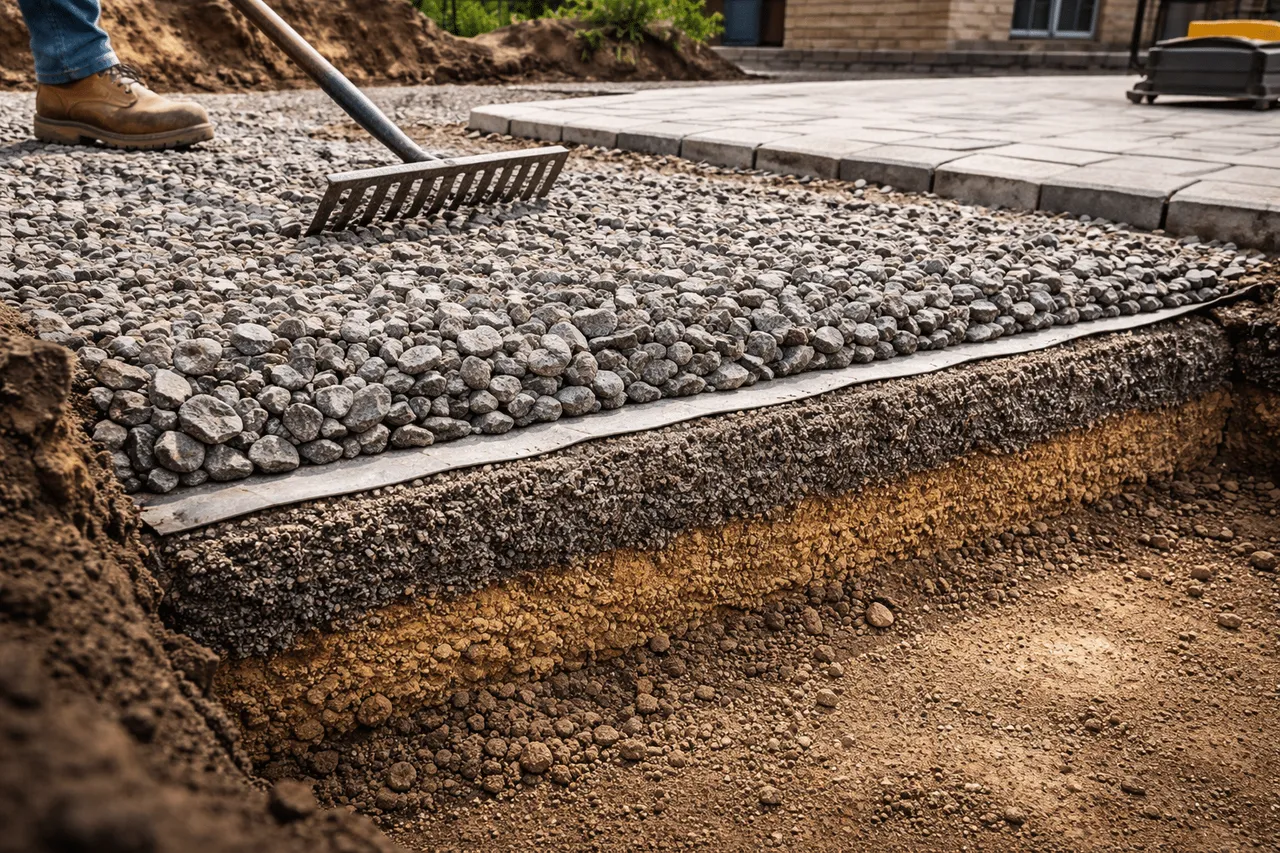
Geotextile fabric is installed directly on the excavated subgrade, before any stone goes in.
Its job is to separate the stone from the native soil below. Without it, fine soil particles migrate upward into the stone layer over time, filling the void spaces that make drainage possible. Once those voids fill in, the drainage layer stops draining.
Geotextile fabric is permeable, so water still passes through it freely. It blocks soil migration without blocking water flow, which is exactly what you need at this interface.
What Goes Down First, the Base Layer or the #57 Stone?
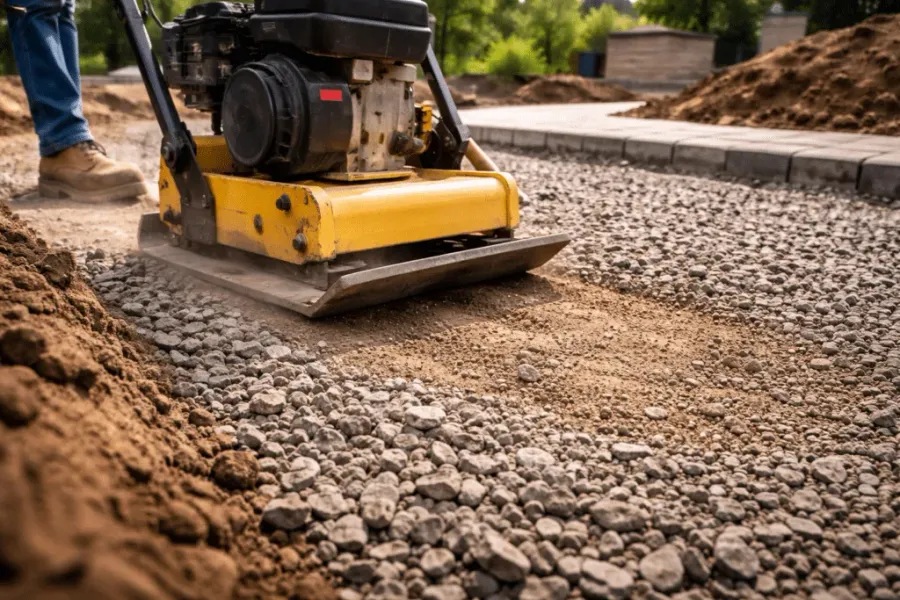
For most hardscape applications, a compacted base layer goes down before the #57 stone. This base layer is typically crusher run. It’s a mixture of crushed stone particles in various sizes, including fines, that bind together and compact into a firm, stable mat.
Spread the crusher run evenly across the prepared subgrade. Use a vibratory plate compactor or roller to compact it thoroughly in passes, slightly overlapping each one. The finished base should be firm, level, and consistent in depth.
How Do You Spread and Compact #57 Stone Correctly?
Step 1
Once the base layer is compacted and ready, you can begin placing the #57 stone. Spread the aggregate evenly across the surface using a wheelbarrow or mechanical spreader. Aim for a consistent depth of 3 to 4 inches.
Step 2
Rake the stone to create a level surface before compaction begins. Check for high and low spots and correct them as you go. The surface should have a slight slope directed away from structures or toward the intended drainage outlet.
Step 3
Use a vibratory plate compactor to compact the #57 stone into the base layer beneath. Make multiple passes across the entire surface, overlapping each pass slightly. During compaction, the angular edges of the stone will interlock, which increases both stability and load-bearing capacity.
Step 4
Continue checking for consistency until the surface is uniform. A correctly compacted #57 stone layer should feel firm underfoot and show minimal movement when walked on.
How Should You Manage Drainage and Edging?
The slope you build into the stone layer does most of the drainage work. A 1 to 2 percent grade moves water away from foundations, structures, and low-lying areas without causing erosion or surface runoff problems.
For areas that collect significant water, consider adding perforated drain pipe within the #57 stone layer.
Edging, on the other hand, is just as important as slope. Install edging before the stone if possible, or set it in place immediately after spreading and before final compaction.
How Much #57 Stone Do You Need?
To estimate your material quantity, measure the length and width of the project area in feet, then decide on the layer depth in inches. Convert the depth to feet by dividing by 12. Multiply length by width by depth to get cubic feet, then divide by 27 to convert to cubic yards.
Always add 10 to 15 percent to your estimate to account for settling, uneven subgrade, and material left over at edges. Running short mid-project creates delays and often means reordering at a higher per-unit cost.
Ready to Order #57 Stone?
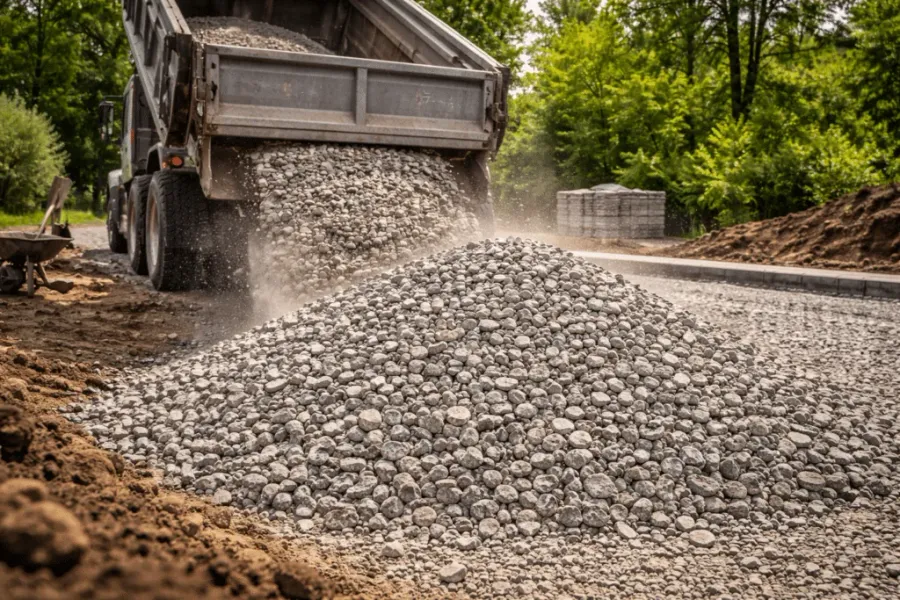
Once you’ve calculated your project dimensions and layer depths, you have what you need to place an accurate bulk order.
Hello Gravel’s material calculator helps you the quantity for your project before you order in bulk delivery directly to your project site. Contact Hello Gravel today for all your material needs for your landscaping and construction projects.
Frequently Asked Questions
Is #57 stone the same as drain rock?
The terms are often used interchangeably. Both refer to open-graded crushed stone that drains freely, though specific sizing can vary slightly by region and supplier.
How much #57 stone do I need per square foot?
At a 4-inch depth, you need approximately 0.012 cubic yards of #57 stone per square foot of surface area, or roughly 100 square feet per cubic yard.
Can I use #57 stone without a base layer underneath?
For drainage trenches and French drains, yes. However, for load-bearing surfaces like driveways, a compacted crusher run base beneath the #57 stone greatly improves long-term stability.
Does #57 stone need to be compacted?
Yes, compaction causes the angular stones to interlock, which improves load-bearing capacity and reduces shifting over time.
How do I prevent #57 stone from spreading into my yard?
Install steel, aluminum, or plastic edging around the perimeter before or immediately after spreading the stone, then anchor it securely into the ground.
Can #57 stone be used in a French drain?
Yes, it’s one of the most common materials for French drain construction because its open structure allows water to move freely through the trench.
How long does a #57 stone sub-base last?
When properly installed with geotextile fabric and adequate edging, a #57 stone sub-base can last decades with only minor maintenance like topping off settled areas.