
How to Choose the Best Edging for a Safe and Tidy Gravel Path
Guide handoff
Want help applying this guide to your project?
Share your ZIP and what you need help with. We'll use this guide as context when we follow up.
- 1 This guide gives us the context you were reading.
- 2 Ask about pricing, material choice, delivery timing, or quantity.
- 3 Keep it broad if you are still figuring out the project.
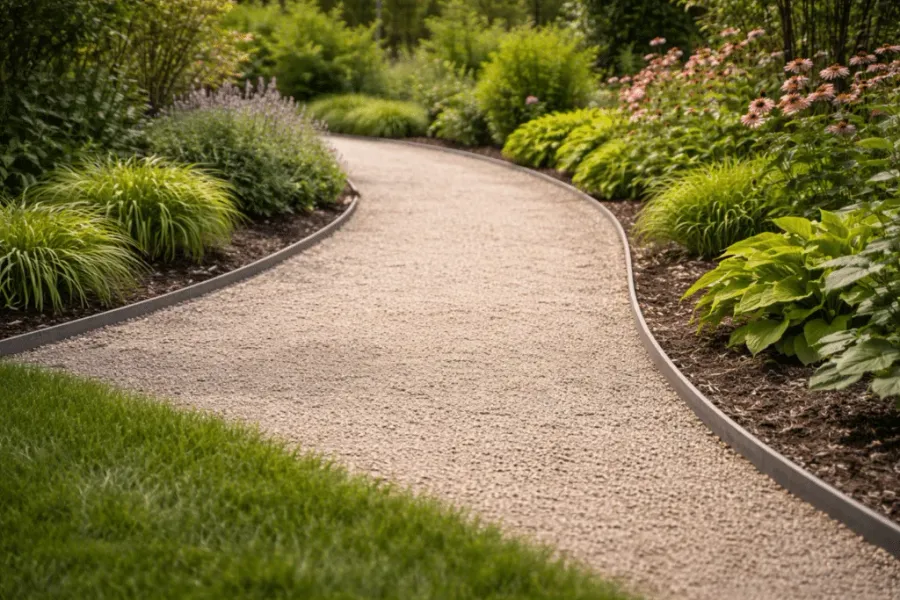
For most gravel paths, steel or aluminum edging is the best choice. These materials are durable, low-profile, and flexible enough for curved designs. If you’re building a driveway or another high-traffic area, concrete pavers, Belgian blocks, or natural stone provide the necessary strength. Proper edging is essential for keeping gravel contained, preventing slip hazards, and reducing long-term maintenance.
Why Edging Is a Non-Negotiable for Gravel Paths
The transition points where gravel meets grass, pavers, or concrete are common sites for outdoor slips and falls. Without a barrier, loose stones migrate onto adjacent surfaces, creating an uneven and unpredictable walking area. Runoff can also wash fine gravel particles onto hardscapes, leaving a gritty film that reduces traction, especially when wet.
Edging solves this by creating a clean, defined boundary. It keeps gravel contained, prevents grass from encroaching on your path, and makes mowing safer by keeping stones out of the lawn. In areas with heavy rain, edging also helps control erosion, locking the aggregate in place. Ultimately, it’s not an optional add-on; it’s a required component for a safe, stable, and low-maintenance path.
Comparing Edging Materials for Your Project
The right material depends on your project’s budget, aesthetic, and durability needs.
Metal Edging (Steel and Aluminum)
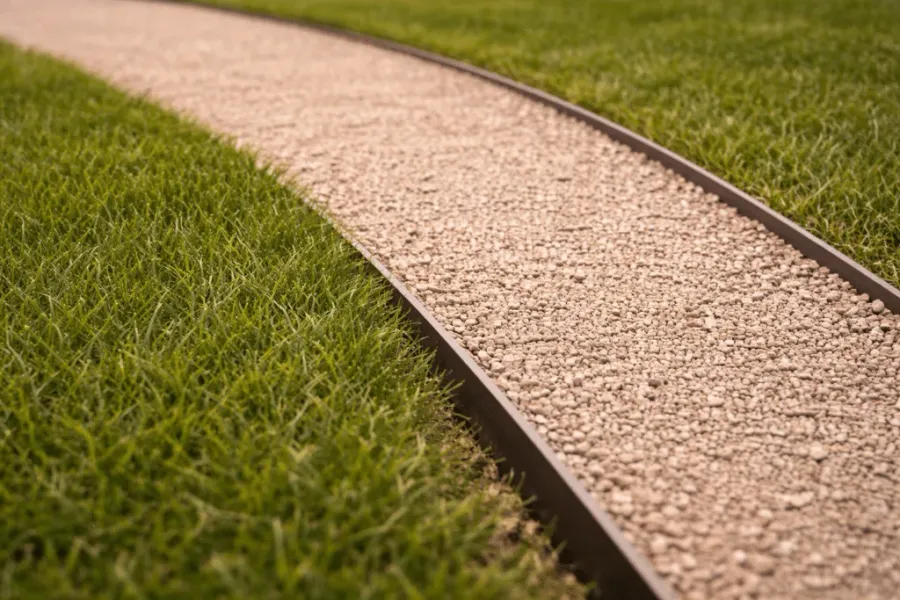
Steel and aluminum are the most popular and practical choices for standard gravel paths. Once installed, they are nearly invisible and can be bent to follow curved layouts.
Aluminum is lightweight and will not rust. Steel offers greater strength for high-use areas, though it may require a protective powder coating to prevent corrosion. For tight curves, a thinner 16-gauge metal is easier to work with, while thicker 12- or 14-gauge steel holds straight lines better over time.
Concrete Pavers and Brick
Concrete pavers come in a wide range of sizes, shapes, and colors. Their interlocking designs help them resist shifting under pressure, and you can choose textured finishes to improve slip resistance at the transition zone.
Brick is another excellent option, especially where a gravel path meets a brick patio. For both materials, installation on a compacted gravel base is critical. Placing them directly on soil is a common mistake that leads to sinking and unevenness.
Quick Tip: Always install brick or paver edging on a compacted gravel base, not directly on soil. Skipping this step is the most common cause of sinking and unevenness within a year.
Natural Stone
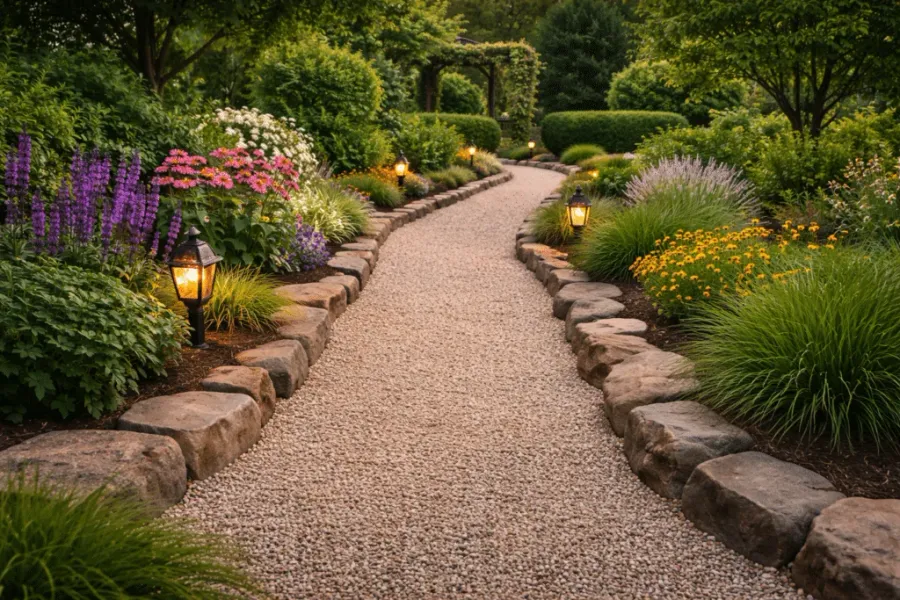
For a permanent and formal look, natural stone provides the most durable containment available. It requires excavating a proper trench and laying a compacted gravel base to prevent the stones from shifting.
While it is the most labor-intensive and expensive option, natural stone edging is a lifetime solution ideal for high-traffic paths and formal landscape designs.
Pressure-Treated Timber
Lumber, such as 4×4 or 6×6 timbers, offers a simple border for rustic or informal garden paths. Installation involves digging a shallow trench, setting the timber, and anchoring it with rebar stakes driven through pre-drilled holes.
Even quality pressure-treated wood has a limited lifespan in direct contact with soil. Expect to replace it in 10 to 15 years due to rot.
Plastic and Rubber
Plastic and rubber edging are budget-friendly, lightweight, and easy for DIY installers to use on curved paths. Rubber, often made from recycled materials, tends to hold up better against temperature changes and UV damage than plastic.
These materials work best in low-traffic garden areas where they won’t be subjected to heavy loads.
Choosing Edging for a Gravel Driveway
A driveway carries significantly more weight than a garden path, so the edging must withstand vehicle pressure and lateral forces.
Belgian blocks are a classic, durable choice. When set lengthwise with about one inch exposed above the gravel, they create a strong barrier that resists shifting. They require a compacted stone base but are virtually maintenance-free.
Key for Driveways: For any driveway, a raised edge is more effective than a flat one. Raised edging provides a physical barrier that stops gravel from spilling out, while flat edging offers minimal resistance to vehicle pressure.
For a cleaner, modern look, 4- to 6-inch-high steel edging with a powder-coated finish and dual-stake locking systems provides excellent stability.
Key Installation Steps for Safe Transitions
Installing edging correctly is just as important as choosing the right material.
First, grade the path with a slight crown or a 1–2% slope. This allows water to run off the surface instead of pooling at the transition to a hardscape, which is a major slip hazard.
Set the top of the edging about a half-inch above the finished gravel surface. This small lip is enough to catch migrating stones before they spill over.
Pro Tip: For the most stable path, install and compact the gravel in 1- to 2-inch layers. A dense, compacted surface resists migration far better than loose-fill gravel.
Long-Term Maintenance for Safe Pathways
A well-built path requires minimal but consistent upkeep to remain safe. After heavy rain, rake any stray gravel back toward the center of the path. It’s also wise to inspect edging stakes after the winter, as freeze-thaw cycles can push them out of alignment. To maintain good traction, be sure to clear wet leaves and other organic debris from transition zones, and address any moss or algae on shaded paths with an anti-slip sealer to add a safe, gritty texture.
Plan Your Project with Confidence
With your path planned and your edging material selected, the next step is to calculate the right amount of gravel for your project. Accurate measurements ensure you order the correct volume, saving you time and money. You can reach out to us to place an order.
Frequently Asked Questions (FAQ)
**What is the best edging for a gravel path?******For most applications, steel or aluminum edging is best. It’s durable, handles curves well, and has a low profile. For driveways or a more decorative look, consider concrete pavers, Belgian blocks, or natural stone.
**Do gravel paths need edging?******Yes. Edging is essential for containing gravel, preventing it from migrating into lawns or onto hardscapes. It reduces maintenance, stops weed intrusion, and improves safety at transition zones.
**What is the best material for the edge of a gravel driveway?******Belgian blocks and concrete pavers are the most durable options because they can withstand vehicle loads. Heavy-duty raised steel edging is another excellent choice for a clean, strong border.
**How deep should edging be installed?******Metal and plastic edging should be buried 4 to 6 inches deep, with about a half-inch left exposed above the gravel. Stone and brick require a deeper trench filled with a compacted base layer to prevent settling.
**Can gravel be stabilized so it doesn’t need constant raking?******Yes. Applying a gravel binder or stabilizer locks the aggregate together while allowing water to drain. Installing gravel in compacted layers or using grid paver systems also significantly reduces movement.