
Gravel cost per ton 2026 complete pricing guide and calculator
Guide handoff
Want help applying this guide to your project?
Share your ZIP and what you need help with. We'll use this guide as context when we follow up.
- 1 This guide gives us the context you were reading.
- 2 Ask about pricing, material choice, delivery timing, or quantity.
- 3 Keep it broad if you are still figuring out the project.
Planning a gravel project and wondering about costs? You’re looking at spending between $20 to $75 per ton for gravel in 2026, depending on the type and quality you choose. Understanding these costs upfront helps you budget accurately and avoid expensive surprises during your project.
Quick Answer: Crushed stone costs $25-40 per ton, pea gravel runs $30-50 per ton, and river rock ranges $40-75 per ton. Transportation typically adds $10-20 per ton depending on distance from the quarry.
Whether you’re building a driveway, creating garden pathways, or working on drainage systems, this guide walks you through everything you need to know about gravel pricing, from different types and their costs to smart purchasing strategies that can save you hundreds of dollars.
Best types of gravel and their 2026 costs
Different gravel types serve specific purposes and come with distinct price points. Choosing the right material for your project affects both performance and your final bill.
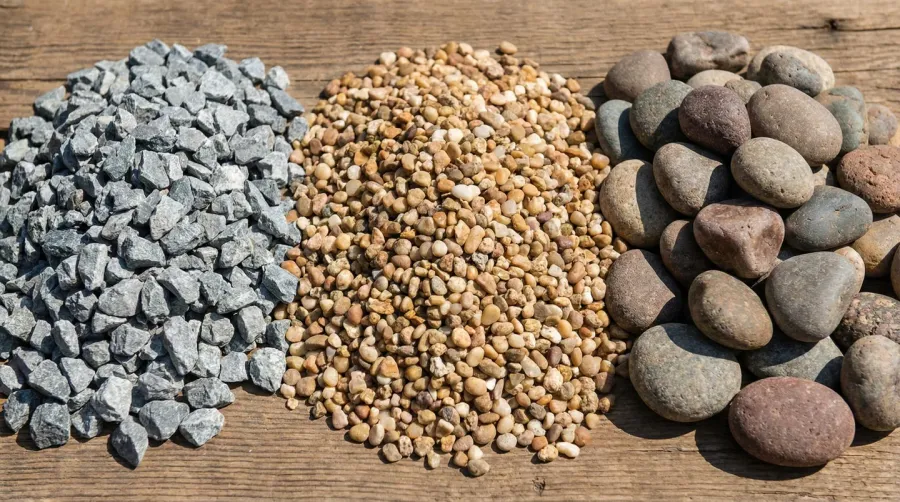
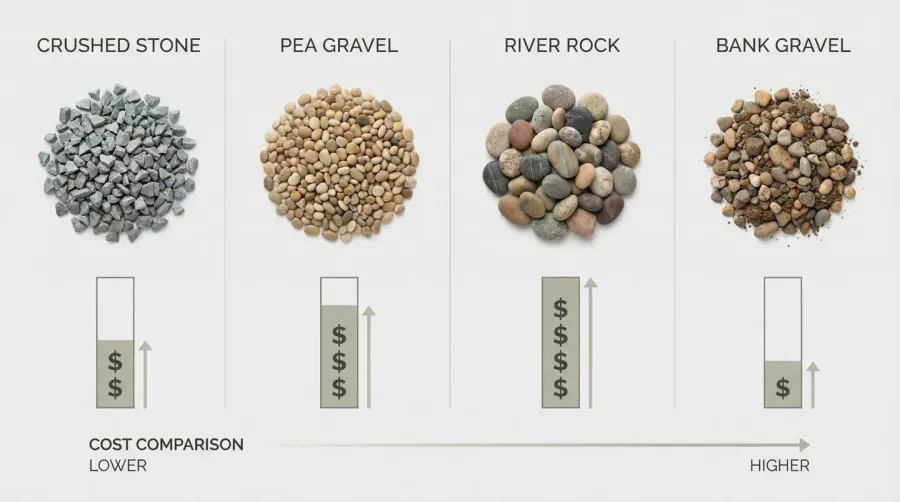
Crushed stone remains the most popular choice for driveways and construction projects. The angular edges lock together when compacted, creating a stable surface that handles heavy traffic well. You’ll pay around $25-40 per ton for quality crushed stone, making it an economical option for most applications. For a complete breakdown of gravel driveway costs, including installation and material expenses, check out our comprehensive guide.
Pea gravel offers a smoother, more decorative appearance with its rounded stones. Perfect for garden pathways and decorative areas, pea gravel costs $30-50 per ton. The smooth texture makes it comfortable to walk on, but the rounded edges don’t compact as tightly as crushed stone. Learn more about how much a ton of pebbles costs to understand pricing variations.
River rock provides the most natural aesthetic but comes at a premium price of $40-75 per ton. These larger, rounded stones work beautifully for water features and decorative landscaping, though they’re less suitable for high-traffic areas due to their tendency to shift under weight. For detailed information on the current price of river stones, explore our comprehensive pricing analysis.
Bank gravel, a mixture of sand and small stones, costs $20-35 per ton and serves as an excellent base material for construction projects. Its composition provides good compaction properties while remaining budget-friendly for larger projects.
| Gravel Type | Cost Per Ton | Best Uses | Compaction Rating |
|---|---|---|---|
| Crushed Stone | $25-40 | Driveways, roads | Excellent |
| Pea Gravel | $30-50 | Decorative, walkways | Good |
| River Rock | $40-75 | Landscaping, water features | Fair |
| Bank Gravel | $20-35 | Base material, construction | Excellent |
What affects gravel prices per ton
Several key factors determine what you’ll ultimately pay for gravel, and understanding these helps you make smarter purchasing decisions.
Location plays the biggest role in pricing. Gravel from quarries within 20 miles of your project typically costs $10-20 less per ton than materials shipped from distant sources. Transportation costs add up quickly since gravel is heavy and requires specialized trucks for delivery. At Hello Gravel, we work with local pits and haulers nationwide to optimize delivery costs and ensure you get competitive pricing regardless of your location.
Quality grades significantly impact your final cost. Premium gravel with consistent sizing and minimal dust commands higher prices but often provides better long-term value. Construction-grade materials cost less but may require additional screening for decorative applications. For those considering alternatives, crushed concrete per ton offers a cost-effective option worth exploring.
Money-Saving Tip: Purchase gravel during off-peak seasons (late fall through early spring) when demand drops and suppliers offer better rates to maintain steady business.
Supply and demand fluctuations affect pricing throughout the year. Spring and summer months see increased demand for landscaping materials, often driving prices 15-25% higher. Major construction projects in your area can also create temporary price spikes as suppliers struggle to meet increased demand.
Market conditions and fuel costs influence transportation expenses, which represent a significant portion of your total gravel cost. When fuel prices rise, expect delivery charges to increase accordingly. Understanding the current sand and gravel prices helps you anticipate market trends.
Gravel calculator for tons needed
Calculating the right amount of gravel prevents costly delays and ensures your project stays on budget. The process involves measuring your area and converting to tonnage using specific formulas.
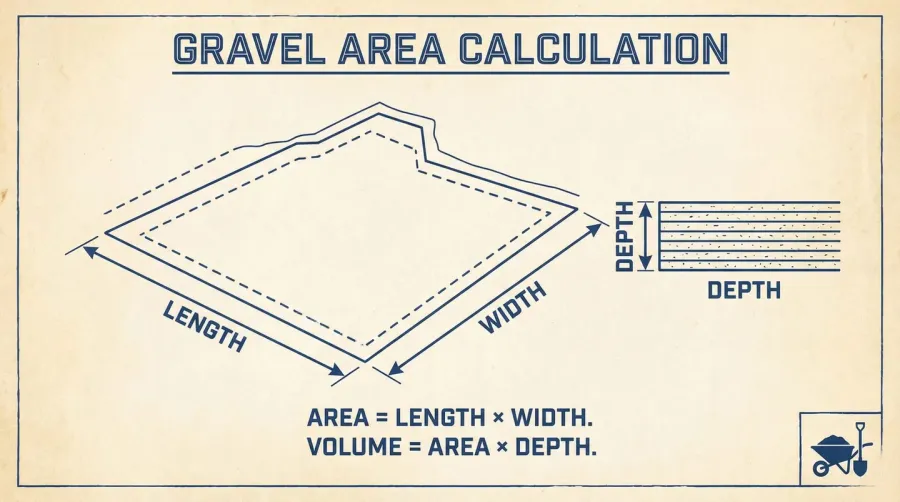
Start by measuring the length, width, and desired depth of your project area in feet. Multiply these dimensions to get cubic feet, then divide by 27 to convert to cubic yards. For example, a 12×50 foot driveway with 3-inch depth equals 150 cubic feet, or about 5.6 cubic yards.
Apply a compaction factor of 1.25 to account for settling and compaction during installation. This means you’ll need about 7 cubic yards of loose gravel to achieve 5.6 cubic yards of compacted material.
Convert cubic yards to tons using the weight factor for your chosen gravel type. Crushed stone weighs approximately 1.3 tons per cubic yard, while pea gravel weighs about 1.4 tons per cubic yard. Using our example, you’d need roughly 9-10 tons of gravel for the driveway project. For more detailed calculations, see our guide on how much a yard of gravel costs.
Always order 5-10% extra material to account for waste, spillage, and future maintenance needs. This small buffer prevents project delays and gives you material for touch-ups down the road. Hello Gravel’s online material calculator can help you determine exact quantities based on your project measurements, taking the guesswork out of ordering.
How to buy gravel in bulk and save money
Smart purchasing strategies can significantly reduce your gravel costs without compromising quality. These approaches work whether you’re tackling a small residential project or managing a large commercial build.
Buying in bulk quantities offers the best value for most projects. Suppliers typically provide price breaks at 10, 20, and 50-ton levels, with savings of 15-30% compared to smaller purchases. Hello Gravel specializes in transactions of 500 tons or more but accommodates smaller orders as well, ensuring competitive pricing across all project sizes. If you have storage space, consider coordinating with neighbors on similar projects to reach bulk pricing thresholds. Discover the benefits of purchasing gravel by bulk to maximize your savings.
Timing your purchase strategically can yield substantial savings. Off-season buying during fall and winter months often provides 10-20% discounts as suppliers look to maintain cash flow during slower periods. Avoid peak construction season (April through August) when possible.
Research local suppliers thoroughly before making decisions. With Hello Gravel’s nationwide network, we can source and deliver material nearby wherever your job is located, eliminating the need to call around for price sheets. Our marketplace serves as a free directory of up-to-date aggregate prices, providing transparency that helps you make informed decisions. Get quotes from at least three suppliers, ensuring you compare total delivered costs rather than just material prices. For contractor-specific strategies, explore our material sourcing secrets for busy contractors.
Consider alternative materials that meet your project requirements. Sometimes a less expensive gravel type can perform just as well for your specific application. Discuss options with suppliers who understand your project goals and can recommend cost-effective alternatives. Learn how to find the best deals on aggregates for large projects to optimize your purchasing strategy.
Building relationships with local suppliers pays dividends on future projects. Reliable customers often receive priority scheduling, better pricing, and helpful advice on material selection. At Hello Gravel, we provide dedicated account managers for quotes, scheduling, and repeat orders, ensuring personalized service that treats you as a partner rather than just a transaction.
Understanding gravel costs per ton helps you make informed decisions that balance quality, performance, and budget considerations. With proper planning and smart purchasing strategies, you can complete your project successfully while keeping costs under control. Remember that the cheapest option isn’t always the best value when you factor in durability and long-term performance.
FAQ
How much does gravel cost per ton in 2026?
Gravel costs between $20 to $75 per ton in 2026, depending on the type and quality. Crushed stone costs $25-40 per ton, pea gravel runs $30-50 per ton, river rock ranges $40-75 per ton, and bank gravel costs $20-35 per ton. Transportation typically adds $10-20 per ton depending on distance from the quarry.
How do I calculate how many tons of gravel I need?
Measure the length, width, and desired depth of your project area in feet. Multiply these dimensions to get cubic feet, then divide by 27 to convert to cubic yards. Apply a compaction factor of 1.25 and convert to tons using weight factors: crushed stone weighs about 1.3 tons per cubic yard, while pea gravel weighs about 1.4 tons per cubic yard. Always order 5-10% extra material.
What factors affect gravel pricing?
Location is the biggest factor – gravel from quarries within 20 miles costs $10-20 less per ton than distant sources. Quality grades, seasonal demand (spring/summer prices are 15-25% higher), market conditions, fuel costs for transportation, and supply availability all impact pricing. Off-peak season purchases can save 10-20%.
How can I save money when buying gravel in bulk?
Buy in bulk quantities of 10+ tons for 15-30% savings, purchase during off-season (fall/winter) for 10-20% discounts, get quotes from at least three local suppliers within 25 miles, and consider coordinating with neighbors to reach bulk pricing thresholds. Building relationships with suppliers can also lead to better pricing and priority service.