
Channel Drain Calculator
— How Much Do You Need?
Quick channel drain estimator — calculate trench size and material truckloads with clear pricing.
How to Use This Channel Drain Calculator
Planning a channel drain requires precise measurements to ensure you order enough material without overspending.
- 1 Measure Area: Measure the length and width of your planned channel drain area in feet.
- 2 Determine Depth: For most channel drain projects, a depth of 4 to 6 inches is recommended for stability.
- 3 Review Results: The calculator provides both cubic yards (for bulk volume) and tons (for ordering weight).
Common Materials for Channel Drains
Selecting the right base and bedding materials ensures proper compaction, drainage, and long-term structural stability for the channel drain system.
| Material | Description | Best For | Est. Cost |
|---|---|---|---|
| Class 5 Base Gravel | Crushed aggregate blend of gravel and fines, typically 3/4-inch minus, that compacts into a dense, stable layer. | Compacted Base Layer, Trench Foundation, Structural Support | $ |
| Setting Sand | Fine, clean, washed sand with uniform particle size used to create a level, workable bedding surface. | Bedding Layer, Channel Leveling, Elevation Fine-Tuning | $ |
| #8 Crushed Stone | Small, clean-crushed angular stone approximately 3/8-inch in size with minimal fines for high permeability. | Subsurface Envelope Material, Filter Layer, Perforated Pipe Surround | $$ |
| Crusher Run (QP) | Blended mixture of crushed stone and stone dust ranging from 3/4-inch down to fines that binds and compacts firmly. | Alternative Base Layer, Trench Backfill, Limited Use | $ |
Understanding the Cost
Several factors influence the final price of your channel drain project.
Material Volume
The dimensions of your project directly dictate the tonnage needed. Deeper bases require significantly more material.
Delivery Distance
Transport logistics play a major role. Being closer to the quarry or depot reduces delivery fees significantly.
Material Type
Decorative stones cost more than utility grades. Choose based on your project's functional and aesthetic requirements.
Recommended Products for Your Channel Drain

Gravel Calculator
This gravel calculator estimates cubic yards, tons, and coverage for any area. Enter dimensions and depth for driveways, patios, paths, and landscaping.

Crushed Stone Calculator
This calculator estimates crushed stone quantity and weight. Enter dimensions for results in cubic feet, cubic yards, and tons with density factored in.

Drainage Rock Calculator
This calculator estimates drainage gravel for French drains, yard drainage, and erosion control. Factors in the 4-6 inch depth most systems need.

Concrete Sand Calculator
Concrete sand calculator — estimate volume and weight based on your project's length, width, and depth. Results in cubic yards and tons, ready for ordering.
Frequently Asked Questions
What is a channel drain and what is it used for?
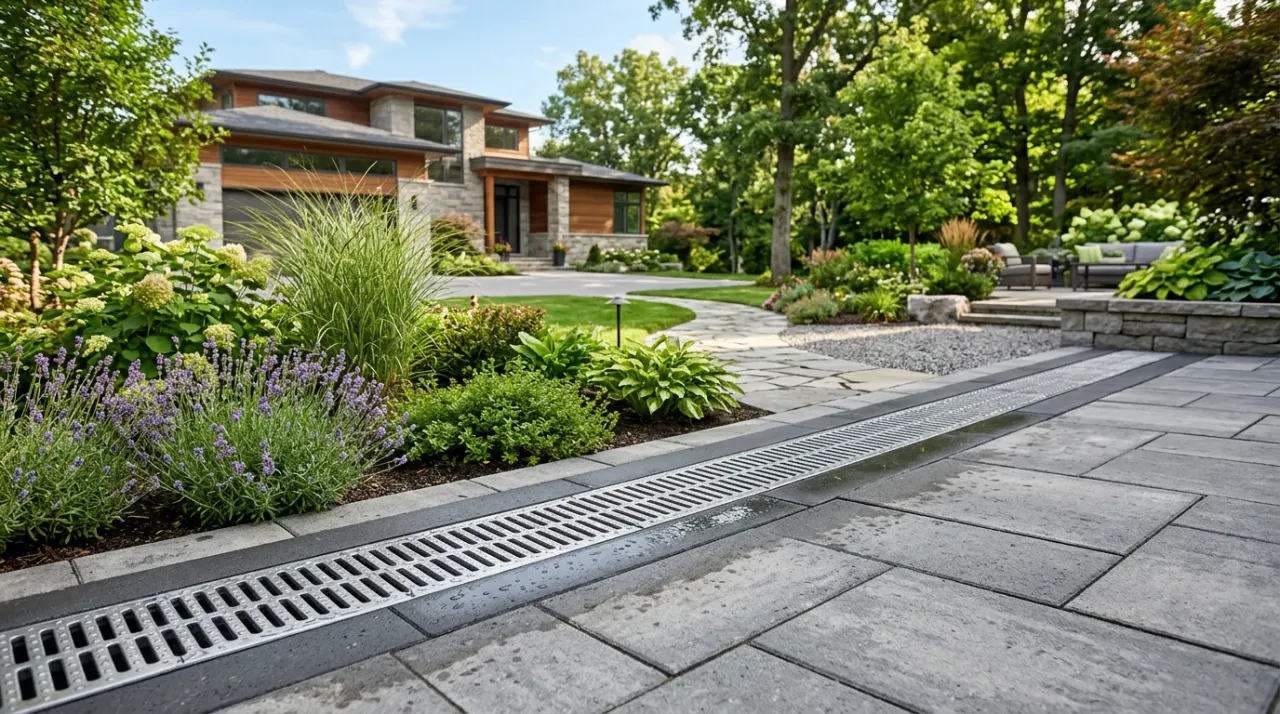
A channel drain is a long, narrow drainage system set into the ground with a grate or slot along the top. Unlike a round catch basin that collects water at a single point, a channel drain gathers water across its entire length and moves it toward an outlet at one or both ends. You'll find them in driveways, garage aprons, pool decks, patios, walkways, and commercial entrances -- anywhere a sheet of water needs to be intercepted before it causes a problem. They're especially common at the base of a sloped driveway where water would otherwise run straight into a garage, or at the transition between an outdoor surface and a building's foundation. If water is arriving across a wide front rather than from a single spot, a channel drain handles it far more effectively than a traditional point drain.
What is the difference between a channel drain and a trench drain?
For most practical purposes, these two terms mean the same thing. Both refer to a linear drainage system set into a trench with a grate on top that collects water along its length. Some contractors use "trench drain" when talking about heavier-duty industrial or commercial installations, while "channel drain" tends to come up more in residential and light commercial contexts. But the underlying concept is identical. What matters more than the label is choosing the right load rating, channel depth, and width for your specific application. A residential driveway drain and a loading dock drain are both "channel drains" at their core, but they're built to very different specifications. Focus on your flow requirements and traffic loads, and the right product will follow from there.
How does a channel drain work and where does the water go?
Water flows across the surface, drops through the grate, and enters the channel body below. From there, gravity carries it along the length of the channel toward an outlet at one or both ends. That outlet needs to connect to somewhere functional -- a storm sewer, a dry well, a swale, a retention area, or a piped drainage system that leads water safely away from your property. Some installations include a sump or collection pit at the lowest end to capture sediment before the water exits the system. The outlet connection is one of the most important parts of the whole setup. A channel drain that collects water with nowhere to send it isn't a drainage solution -- it's just a holding tank. Always confirm your outlet route before you start digging.
When do you actually need a channel drain?
You need a channel drain when water is moving across a hard surface and you need to stop it before it reaches something it shouldn't -- a garage floor, a building foundation, an entrance, or a lower area of your property. The most common triggers are water sheeting off a sloped driveway toward a garage, runoff crossing a pool deck or patio, drainage issues at a commercial entry, and water collecting at the base of a retaining wall or slope. If you have a round catch basin already and it's not keeping up with heavy rain, that's often a sign the water is arriving along too wide a front for a single point drain to handle. That's exactly the situation where a channel drain earns its keep. If water regularly pools or flows where it shouldn't after a rainstorm, a channel drain is almost always worth the investment.
How deep should a channel drain be installed?
The finished grate should sit flush with or just slightly below the surrounding surface so water flows naturally into it rather than over it. How deep you actually excavate depends on the drain body you've chosen, but most residential channel drain bodies run between 4 and 12 inches deep, with deeper channels handling higher water volumes. Below the drain body itself, you need a compacted layer of crushed stone or gravel as a bedding base, typically 4 to 6 inches thick. That bedding layer gives the drain a stable, level foundation to sit on and allows any groundwater beneath the trench to drain away rather than undermine the installation. Always check the manufacturer's specs for the specific drain unit you're using, since dimensions vary quite a bit by brand and load class.
More Project Calculators

Playground Calculator
This calculator estimates mulch, rubber, or wood fiber surfacing for playgrounds. Enter area and recommended depth to get cubic yards and tons.

Chicken Coop Calculator
Use this calculator to estimate how much gravel your coop base requires. Input dimensions and depth for volume in cubic yards and stone type guidance.

Basketball Court Calculator
Court base calculator — estimate gravel, sand, and sub-base quantities for backyard or regulation basketball courts. Input court size for material totals.

Tennis Court Calculator
Use this calculator to estimate the crushed stone base for a new or resurfaced tennis court. Enter dimensions and depth for volume and tonnage.
Delivery Logistics & Truck Info
Know your delivery options and access requirements before scheduling your order.
Truck Capacities
- Standard Dump Truck10–14 tons
- Tandem Axle14–18 tons
- Semi End Dump20–25 tons
A standard cubic yard weighs approximately 2,000–2,700 lbs depending on material and moisture.
Site Access Requirements
- Trucks require a minimum 12-ft wide, overhead-clear access path
- Soft ground or slopes over 10% may limit truck access — contact us before ordering
- Ensure no underground utilities or irrigation lines are in the drop zone
- Mark your desired drop location clearly before delivery
Important Notes
- Delivery estimates are based on available inventory and route proximity
- Minimum order quantities apply — typically 5 cubic yards or 1 truckload
- Material certification is available upon request for permitted projects
- Always confirm local ordinances before major material placement