
Screened Topsoil Calculator
— How Much Do You Need?
Screened topsoil calculator — estimate cubic yards, tons, and coverage for beds, lawns, planters.
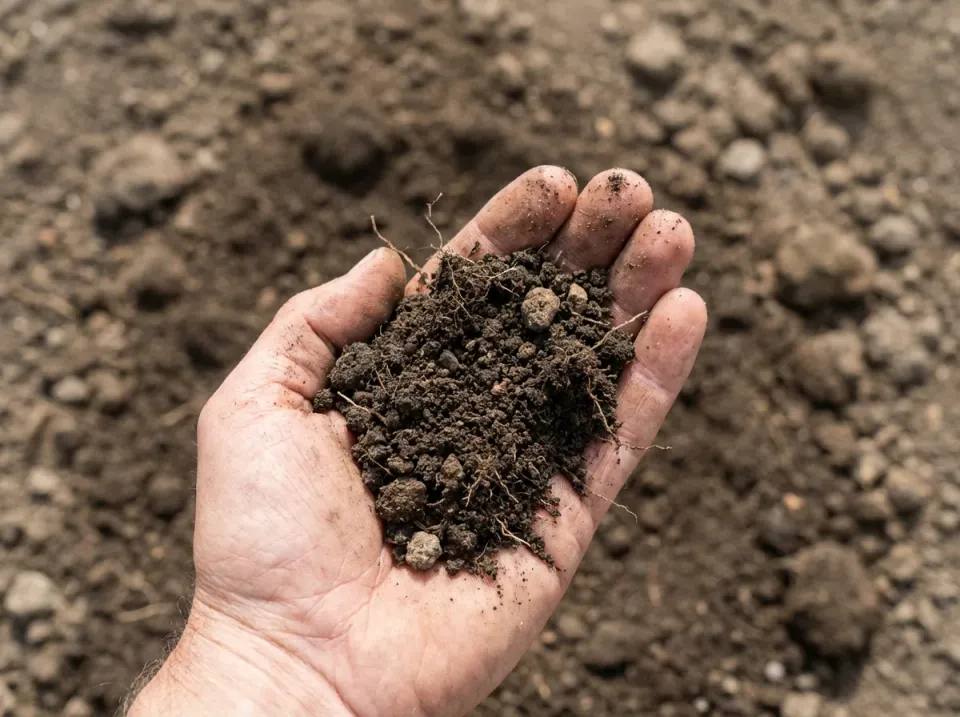
How to Use This Screened Topsoil Calculator
Planning a screened topsoil project requires precise measurements to ensure you order enough material without overspending.
- 1 Enter Dimensions — Input the length and width of your area in feet. Round up slightly for a buffer.
- 2 Choose Depth — Select the depth in inches. For most screened topsoil projects, 3–6 inches is standard.
- 3 Review Results — Instantly see cubic yards and tons needed to accurately plan your order.
Visual Area Guide
Use these diagrams to measure your project area correctly.
Rectangular Area
Measure length × width for square or rectangular areas. Most driveway, patio, and grading projects use this method.
Circular Area
Measure the radius (half the diameter) for round beds, drain fields, or circular landscaping. Formula: π × radius².
Material Coverage & Grading
Common screened topsoil grades per ASTM D5268 and USCS classifications used in landscaping, revegetation, and civil construction applications
| Grade | Application |
|---|---|
| ASTM D5268 | Standard screened topsoil meeting ASTM D5268 Table 1 requirements, containing 3–10% organic matter, 35–70% fines (silt and clay), and passing a 50 mm screen. Balanced loam or sandy loam texture supports uniform grass establishment and vegetative cover. Ideal for residential and commercial landscaping, finish grading, and site revegetation where consistent plant-growth support is required. |
| Screened Loam | Naturally occurring loam soil processed through a 50 mm screen to remove roots, rocks, and debris, yielding a uniform, workable material with balanced sand, silt, and clay fractions. Organic matter typically 3–8%, with moderate moisture retention and drainage. Widely used by contractors for lawn establishment, top-dressing, and fine grading on residential and light commercial sites. |
| Pulverized | Topsoil subjected to additional mechanical processing through finer screens (typically ≤12 mm) to break up clods and produce a refined, lump-free growing medium. Increased surface area improves seed-to-soil contact and nutrient availability. Best suited for seed bed preparation, sod installation, athletic fields, and premium residential lawn and garden applications requiring a smooth, fine-textured finish layer. |
| Eng. Amendment | Engineered soil amendment with elevated organic matter content (≥75%) blended into screened topsoil to restore nutrient-poor or degraded substrates per ASTM D5268 engineered variant criteria. Significantly enhances biological activity, water-holding capacity, and root-zone fertility. Applied in horticultural restoration, urban tree pits, green roof growing media, and amended subgrades on disturbed or capped sites. |
| USCS SM/ML | Screened topsoil classified under the Unified Soil Classification System as silty sand (SM) or silt of low plasticity (ML), containing 5%+ organics and a well-graded silt, clay, and sand matrix with low deleterious material. Compacts to 80–85% Proctor density with moderate permeability. Used in civil applications such as site cap cover systems, streambed restoration, landfill intermediate cover, and erosion-control revegetation layers. |
| Salvaged Screened | On-site or salvaged native topsoil stripped, stockpiled, and returned through a 50 mm screen to remove oversized debris and roots prior to re-spreading. Organic matter and texture vary by source but must meet project-specific or ASTM D5268-equivalent minimums. Commonly specified in DOT and civil contracts for site restoration, borrow-area reclamation, and finish grading where preserving native soil ecology and reducing import costs is a priority. |
Plan Your Next Project
Raised Garden Bed Calculator
Raised bed calculator — estimate how much soil, compost, and amendments to buy for any bed shape. Enter dimensions for results in cubic feet and bags.
Berm Calculator
Berm calculator — estimate fill dirt or soil volume for a landscape berm. Enter base width, height, and length for cubic yards and proper grading.
Flower Bed Calculator
Flower bed calculator — estimate how much soil or mulch your bed requires. Enter length, width, and depth for results in cubic feet, yards, and bags.
Frequently Asked Questions
What is screened topsoil, and how is it different from regular dirt or unscreened topsoil?
Screened topsoil starts out as natural topsoil, which is the upper layer of earth richest in organic matter and nutrients. Before it reaches you, it is run through a mechanical screen that removes rocks, roots, clumps, and other debris. The result is a clean, fine-textured soil that is consistent and easy to spread across any surface. Regular dirt, often called fill dirt, is typically subsoil. It sits below the topsoil layer, contains little to no organic matter, and is not suited for growing plants. It works well for large fill and grading jobs where plant growth is not the goal, but it will not give your lawn or garden beds what they need to thrive. Unscreened topsoil is topsoil in its raw form before any processing takes place. It can still contain clods, rocks, and debris, which makes it harder to spread evenly and less suitable for planting beds or fine finish grading. When you order screened topsoil, you are getting the cleaner, more workable version. It is the right choice whenever you need soil that plants can grow in and that you can spread smoothly across a surface.
What is screened topsoil best used for?
Screened topsoil is one of the most versatile materials you can order for yard and garden work. It is the go-to choice for establishing a new lawn, whether you are laying sod or seeding from scratch. The fine, debris-free texture gives grass roots an easy path to take hold and spread. It is also excellent for filling and leveling low spots in your yard. If you have depressions that collect standing water after rain, a layer of screened topsoil can even things out and give you a smoother, healthier surface. For garden beds, raised planters, and general landscaping work, it gives plants a nutrient-rich medium to grow in right from the start. Contractors and landscapers also rely on screened topsoil to backfill around foundations, trees, and shrubs, and to finish grade a property before seeding or sodding. If your project involves anything where plants need to grow or where you want a clean, smooth finish to the soil surface, screened topsoil is the right material for the job.
Can I plant directly into screened topsoil, or do I need to add anything to it?
For most common projects, yes, you can plant directly into screened topsoil. Grass seed, sod, shrubs, flowers, and many vegetables will all establish well in a quality screened topsoil without any additional amendments. It has enough organic content and workable texture to support plant growth right away. That said, every yard is different. If you are starting a high-production vegetable garden or working with plants that need especially rich or moisture-retentive soil, mixing in compost can give you an added boost. But for lawn establishment and general landscaping, screened topsoil on its own is typically all you need to get things growing. The key is making sure you apply enough depth. For seeding a new lawn, a 2-to-4-inch layer gives roots plenty of room to develop. For deeper planting beds, 6 or more inches is ideal. Use the Hello Gravel calculator to figure out exactly how much material you will need based on your specific dimensions before you place your order.
Can I add screened topsoil over existing grass to improve my lawn?
Yes, and it is a well-established technique called topdressing. A thin layer of screened topsoil spread across your existing lawn can help fill in minor low spots, improve the soil composition beneath the grass over time, and create a better environment for new seed to germinate when you overseed in the same pass. The key word is thin. A light application of roughly a quarter to half an inch allows the existing grass to breathe and grow up through the new soil. If you apply too thick a layer, you risk smothering the turf you already have. If you are trying to raise the grade significantly or fill depressions deeper than about an inch, you will get better results by removing or tilling the existing turf first, applying your screened topsoil to the right depth, and then reseeding. For a precise estimate of how much material either approach requires, the Hello Gravel calculator is the fastest way to work out the right quantity for your specific area.
How much area does one cubic yard of screened topsoil cover, and how do I figure out how much to order?
Coverage depends entirely on how deep you spread the material. At 1 inch of depth, one cubic yard covers roughly 324 square feet. At 2 inches deep, that drops to about 162 square feet. At 3 inches deep, you are looking at around 108 square feet, and at 4 inches deep, approximately 81 square feet. For establishing a new lawn, most projects call for a 2-to-4-inch layer. If you are topdressing an existing lawn, a quarter to half an inch is usually sufficient. Garden beds typically benefit from 4 to 6 inches of screened topsoil to give plants a healthy growing environment. These figures give you a solid starting point, but your actual needs depend on the specific dimensions of your space and how much uneven ground you need to account for. The Hello Gravel calculator makes it simple to enter your square footage and target depth to get a reliable estimate of how many yards to order. Taking a few minutes to run those numbers before you place your order helps make sure you get enough material the first time without over-ordering.
Other Material Calculators
Delivery Logistics & Truck Info
Know your delivery options and access requirements before scheduling your order.
Truck Capacities
- Standard Dump Truck 10–14 tons
- Tandem Axle 14–18 tons
- Semi End Dump 20–25 tons
A standard cubic yard weighs approximately 2,000–2,700 lbs depending on material and moisture.
Site Access Requirements
- Trucks require a minimum 12-ft wide, overhead-clear access path
- Soft ground or slopes over 10% may limit truck access — contact us before ordering
- Ensure no underground utilities or irrigation lines are in the drop zone
- Mark your desired drop location clearly before delivery
Important Notes
- Delivery estimates are based on available inventory and route proximity
- Minimum order quantities apply — typically 5 cubic yards or 1 truckload
- Material certification is available upon request for permitted projects
- Always confirm local grading ordinances before major material placement