
Millings Calculator
— How Much Do You Need?
Calculate tons or cubic yards of millings needed for driveways, patches, and resurfacing projects.
How to Use This Millings Calculator
Planning a millings project requires precise measurements to ensure you order enough material without overspending.
- 1 Enter Dimensions — Input the length and width of your area in feet. Round up slightly for a buffer.
- 2 Choose Depth — Select the depth in inches. For most millings projects, 3–6 inches is standard.
- 3 Review Results — Instantly see cubic yards and tons needed to accurately plan your order.
Visual Area Guide
Use these diagrams to measure your project area correctly.
Rectangular Area
Measure length × width for square or rectangular areas. Most driveway, patio, and grading projects use this method.
Circular Area
Measure the radius (half the diameter) for round beds, drain fields, or circular landscaping. Formula: π × radius².
Material Coverage & Grading
Common asphalt millings (RAP) grades and applications
| Grade | Application |
|---|---|
| Type 1 | Standard coarse millings with a top particle size of 1–2 inches, produced directly from milling drums with minimal processing. Retains high residual binder content for self-binding under compaction. Best suited for road sub-bases, embankments, and structural fill where load-bearing capacity is the primary requirement. |
| Type 2 | Screened or fine millings with a top particle size of 1/2–1 inch, providing more uniform gradation than Type 1. Reduced oversize particles improve compaction density and surface smoothness. Commonly applied in residential driveways, parking lot bases, and low-volume road bases. |
| Micro | Micro-millings or dust tailings with particle sizes under 1/4 inch, generated by shallow, high-pass milling for fine surface texturing. Extremely high fines content enables tight self-binding and a near-smooth finished surface. Ideal for pedestrian pathways, surface stabilization, and low-traffic lot surfaces requiring a dense, low-void finish. |
| RAP | Processed reclaimed asphalt pavement that has been stockpiled, sized, and optionally rejuvenated with binder additives for reintroduction into hot-mix or warm-mix asphalt plants. Binder content is tested and controlled to meet DOT specifications for overlay and road rehabilitation projects. Used primarily in road rehabilitation overlays and as a partial aggregate substitute in new asphalt mix designs. |
| 1.5" Minus | Unscreened millings passing a 1.5-inch top screen, retaining the full range of particle sizes from dust to 1.5 inches for maximum compaction density. The inclusion of all fines and binder-rich particles creates a dense, interlocked matrix upon rolling. Well-suited for driveway base courses, utility trench backfill, and unpaved road surfaces requiring high density and stability. |
| Crusher Run | Further-processed millings that have been run through a crusher to break down oversize chunks and improve particle uniformity. The additional crushing increases angular surface area, enhancing interlock and load distribution comparable to virgin crusher run aggregate. Applied in heavy-duty base course construction, commercial parking areas, and road sub-base layers where tight gradation and structural performance are critical. |
Plan Your Next Project
Driveway Calculator
Driveway calculator — estimate cubic yards and tons from your length, width, and preferred gravel depth. Covers single-layer and three-layer builds.
Gravel Driveway Calculator
Gravel driveway calculator — estimate how many cubic yards or tons your driveway needs. Enter length, width, and depth for volume per layer.
Walkway Calculator
Walkway calculator — enter length, width, and depth to estimate the exact gravel volume in cubic yards and tons. Includes recommended depth guidance.
Parking Pad Calculator
Parking pad calculator — estimate crushed stone or gravel for a residential pad. Enter area and depth for cubic yards, tons, and approximate cost.
Frequently Asked Questions
What are asphalt millings, and what are they also called?
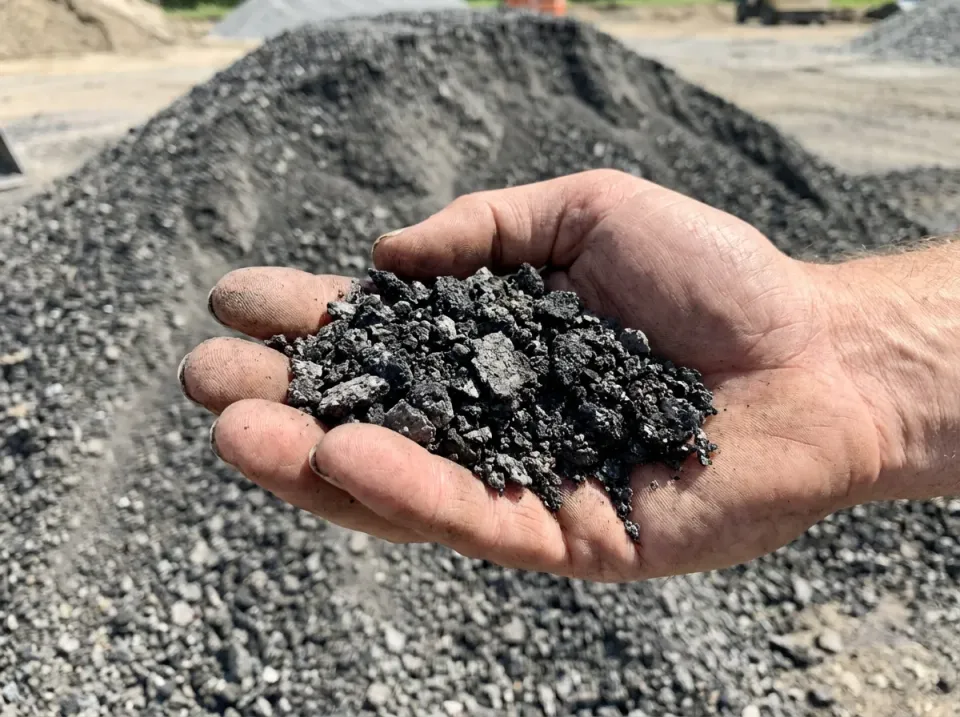
Asphalt millings are recycled pavement material created when old asphalt roads, parking lots, and driveways are ground up and removed. The result is a dark gray or black granular material that still contains the original asphalt binder, which is the tar-like substance that held the original pavement together. Because of that binder, millings behave differently from regular gravel. When you compact them and expose them to traffic and sunlight, they actually bind back together and form a firm, semi-solid surface over time. You will hear asphalt millings referred to by several other names depending on where you are in the country. Recycled asphalt, reclaimed asphalt pavement, crushed asphalt, and RAP (short for reclaimed asphalt pavement) are all common terms for the same product. Some people also call them "poor man's concrete" because a well-compacted layer of millings can create a hard, stable surface at a fraction of the cost of poured concrete or fresh asphalt. Hello Gravel delivers asphalt millings in bulk by the truckload, so whether you are surfacing a long driveway or covering a large parking area, you can order the volume you need and have it delivered right to your property.
What can asphalt millings be used for?
Asphalt millings are one of the most versatile materials you can order for a residential or commercial project. The most popular use is driveways. Millings compact into a firm, low-maintenance surface that holds up well under regular vehicle traffic, and they cost significantly less than fresh asphalt or concrete. Many homeowners in rural or suburban areas choose millings specifically because they deliver a clean, dark surface that looks much more finished than loose gravel. Beyond driveways, millings work well for private roads, farm lanes, and rural access roads where you need a stable surface that can handle trucks, trailers, or heavy equipment. They are also a practical choice for parking lots, construction site access roads, and temporary haul roads on job sites where durability and cost efficiency matter. Millings can also serve as a strong base layer beneath other surface materials. If you are eventually planning to have a finished asphalt surface installed by a paving contractor, a well-compacted layer of millings underneath provides excellent foundation support. Hello Gravel does not supply or install finished asphalt, but supplying the base material is exactly what we do. If you are not sure whether millings are the right fit for your specific project, reach out to the Hello Gravel team and we are happy to point you in the right direction.
How thick should asphalt millings be for a driveway?
For a residential driveway with a solid existing base, a compacted depth of 3 to 4 inches is the standard recommendation. That range gives you enough material to create a stable, bound surface that holds up under regular car and light truck traffic. If your ground is soft, unstable, or poorly drained, going closer to 4 to 6 inches of compacted depth will give you a more forgiving foundation. It is worth keeping in mind that millings compress significantly during compaction. Expect roughly 25 to 33 percent reduction in thickness, which means you will typically need about 1.5 inches of loose material to achieve 1 inch of compacted depth. So if your goal is a 4-inch compacted surface, plan for approximately 6 inches of loose material spread before you run the compactor. As a general rule of thumb, at a 4-inch compacted depth, 1 ton of asphalt millings covers approximately 40 to 50 square feet. That figure varies based on how dense your material is and how well it compacts, so treat it as a planning estimate rather than a precise guarantee. For a more accurate quantity estimate based on your specific driveway dimensions, use the Hello Gravel online calculator. Punch in your length, width, and desired depth, and it will give you a truckload recommendation tailored to your project. Proper compaction is critical regardless of the depth you choose. A plate compactor or a drum roller will give you the firm, bound surface that millings are known for. Without compaction, millings behave more like loose gravel and will not develop the semi-solid character that makes them such a popular driveway material.
How much do asphalt millings cost, and how many tons will I need?
Pricing for asphalt millings varies based on your location, current material availability, and the volume you need, so rather than quoting a number that could change over time, we always recommend checking current pricing directly through the Hello Gravel calculator or by contacting our team. That way you get an accurate, up-to-date figure specific to your area. What we can tell you is how to estimate the quantity you will need. At a 3-inch compacted depth, 1 ton of millings covers roughly 80 to 90 square feet. At a 4-inch compacted depth, that drops to approximately 60 to 65 square feet per ton. These are real-world working estimates, and actual coverage can vary slightly depending on the specific material and how well it compacts. For a quick example: if you have a driveway that is 12 feet wide and 100 feet long, that is 1,200 square feet. At a 4-inch compacted depth, you would be looking somewhere in the range of 24 to 30 tons. A standard dump truck load typically carries around 10 to 14 tons depending on the truck and region, so a project that size would likely require two to three truckloads. The Hello Gravel calculator will run those numbers precisely based on your actual dimensions, so use that as your starting point before placing your order.
Are asphalt millings cheaper than gravel?
In most cases, yes. Asphalt millings tend to cost less per ton than crushed stone or traditional gravel, which makes them a popular choice for budget-conscious homeowners and contractors who need to cover large areas without overspending. The exact difference depends on your region and current material prices, but millings are generally considered one of the more affordable driveway and road surfacing options available in bulk. The cost advantage goes beyond just the upfront price per ton. Because millings bind together over time, they tend to stay in place better than loose gravel. Loose gravel scatters, migrates to the edges, and often needs to be replenished or redistributed after heavy rain or heavy traffic. Millings, once properly compacted, form a more stable surface that requires less ongoing material replacement. That reduces your long-term cost of ownership even further. There is also no need for additional binding agents or surface treatments. The asphalt binder is already in the material. Sun and traffic do the work of hardening the surface for you. To compare current pricing on millings versus other materials in your area, visit the Hello Gravel calculator or get in touch with our team. We can help you figure out which product gives you the best value for your specific project.
Other Material Calculators
Delivery Logistics & Truck Info
Know your delivery options and access requirements before scheduling your order.
Truck Capacities
- Standard Dump Truck 10–14 tons
- Tandem Axle 14–18 tons
- Semi End Dump 20–25 tons
A standard cubic yard weighs approximately 2,000–2,700 lbs depending on material and moisture.
Site Access Requirements
- Trucks require a minimum 12-ft wide, overhead-clear access path
- Soft ground or slopes over 10% may limit truck access — contact us before ordering
- Ensure no underground utilities or irrigation lines are in the drop zone
- Mark your desired drop location clearly before delivery
Important Notes
- Delivery estimates are based on available inventory and route proximity
- Minimum order quantities apply — typically 5 cubic yards or 1 truckload
- Material certification is available upon request for permitted projects
- Always confirm local grading ordinances before major material placement